
Medical center
launches umbilical
cord blood bank
Blood from a baby's
By Helen Altonn
umbilical cord can give
'a second chance at life'
Star-BulletinEight-year-old Jordy Serwin wrote a little note to President Clinton asking, "Please tell people to save kids' cord blood so people like me have what they need to get well."
The child was able to deliver his letter in person to Clinton in Washington, D.C., after going to the Johns Hopkins University Medical Center to consult about an unrelated bone-marrow transplant.
Diagnosed with leukemia two years ago, Jordy's life was saved in one of the first cord blood transplants at UCLA Medical Center.
Performing the procedure was Dr. Randal Wada of Hawaii, then at the UCLA center. He returned to the islands to join the Cancer Research Center and try to make cord blood technology available to Hawaii residents.
Wada worked with the Kapiolani Medical Center for Women & Children to establish Hawaii's first public umbilical-cord blood banking program.
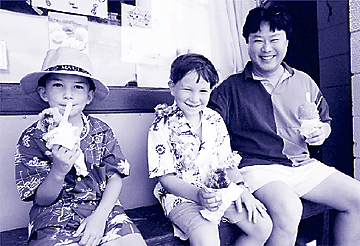
Jordy; his parents, Meghan and Brad Serwin; and brother Jake, nearly 7, are here from Pasadena, Calif., to help launch the Hawaii Cord Blood Bank and enjoy their first family vacation since Jordy's ordeal.
Meghan Serwin said no one in their family was a match for a bone marrow transplant for Jordy. "We thought he'd probably be one of those kids you read about in the paper who waits and waits and waits for a donor and eventually dies waiting."
Then, unexpectedly, a match was found from a cord blood registry in New York.
Like bone marrow, blood in a baby's umbilical cord is a rich source of life-giving stem cells. The blood is drawn from the cord in a painless procedure after a baby is born and the cord is clamped.
Wada yesterday took the Serwins for a plate lunch and shave ice.
He said Jordy has changed dramatically since he saw him last year at UCLA while teaching a course. "Now he's a boy again. . . . He's doing very well."
Jordy, who plans to become a special-effects director, said he expects to "pretty much hang out on the beach" while here for a week.
And he's telling people to "save cord blood to cure cancer, to help kids like me."
Wada said if a patient can't have a related transplant donor, the next best is unrelated cord blood.
More than 4,000 Hawaii residents annually are diagnosed with life-threatening diseases, he pointed out.
Patients of Asian, Polynesian or mixed ethnic ancestry face odds of worse than one in a million in finding a matched donor, Wada said.
"Given Hawaii's ethnic diversity, we face an incredible challenge in finding precise matches for our patients ... but we also have the incredible opportunity to build the world's most unique banked cord blood supply because of that same ethnic richness and our aloha spirit."
Frances Hallonquist, Kapiolani's chief executive officer, said, "With cord blood technology, a birth can now be seen as a double blessing because a match can literally give someone a second chance at life."
The new blood bank is seeking 200 donations in its first year from families having babies at Kapiolani Medical Center.
The blood bank will pay all costs of collecting, processing and storing the specimens, with initial funding contributed by Emily Castle and supplemented by the Kosasa Family Foundation.
Wada said cord blood specimens will be collected at Kapiolani, taken to the Blood Bank of Hawaii, then shipped to the Puget Sound Blood Center in Seattle where they will be stored and designated as units from the Hawaii Cord Blood Bank.
The blood will be there "for anyone in our community or the world who needs a second chance at life," he said. "Once the bugs are worked out, we will offer the service to any hospital in the state that wants to participate."
The Blood Bank already has communication links with hospitals which the Cord Blood Bank "can piggyback on," he said.
For more information, call 983-BANK (2265).
Newborn’s cord blood
may save brother, 5A local couple hopes an operation
By Helen Altonn
will treat their son's leukemia
Star-BulletinA son born to a Honolulu Navy couple may save the life of his 5-year-old brother, Joshua.
After the baby was delivered last Wednesday, blood was taken from the umbilical cord to treat his brother's leukemia.
A transplant operation will be performed next month at Stanford University Medical Center in Palo Alto, Calif.
Chief Petty Officer Herbert Kelton and his wife, Evelyn, have taken their baby, Justin, home from Tripler Army Hospital.
The cord blood was collected and sent by courier to the Cord Blood Registry, which processes and banks blood at the University of Arizona in Tucson.
Maj. Bruce Chen, chief of Tripler's Maternal-Fetal Section in the Obstetrics and Gynecology Department, said the procedure is simple and painless.
Cord blood is extracted from the umbilical cord after a baby is born.
It is rich in stem cells, used to treat leukemia, sickle-cell anemia and other cancer and blood diseases.
A bone marrow donor search was made for Joshua, but matching donors are scarce for minority groups. Kelton is African American and his wife is Filipino.
"Collecting and transplanting his brother's cord blood is Joshua's chance to survive his leukemia," said Jeanne Egan, clinical nurse with Tripler's Pediatric Specialty Clinic.
"This is such a wonderful family. Joshua's dad is my No. 1 dad in the clinic. He is always there for his family and still wins awards for doing his job at his ship."
Said Kelton, "We are so blessed and so thankful to everyone for working for us."
The military's health plan, TRICARE, joined with The Queen's Health Care Plan to help the Keltons. The Queen's plan is the Defense Department subcontractor for TRICARE Hawaii.
Karl Kiyokawa, with TRICARE operations at Queen's, said "it was a true partnership" between Queen's case managers and Tripler doctors, who suggested the procedure.
Queen's Health Plans signed an agreement in June with the Cord Blood Registry to give pregnant members the option of umbilical blood banking.
Minority organ and tissue
By Helen Altonn
donors needed
Star-BulletinReports about a zero record for Hawaii organ donations from January to May this year prompted a gift of organs from a Maui man who died April 19.
At least four lives were saved with the liver and kidneys of Herman Casco, 54, a Lahaina mail carrier who died of a stroke at Kaiser Medical Center on Oahu. Many others benefited from his heart valve, corneas and tissue.
His wife, Janis, and two daughters tonight will receive an award at a Minority Organ/Tissue Transplant Education Program dinner at the Philippine Consulate.
But the Casco donation is one of only six to date this year in the state, while 191 residents are awaiting life-saving transplants, according to the Organ Donor Center of Hawaii.
Eight islanders die annually on an average waiting for a transplant, says the center. Yet it's estimated about 1,000 of 8,000 people who die every year in Hawaii are potential candidates for organs, tissue and eyes.
Of donors so far this year, three were Caucasian, one Japanese and two of mixed ethnic background. Other minority donors are missing. Of those waiting for transplants, however, 50 are Filipinos -- 49 needing kidneys and one a heart.
Clive O. Callender, founder and chief investigator for the National Minority Organ/Tissue Transplant Education Program, is here to help remedy the situation. The answer, he says, is education. And Filipinos are being targeted first because of the great need.
"It's early for Hawaii, but in another year we ought to be able to see tangible results ... of people carrying the message forward and empowering Filipino donors," Callender said today.
One donor could help about 30 people, he pointed out. About 10 lives could be saved, and another 20 could have tissue transplants which would improve their survival, he said.
After doctors have done all they can to save a life, they should notify the organ donor agency to send someone trained to talk to families, he said.
Families are urged to discuss organ donations so they will know the wishes of a loved one after death.
"My dream is when people come in, if they lose a loved one, they will ask how to donate organs and tissues," Callender said.
