Critics cry favoritism over contracts
HLRB orders state to discuss Kapolei move
for Bert Kobayashi's company, but the state
and governor deny any wrongdoing and
point to a mandate to expedite
school constructionBy Rob Perez
Star-BulletinA company whose financial backer is a close friend and supporter of Gov. Ben Cayetano has received more than $40 million worth of state school contracts since last year without having to compete for the jobs.
State officials say the nonbid contracts were awarded legally, had nothing to do with favoritism toward builder Bert A. Kobayashi and will greatly benefit Kapolei students and parents, bringing two new schools to the area faster than the government otherwise could have done.
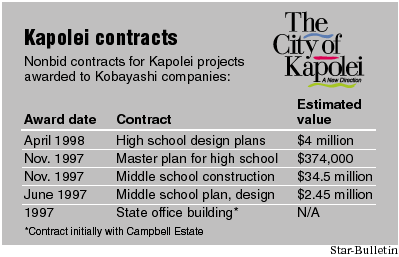
The string of exclusive deals started last year when planning and construction contracts worth nearly $37 million for a Kapolei middle school were awarded to a company affiliated with Kobayashi.
The state did not solicit proposals from other bidders before awarding the contracts to Makai Village Partnership in June and November.
Kobayashi, whom Cayetano describes as a dear friend and one of the state's most honest business people, is chairman of PAB Investment Corp., one of two general partners for Makai Village. He also is financial equity partner for Makai Village.
The state awarded the contracts to help meet a 1996 legislative mandate to expedite school construction in Kapolei, a fast-growing community with only one public school, a severely overcrowded elementary school.
On the day Makai Village broke ground for the middle school, Nov. 14, 1997, it received another contract, again on a noncompetitive basis, to begin the planning process for a Kapolei high school.
Last April, it got another nonbid contract to develop the high school's design plans, specifications and environmental assessment. The two most recent agreements are worth more than $4 million.
For most major contracts, the state is required to seek competitive bids to try to ensure that taxpayers get the best deals for their money. The idea is that competing companies will bid as low as economically feasible to win the business.
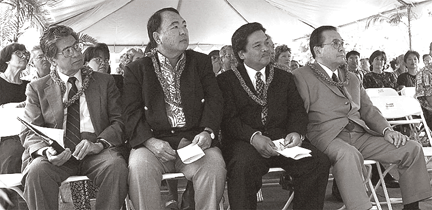
A competitive process also is supposed to prevent selections based on favoritism.The manner in which Kobayashi's company got the Kapolei contracts has raised questions of favoritism and fairness, particularly when some contractors are struggling for jobs in Hawaii's sputtering economy.
"I guarantee you any number of companies would have bid" if given the chance, said Charlie Robinson, marketing and business development director for Charles Pankow Builders Ltd., a major Hawaii contractor. "Especially in this kind of economy. We're all begging for work."
Kobayashi's close ties to Cayetano also have fueled criticism of the deals.
Shortly after Cayetano took office, he nominated Kobayashi to probably the most prestigious state board in the isles: the University of Hawaii Board of Regents.
When President Clinton came to Hawaii in 1996, Kobayashi was among a select group of six people invited to golf with Clinton and the governor.
Giving nonbid work to someone so close creates the appearance of rewards, critics charge.
"I'm disappointed," said Desmond Byrne, chairman of the government watchdog group Common Cause Hawaii. "I thought the governor was going to try to clean house on this kind of thing. But it's the same old stuff."
Cayetano said the contract awards were handled "by the book" and that he had nothing whatsoever to do with them.
"If it involves people I know, I take great pains to stay away from the entire process," Cayetano said, dismissing the notion that Kobayashi's friendship helped land the contracts.
"In an election year, people are going to infer all kinds of things" that aren't true, said the governor, who is up for re-election in November.
Kobayashi replies
Kathy Inouye, Makai Village's chief operating officer, said Kobayashi wasn't involved in any of the school deals.What he did do, Inouye said, was authorize the company to take substantial financial risks on the projects, so much so that other developers "thought we were nuts."
For the middle school, for example, Makai Village started doing preliminary work about a year before it even had a state contract -- and with no guarantee the company would get paid, Inouye said. The work had to be done, though, if a 1999 opening date set by the state and community were to be met, she said.
"When we decided to commence design work and enter into contracts prior to the allocation of funds by the Legislature, we risked hundreds of thousands of dollars in the very real event the Legislature did not approve funding," Kobayashi said in a written statement. "The reason we were successful in negotiating these agreements with the state is because of our willingness to take this very substantial risk, our unblemished reputation and our guarantee that the project would be brought in at or under budget and in time for the 1999 school year."
He said the school contracts were signed in the best interests of state taxpayers, residents and future students of Kapolei.
Makai Village also has its own interests in seeing the schools come on line quickly. It expects the schools to help in marketing homes that the company plans to build in the surrounding area.
The state's view
State officials said the departments of Education and Accounting and General Services carefully scrutinized the school contract amounts to make sure they were justified. The $34.5 million construction agreement, for instance, came in lower than the state's estimate, they said.The state used the nonbid process largely because of the 1996 mandate from the Legislature, according to George White, a spokesman for what used to be the Housing Finance and Development Corp., lead agency for the school contracts.
Prompted by an outcry from Kapolei residents, the Legislature adopted a measure authorizing HFDC to sign agreements with developers to expedite school construction in the West Oahu community.
Shortly after Cayetano signed the bill into law in June 1996, Makai Village presented the housing agency with what White called an ambitious proposal to complete the schools two years sooner than scheduled, using an innovative community-based design approach.
The proposal came as the company and HFDC were negotiating a development agreement for construction of two housing projects in the state-planned Villages of Kapolei. That agreement, signed in February 1997, stipulated that HFDC had the option to negotiate a separate contract with Makai Village for development of the schools, both of which already had assigned sites within the proposed housing projects.Yet when the agency originally sought bids for those housing projects in 1995, it did not ask for proposals to construct the two schools as part of that package. The eventual result: Makai Village got exclusive cracks at the school work.
White said HFDC's enabling legislation permitted the agency to entertain proposals from developers without going to bid -- a power that, he added, was rarely used.
In the Makai Village case, the decision to use the nonbid process was made because that was the only way the state had a chance to meet the 1999 and 2000 targeted opening dates for the middle and high school, respectively, officials involved with the deals said.
If the state were to miss the 1999 opening for the middle school, Kapolei students still would attend Ilima Intermediate in Ewa Beach, swelling that school's population to roughly 1,600 next year, according to Lester Chuck, DOE's facilities director.
"That would be intolerable," Chuck said. But with the Makai Village deal, "we get the school going earlier. That's really the key."
Added White: "This thing came down to the state basically responding to the Kapolei community and legislators."
'Shibai,' says one builder
When the Legislature considered the 1996 bill, one contractor group stressed to lawmakers the importance of opening the school construction projects to all qualified bidders."This practice assures the taxpayer of the best possible job for the dollar," Gary Wiseman, executive director of the Hawaii chapter of the Associated Builders and Contractors, said in written testimony at the time.
Inouye said competitive bidding isn't always the best approach, particularly when time constraints are severe enough. That's when public-private partnerships need consideration, she said.
Pankow's Robinson scoffed at Makai Village's defense of the nonbid process. "Everything they're telling you is shibai to cover their tracks," he said.
The school projects aren't the only nonbid work a Kobayashi company is doing in Kapolei. Another one, KCCD LP, got a contract last year with Campbell Estate to build the new state office building, which is set to open next month.
And more work could be in the offing. According to one of the high school contracts, the state and Makai Village anticipate entering into a construction agreement for that facility, suggesting yet another nonbid contract.
The estimated cost for the school: roughly $75 million.