

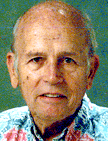
GOTARO Ogawa, the newest consul general assigned to Honolulu from Japan, was born in 1943. His first memories are not of the war going on when he was born but of Japan's tough economic and reconstruction years immediately afterward. Japan’s new consul general
makes his roundsHe knows foreign World War II emotions, however, from having spent his senior high school year living as an exchange student with an upper-income family in Albuquerque, N.M. He heard heated arguments that the Pearl Harbor attack justified the nuclear bomb use.
In consular service in the Philippines he learned Filipino views of wartime occupation by Japan. In Korea he was exposed to the thoughts of a populace that had been under Japanese rule for more than 30 years before 1945.
Thus he brought special understandings to the Independence Day weekend observances here to honor the World War II contributions to America of thousands of soldiers of Japanese ancestry and the families that supported them even as they had relatives in Japanese military uniforms.
He is pleased that Hawaii's Japanese still honor Japanese customs such as O-bon dances, floating of candles downstream and visits to graves to honor ancestors.
Japan today, he says, is one of the most pacifist countries in the world, a leader in the drive in the United Nations for nuclear disarmanent.
I recalled an early 1960s talk by Edwin Reischauer, then U.S. ambassador to Japan, pointing out that Japan -- then still in tough financial shape -- had a long, rich cultural history, a well-educated populace and a commitment to recovery that surely would bring it back to the forefront of the world's nations.
Reischauer's prediction seemed a bit brave then, but was more than fully fulfilled. Consul General Ogawa has no doubt that Japan also will work out a strong recovery from its present economic difficulties.
He sees the flow of tourists to Hawaii continuing, even though the rate may diminish somewhat and individual spending may be smaller.
His predecessor sounded a well-received public warning that crime in Hawaii might diminish the visitor flow. It helped spur a tougher crack-down on crimes against tourists. Ogawa said he feels quite secure today but would speak up, too, if it seemed necessary.
Ogawa thinks the USS Missouri Memorial Association has a reasonable expectation that visitors from Japan will want to see the ship on which the surrender was signed in Tokyo Bay, just as they flood to see the USS Arizona hulk, sunk in the Pearl Harbor attack.
Many younger Japanese know relatively little of World War II, he said, but know Arizona and Missouri are significant sites, will want to see them, and will learn history from them. He joins in the view that Missouri symbolizes a new beginning for Japan, a start toward democracy, more individual freedom and greater prosperity.
"Japanese people are proud of our post-war development," he said. "We look on the end of the war with very positive eyes. The Missouri is a symbol of that."
HE does not think that visitations will be much discouraged by the fact visitors will have to pay to board Missouri whereas USS Arizona visits are free because it is under the U.S. Park Service.
Ogawa's predecessor, Kishichiro Amae, served here for the 50th anniversary of the end of World War II and a visit by Emperor Akihito. No such dramas are now in sight for the two or three years Ogawa is likely to be here, but he still will have a busy calendar keeping up contacts with the U.S. military commands here, other consular officers, VIP visitors, reaching out into the Japanese community and handling the visa and other routines common to all consulates.
A.A. Smyser is the contributing editor
and former editor of the the Star-Bulletin
His column runs Tuesday and Thursday.