
Color this
annual concert blue,
for the canoes
Keeping the paddlers
By John Berger
racing is an expensive
proposition
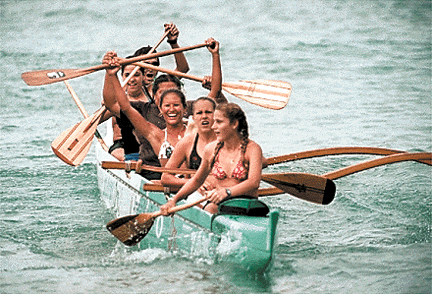
Special to the Star-BulletinJoan Kaaua recalls when Hawaiian canoe racing consisted of three clubs and a few volunteers who staged races on Oahu and several neighbor islands. That was in 1949.
The first formal association, the Hawaiian Canoe Racing & Surfing Association, chartered in 1950, is now the Hawaiian Canoe Racing Association and includes six subsidiary organizations and more than 40 canoe-racing clubs. Other teams come from as far away as Germany to compete.
"We get teams from England, Hungary, Germany, Japan, Canada, Tonga, Samoa, Guam, Tahiti, Australia -- and the Illinois Brigade that came down and beat us in the mid-'80s. It's all over the world now, and it's on the Net. ... It's wonderful, but we don't quite know how to handle all the success."
Kaaua represents the Oahu Hawaiian Canoe Racing Association, a group that administers koa canoe races and regattas on Oahu. The association is also the beneficiary of the Blue Hawaiian Moonlight summer concert happening Saturday at the Waikiki Shell.
Peter Moon, a self-styled "water rat" and life-long ocean sports fan, produces and headlines the show each year. Proceeds help cover the considerable expense of perpetuating the official team sport of Hawaii.
"It probably costs OHCRA about $40,000 just to put on the Molokai Ho'e. I don't know what we would do without the Bank of Hawaii (as a sponsor) for Molokai Ho'e.
"There are also teams that go out and solicit sponsors to help with their expenses. There are businesses who help, but on an individual basis, Blue Hawaiian Moonlight is a way that everybody can help perpetuate Hawaiian koa canoe racing."
The increased popularity of canoe racing -- as a sport and an expression of Hawaiian culture -- has made participation a matter of pride as well as sporting accomplishment. Kaaua recalls the shock waves that rippled through local racing circles when a Tahitian team placed second in the Molokai Ho'e in 1975. The Tahitians paddled faster and used paddles of a different shape. Rather than wimping out and banning outside teams or new ideas, Hawaiian teams learned from the Tahitians.
"The Hawaiian people went 'paddle change,' and so there have been changes since '75," Kaaua said. "The rule says that the paddles must be made of wood. That's a simple statement, but people were trying to put percentages in there. There are some paddles that use something other than wood to strengthen the paddle, and clubs have been warned that they have to clear this with the specs committee. You can put fiberglass over it to protect it, but you can't use aluminum paddles in our races. That could change in the future, but our tradition is using wood, and we're holding on to tradition. "
Blue Hawaiian
Moonlight 1998Peter Moon, Teresa Bright, John Cruz, Frank DeLima, Kalapana, Kekuhi Kanahele perform.
Concert time: 7:15 p.m. Saturday, gates open at 5:45 p.m.

