
Dead whales
support deep-sea
colonies
A UH study of whale
By Helen Altonn
carcasses could lead to the
development of a new
cold-water detergentStar-Bulletin
When Craig Smith began studying rotting whales on the ocean floor, little did he suspect the results could end up in a washing machine.
Enzymes from bacteria feasting on the carcasses hold promise for a cold-water detergent that will dissolve greasy stains.
It may even help clean messy, stinking blubber from the University of Hawaii oceanographer's wet suit after hauling a dead whale to sea and sinking it.
"The last time, we actually rented wet suits, so we didn't have a problem," he said, grinning. Still, they were returned scrubbed, he said.
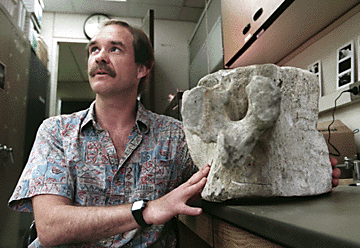
Smith is studying relationships between animals that live in sulfide-rich whale carcasses and hydrothermal vents in the sea floor's active rift zones.
It is speculated that whale bones might have been stepping stones for dispersal of animals in the ocean for more than 30 million years, he said.
"They can die and sink anywhere in the ocean and disperse sulfide. The larvae could colonize the whale bones and disperse to the next whale fall or hydrothermal vents."
While exploring the evolutionary issue, Smith collects bacteria samples from whale blubber and bones for Diversa, a San Diego-based biotechnology firm.
Jeff Stein, Diversa's chief scientist, said the detergent industry is searching for enzymes that break down fats and proteins under cold conditions to save energy.
At least 32 such enzymes have been identified, and the project has attracted Procter & Gamble, makers of Tide, Stein said. Other potential uses are in manufacture of food supplements and cheese, he said.
"This whole project has been kind of a roller coaster ride," Smith said, explaining the "detergent connection" was an accident.
He said it's "a classic example of how spinoffs can come from basic research and directions you can't anticipate."
Smith said he's been interested in what happens to whales when they die and fall to the sea floor since he was a graduate student at Scripps Institution of Oceanography in 1983.
Scientists had never seen remains on the ocean floor, he said.
"They're so big, and the deep sea is usually such a low-energy environment. What does the community that colonizes it look like?"
His question was answered in 1987 when he was chief scientist on a project with the Woods Hole Oceanographic Institution's submersible Alvin in California's Catalina Basin.
The sub happened upon a 71-foot whale skeleton. It was covered with animals similar to those at hydrothermal vents, such as giant clams and mussels, thick bacterial mats and lipids or organic compounds, Smith said.
The only food source for most of the barren deep sea floor is what sinks from above, so a whale fall is a "huge bonanza," Smith pointed out.
Stein said when he was a graduate student at Scripps, he became aware of Smith's work. Years later he was on a National Oceanic and Atmospheric Administration panel reviewing one of Smith's grant requests.
Intrigued with the research, Stein wrote a grant proposal at Diversa with the Hawaii scientist as collaborator.
Smith said Stein suggested looking for bacteria in whale bones because the large animals are up to 60 percent oil in weight and rich in organic matter.
Since dead whales are hard to find on the ocean bottom, Smith has put four down off California for his studies. NOAA's Marine Mammal Stranding Network notifies him of dead animals that are stranded. "It's really quite a chore to get a carcass, to tow it to sea and sink it," he said.
He flew to California and chartered a ship in April when notified of a dead 30- to 40-ton gray whale under a pier at Gaviota State Park.
Returning June 5 in the Alvin, he found the carcass covered with huge sleeper sharks, thousands of hagfish and millions of shrimp-like scavenging crustaceans.
Smith has investigated whale remains for four years with the Alvin, remote or advanced tether vehicles and time-lapse cameras.
He said he was surprised to find the first whale he sunk stripped to a skeleton in four months.
"We thought it would be a year or maybe a couple years, but scavenger response is very rapid."
Another surprise: The surrounding ocean floor was heavily colonized by "enrichment opportunists," species specializing in organic rich conditions, he said.
It looked like a lawn of white grass with the highest density of polychaete worms ever recorded in the deep sea, he said.
Revisiting the original skeleton in Catalina Basin, Smith said there was still enough oil and organic matter after 11 years to support a strong community of organisms.
It's possible animals could live on the bones of a large blue or fin whale for 100 years or more, he said.
