
Taking stock
of Chinatown
UH program gives a hand to
By Burl Burlingame
historic preservation
Star-BulletinTHINK "historic preservation," and the first thing that comes to mind is buildings. Old buildings; the older, the better. But buildings are just shells that fit around peoples' lives. A community is not only defined by its addresses, it's also defined by its residents.
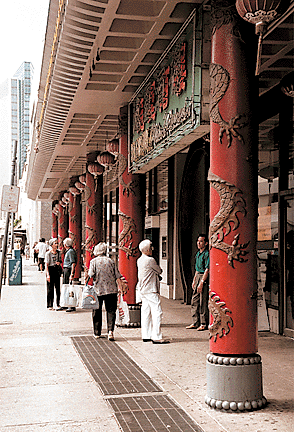
This is the sort of the thing that was on the minds of the University of Hawaii's annual Summer Preservation Field School as the students descended on Honolulu's historic Chinatown district. They documented the district -- as it was in June 1998 -- with drawings and photographs and measurements and paperwork, and they grew to appreciate what a cultural neighborhood means to an modern urban center.
"This is the 8th year we've done this, and it's always a different neighborhood," said UH preservation scholar Bill Chapman, who rides herd on the Field School. Past neighborhoods included the business district of Kaimuki, temples in Southeast Asia and the colony on Kalaupapa.
"In Kalaupapa, we updated the information the Park Service had collected 25 years ago," said Chapman. "The kids learn how to do preservation documentation on a higher level, and it's useful information that the state or city or feds may not be able to afford to do themselves. The Chinatown documents will be passed on to the State Historic Preservation Division, for example, to supplement what they collected when the area was declared a historic district more than 20 years ago."
The very act of "taking inventory," as Chapman calls it, calls attention to the subject. "And when it's married to a public outreach program, people learn a lot about their neighborhood."
Although the field school concentrated on the buildings, the aspect of turnover and social change in Hawaii colors everything about Chinatown. First settled in the 1860s by Chinese plantation laborers, it was twice destroyed by fire, in 1900 nearly leveling the neighborhood.
"Today, it has harmonious buildings that are similar in design and size, and that's because it was largely rebuilt all at once," said Chapman. "It's been a preservation district since 1974, and the design criteria has pretty much stuck to the 1900 time frame, with the result that the area is a little 'sanitized,' with everything so alike that it seems mall-like. The large buildings built on the periphery also hem it in, making it more mall-like in terms of scale."
To examine Honolulu's Chinatown, Chapman brought in cultural-landscape architect Peter Drey, who has worked in the cultural neighborhoods of Albany GA, and Charleston, SC. "A 19th-century building built today is a contrivance," said Drey, of efforts to hang "historic" facades on modern buildings being shoehorned into older neighborhoods.
"It also ignores the diversity of races and cultures in the city, which may go back centuries, and continues today. Historic preservation is also cultural conservation, but virtually all decisions made in urban planning are based on economic consideration, not historic or cultural. But you can lose what's special about a city if you only think economics."
Because most American cities started from scratch within the last couple of centuries, urban design in the U.S. is unlike the rest of the world," said Drey. The biggest change came with the invention of the automobile, "which substantially altered the very way cities work." People abandoned mass transit and the downtown and fled to the suburbs, leaving a financial; wasteland at the heart of many cities that are hard to erase.
Trying to jump-start a city's heart by re-inventing suburban attractions almost never works, and that includes the introduction of malls and "big box" stores.
"Another thing that's a change is the absolute enormous 'footprint' of modern buildings," said Drey. A modern building can some-times occupy an entire city block.
"Every building has a front, and that will traditionally face the most desireable street address," said Drey. "But that means the other three sides, each fronting a street, are essentially service entrances. What does that do to a neighborhood's image?
"Cities need to be more than functional business places. They need a cultural component to provide vitality. The most attractive cities are those that are repositories of cultural artifacts and heritages. This link to its people gives it a center of gravity.
"The beauty of urban areas is the amount of options available to both residents and visitors -- successful downtown revitalization efforts are a mix of attracting new residents and unique businesses -- and ethnic neighborhoods become an extension of family, a subgroup of a larger civic community. The modern American suburb is generic middle-class by design, and doesn't think of culture as an asset. It's diversity that powers the great cities of the world."
Think of that next time you’re driving through Chinatown. That sound you hear is the heartbeat of Honolulu, and the university's preservation students are doing their bit to keep it beating.

