

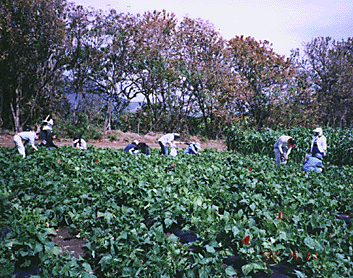
As sugar cane and pineapple disappear from island fields, thousands of acres of land are left fallow while we import tons of fresh vegetables and fruit from the mainland. Certainly, some of this produce won't grow here, but a lot of it will. To increase local vegetable production, the Waimanalo Research Station of the University of Hawaii College of Tropical Agriculture and Human Resources with the Moichi Okada Association of Japan is working on an 8-year crop rotation program. Research station explores
Farming organicallyCrop rotation system could help local farmers
The goal is to reduce farm costs and increase crop production by farming organically. The program has created enough interest that the U.S. Secretary of Agriculture Dan Glickman visited the farm this week for a look at the project. The department is redefining "organic" standards following 245,000 letters of complaint since the April guidelines were established. The great majority of the letter writers felt that the standards defining "organically grown" produce are not strict enough.
Ivan Kawamoto of the Japanese association and Hector Valenzuela of the university head the program which is based on the use of green manure to fertilize the fields. Green manure is a natural fertilizer originating from decaying plant material. It is formed by cover crops, which are fast growing crops that are not harvested but plowed back into the soil.
The program has been adapted from the Japanese model for tropical conditions on farms from one to 25 acres. But on a much smaller scale, it also should work in the backyard vegetable plot.
"Cover crops replace chemical fertilizers, pesticides and most compost," Kawamoto explained. "In Hokkaido where the system was originated, they used only two plantings a year because of their severe winters, but here we can plant all year."
The cover crops used at Waimanalo include cow peas, sorghum and fava beans. The fields are tilled then divided equally into eight plots, and cover crops are planted on each one. When the crops have matured in about eight weeks, the tops are clipped off and when possible used as animal feed. Then the lower parts of the plants and the roots are chopped and tilled back into the soil.
Two weeks later the cash crop is planted. The planting at Waimanalo includes eggplant, daikon, bush beans, carrots, beets, lettuce, sweet potatoes and onions in different combinations of vegetables in each of six plots.
Cover crops enrich soil
The other two are left in cover crops to enrich the soil. When the vegetables have been harvested, another crop is planted. Once a year, a game of farming musical chairs takes place. Each of the six crops moves one space over and two more plots are left in cover crops. This goes on for eight years, until the farmer is back to where he began. Then he starts all over again."When the soil is healthy, you don't need fertilizer," Kawamoto said. 'Green manure restores soil that has been exhausted by too much use. Because most of the cover crops are nitrogen fixers, they restore nitrogen to the soil." Nitrogen fixing plants are the major source of nitrogen in the natural ecosystem. No plant will grow without it, and tropical soils are often low in this nutrient.
Nitrogen in the soil is converted to nitrates by bacteria that change or fix it into a form that plants can use. They live in nodules that form on the roots of nitrogen fixing plants to fertilize and enrich the soil. Nitrogen maintains a plant's green color and is largely responsible for good leaf and stem growth.
Fewer pests are found
Kawamoto said that the incidence of root knot nematodes has decreased dramatically through this program. "There are fewer parasite and disease problems when cover crops are rotated regularly than when the same crop is grown year after year on the same plot," he said."Sometimes the cover crops act as nonhosts, preventing the nematodes from reproducing. Others may produce compounds that are deadly to nematodes. You have to know what species of nematode exists in your field, and then you match the cover crop to them."
On the other hand, Kawamoto said that the practice attracts beneficial insects, particularly spiders and ladybugs, that prey on crop pests. Cover crops also can prevent leaching of nitrates into ground water by taking up leftover nitrogen from fertilizers applied to earlier crops.
While the farm in Hokkaido has been in successful operation for many years, the Waimanalo project began only in February. Vegetables harvested so far have been free of insect damage and of excellent quality, according to the volunteer field workers who share the produce. But Kawamoto admits there's a down side.
"We know the vegetables will grow, and grow well, but the issue is, can we make money? Farming is a business, and if you give up space and time to grow cover crops that you can't sell, will it make up for the fertilizer you don't buy? We are making a careful study of costs, and we may have to make changes to be practical."
In the mean time, in your own vegetable patch, try rotating your crops after harvest. Chop up roots of the old plants and dig them into the soil. Leave empty part of the area that had been planted. Put the lettuce where the green peppers were, and let the peppers replace the cherry tomatoes. Then in a year, mix them up again, leaving a different part of the garden fallow. See if you can get by without fertilizer or pesticides, and be an organic gardener.
Gardening Calendar in Do It Electric!
Send queries along with name and phone number to:
Evergreen by Lois Taylor, Honolulu Star-Bulletin, P.O. Box 3080, Honolulu 96802.
Or send e-mail to features@starbulletin.com.
Please be sure to include a phone number.
Evergreen by Lois Taylor is a regular Friday feature of the
Honolulu Star-Bulletin. © 1998 All rights reserved.

