
All for Damien
History comes alive
By Mary Adamski
as Molokai helps make a movie
about the hero priest
of Kalaupapa
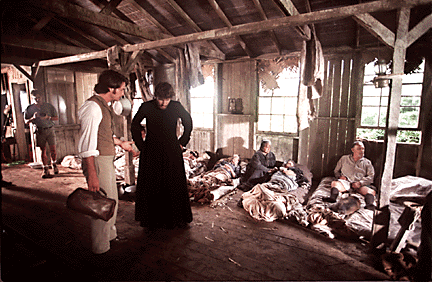
Star-BulletinThe movie script called for the dozen extras to lie back while the actors walked past speaking their lines. The scene was a dark shed circa 1873 full of dying leprosy patients on dingy pallets.
Director Paul Cox tried for a personal interaction between actor David Wenham and extra Olivia Breitha, but Breitha refused to take a spoonful of medicine.
By the time the scene was a wrap, though, it had incorporated the elderly woman's spontaneous hug of the young man who plays the title role in "Father Damien."
Just another surrender to an engaging but implacable auntie, an experience familiar to Hawaii residents. Just a small example of the Hawaiian immersion that leaves the movie professionals from Europe and Australia amused and bemused -- when they have time to reflect at the end of a long, exhausting day.
The movie about the 19th century Catholic priest who served leprosy victims banished to the remote Molokai peninsula is being filmed in Kalawao, the damp and windy eastern end of Kalaupapa at the base of 2,000-foot cliffs.
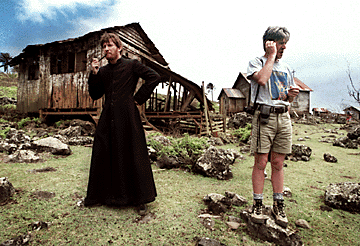
Everyone -- from the European, Australian and mainland filmmakers to the "topside" Molokai residents flown in daily as extras -- is conscious of the historical significance of the site where 8,000 people lived and died during the 104 years that victims of the disease were isolated from the rest of society."This is holy ground," Cox said last week. "The people here are the most wonderful real people in the world. They have all had real lives that don't compare with anything in our experience."
The Australian director ate a solitary lunch on the set, a scattering of ramshackle huts constructed on a hillside of lichen-covered rocks and wind-sculptured brush overlooking the rugged coast and offshore rock formations that evoke the loneliness of the place.
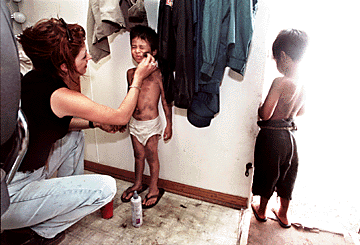
It was a chilly day of constant drizzle and the relentless wind of Kalawao. That didn't deter a group of child extras from continuing with their scratch game of soccer. Wenham joined them at the beginning of the day, and the play -- with a makeshift bundle serving as ball -- continued as directed during filming, with some basketball moves thrown in between takes.
It has been decades since the sound of laughing children has been heard there. Board of Health rules mandated that babies be taken from mothers after birth and sent outside. Even after the quarantine was lifted in 1969, members of the Patients Council, now grandparent age, continued to endorse the ban on children.
"By the end of a day here, you feel like you live here," said Scarlet Ritte-Camara of Kaunakakai. With her that day were six of her children and a granddaughter. In all, 10 of her family have been among more than 300 Molokai residents to collect some welcome cash as extras.On a recent flight down, 5-year-old Kailana Camara befriended a tall, imposing woman. She was Kate Ceberano, an award-winning Australian concert soloist with Kauai roots, who plays Princess Liliuokalani. During a long spell under tents while awaiting filming, Ceberano entertained the local folks by singing ballads. And they gave her tips on Hawaiian pronunciation for "Aloha Oe."
"She feels like the queen," said Ritte-Camara. "You cannot help but get emotional." She granted the moviemakers absolution for a historical inaccuracy: Liliuokalani had not yet written "Aloha Oe" when she visited patients during King Kalakaua's reign.
"It's a piece of history. That's why a lot of us are in it," said Bruce Vollert of Kailua, one of about 30 local technicians in the crew. The backstage bunch is a diverse professional mix. Belgian producer Tharsi Vanhuysse assembled a company of Belgian, Dutch, French, Polish, Australian and American professionals. By Hollywood standards, the crew of 60 and $10 million budget are small. The film is slated for release in the United States, Europe and Australia in early 1999.
Among those on the set daily is a National Park Service ranger whose task is to ensure that nary a rock is moved nor plant uprooted. Virtually all of Kalawao is an archaeological site, of old Hawaiian settlements that predate the 1860s designation as a place of banishment. The film folk chafed at restrictions, but when park ranger Eileen Martinez sternly pointed to a discarded butt, she got sheepish compliance."These movie people are beautiful people. They show a lot of respect," said Kalaupapa resident Edwin Lelepali, who nonetheless regularly cruises by McVeigh Hall, being used as the crew mess hall, to assure himself that the patient-owned furniture is intact.
On any given day, the 100-plus population of Kalaupapa may be doubled or more with outsiders. Vanhuysse and company take pains not to intrude. They met with the Patients Council before beginning and left a script at the Department of Health headquarters for residents to read. They rent beach houses and other living quarters from residents but seldom have time to hang out at the seashore, post office or store.
Their presence and the film project are, understandably, constant topics of conversation in the village community. People drove out to watch, but hesitated to participate in costume designer Bernadette Corstens' tactic of turning costume fabric grungy by stretching it across a dirt road to be ground under tires. They sought a glimpse of the well-known stars: The word is Peter O'Toole was aloof, Kris Kristofferson was friendly.
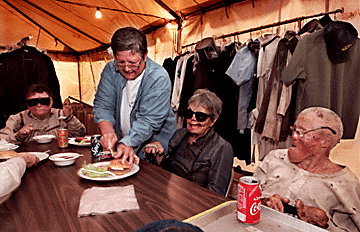
Residents were impressed that the visitors had the good island manners to invite them to a preproduction reception. They reciprocated Sunday by hosting a barbecue potluck."Every day and night we share the lives of the patients. We feel more and more we're making a movie about their lives," said Vanhuysse. The producer was delighted when his party was attended by some of the remaining former patients. He was ecstatic when some of the once-reclusive folks volunteered to be extras. One resident, Norbert Palea, is among 15 Hawaii people with speaking parts in the movie.
"These people have given us their trust which I hope I'll never, and nobody here will ever, put to shame," said Cox. "They they have offered us their faces without lips, their hands without fingers, what a gift. That's the gift of life, what a thing to do."
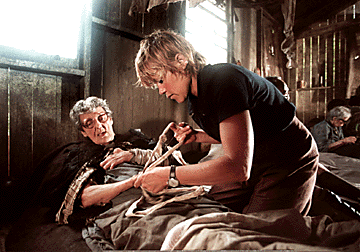
Before the hospital scene was filmed, Breitha and other Kalaupapa aunties sat in a hospital van and reminisced about their early days at Kalaupapa. "You would go to the hospital when you had fever, when you had chills or when you got reaction," said Breitha, who came to Kalaupapa in 1937.
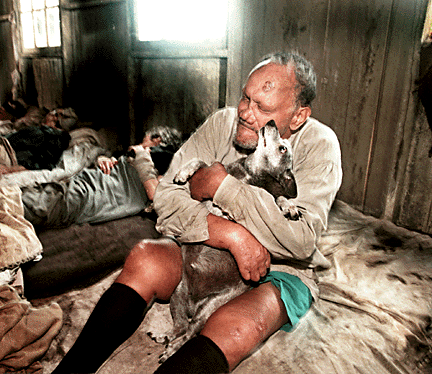
The 12 extras, who moaned and lolled on mats as directed, are in reality dignified kupuna who bear marks of the disease they contracted before medication that halts the effects of leprosy was discovered.
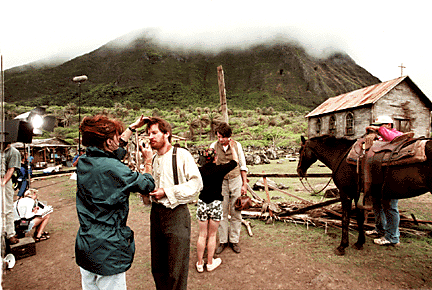
They are among the surviving 54 historical Kalaupapa patients, and all the film professionals were vividly aware of their importance to the film. The producer hovered at the muddy roadside as each elder was helped to the set, several in wheelchairs. The star held an umbrella and charmed the senior citizens with small talk, later posing for snapshots.Among the elders were Kenso Seki, 88, who came to Kalaupapa in 1928 while Brother Joseph Dutton, who knew and succeeded Damien, was still alive; and Sarah Benjamin, granddaughter of Molokai rancher Rudolph Meyer, who administered the settlement while Damien was alive. Kristofferson plays Meyer, and Dutton is portrayed by Tom Wilkinson.
The very special extras also included Clarence Naia, Catherine Puahala, Mae Malakaua, Georgia Marks, Mele Watanuki, Paul Harada, Boogie Kahilihiwa, Jimmy and Nancy Brede.
When they finally heard "it's a wrap," the extras clapped their hands.
And the applause came back at them from the cameramen, producers, wardrobe and makeup ladies, set designers artists, gaffes, grips and assistants.
The Principals
Film’s makers are struck
By Mary Adamski
by Damien's spirit
Star-Bulletin
Producer Tharsi Vanhuysse
"Father Damien" has been the consuming interest in Belgian producer Tharsi Vanhuysse's life since the Catholic Church beatified Damien DeVeuster in Belgium in 1995.He and co-producer Grietje Lammertyn, leaders of the Brussels-based ERA Films, sought out the screenwriter, the director, and searched for an unknown actor to play the lead, preferring that to a known face. In his 25 years in the business, Vanhuysse, 45, has made what he describes as mostly modern European films.
"(Damien) is one of those heroic figures that it is really worth while to spend a few years of your life to make a film. Secondly, I very much relate to him because he is also Flemish," he said.
"Maybe he started as a very devout, even dogmatic, Catholic, but you feel in the story written by John Briley that he is one of the most open-minded men. He had the real ecumenical spirit ... serving human beings, not sticking to one religion. It's a deep story. There are in the whole world three or four people of that mettle of heroic courage."
Filming on the remote Kalaupapa location is difficult and expensive. Supplies are brought in by barge and planes are chartered to shuttle in cast, extras and workers. The choice over less costly locales "was almost a spiritual decision," he said, based on a September reconnaissance visit and meeting with the Patients Council.
"We have been working to develop a relationship of trust with the patients, with the National Park Service, with the Department of Health," he said.
"We told them ... it's very important, can we count on your cooperation? Will you agree to play a part in the movie? People came gradually to us and said it would be possible."
Vanhuysse adopted a local tradition unknown in Europe -- having the movie set blessed, in this case by a Protestant minister. "It was a very moving event for all the crew members," he said. "For all the people coming from Europe and Australia, it was more than an experience. It was giving a very good feeling to start a job like this."
Leading man David Wenham
David Wenham, unknown in America, has acted in Australian movies for 12 years. He's in "Sea Change," a top-rated television series that he compared to the offbeat comedy drama "Northern Exposure."He was recruited for the Damien role after the casting director saw his recent movie, "The Boys," in London.
"I turn 33 just before the film finishes, which is the same age Father Damien was when he came here," said Wenham, who first heard of the priest as a young Catholic student. "The most important research for me was talking to the patients for their firsthand experiences ... what they had actually been through, to gain some insight into the pain and hardship they have experienced.
"I don't see them as people who are terribly different, and I think that is how Father Damien saw them. I just see them as friends -- they are very human people who just happen to suffer from a specific disease.
"My first hope for the film would be that the patients here approve and that it is something they respect. My second hope is that, if it educates people and if people get something from this film, that would be rewarding.
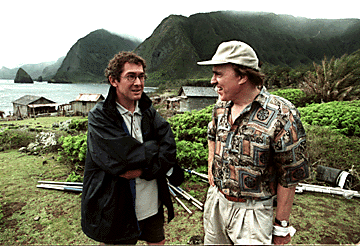
"What goes on the inside of that man was extremely special and doesn't occur in very many people. He is so big and so widely remembered throughout the whole world for his attributes, his incredible love for his fellow humans."Wenham calls his role "monumental ... in all facets and all aspects."
"Technically it is an extremely difficult role: You have an Australian actor coming to Hawaii to play a Belgian priest who delivers a Latin Mass, who sings, who rides a horse," he said.
"Also in terms of the expectation that is on me, especially in this country and especially in Belgium. People have perceptions about the man. I try not to think about it too much. I am here. I'm going to do my best."
Director Paul Cox
Australian director Paul Cox has made 16 feature films, as well as documentaries and children's movies, but says in America "only the people who are serious about film would have heard of me."His work, including a movie on artist Vincent van Gogh, has been in film festivals and at Lincoln Center. He recently published a book, "Reflections, an Autobiographical Journey."
This international collaborative effort is new to Cox, 58. He prefers to have complete control of films he makes because of his dim view of the movie industry, calling it "appalling" and "appealing to our lower instincts."
"It was a great gift to all of us when it started. It had the capacity to enlighten our lives. It formed and shaped our dreams," he said.
"Now it has become one of the most vulgar and ridiculous things on earth. The use of cinema as a means of self-expression is almost out these days. It's become more and more of a product to be sold."
Cox describes "Father Damien" as the largest work he's done and a "marvelous story" consistent with his prior efforts.
"It's about a real hero who spent his life giving to people, doing something big, a man I'd like to expose to the world and share with the world," he said.
"I don't really understand the actual purpose of our lives unless it enlightens another human being. Life is bloody hard; life is not built upon joy and splashing in swimming pools. It is built on tears and pain, and from there you can find a lot of enlightenment and a lot of love and a lot of goodness. But it doesn't come from the nonsense we call entertainment."
Screenwriter John Briley
Of those involved in making "Father Damien," screenwriter John Briley is the best-known in America. He won an Academy Award for his original screenplay of "Gandhi" and also was the writer of "Cry Freedom."Briley, a Michigan native, has lived in London for 20 years. While working on his doctorate, he was hired to write, direct and produce a television series on GIs in England for the Armed Forces Network. That led to a career change from English professor to screenwriter. He has written stage plays as well.
He first heard about Damien on a visit to Hawaii and made the connection to the Damien Brothers, a Dutch religious order that runs the church he attends. Just weeks after the initial introduction to Damien, he said, he got a call from producer Tharsi Vanhuysse about the movie.
"I think Damien is about courage, fear, bravery and the better aspects of human nature," Briley said. "It is not about religion at all, and only incidentally about leprosy. It is about the power of brotherly love, certainly not about religion or sainthood.
"One of the interesting characteristics of Father Damien is that he was young, robust, generous, but he was not an open-minded man. One of the key elements of the screenplay is to show the growth in his attitude toward other beliefs."
Briley said Damien's religious order criticized a depiction in the screenplay of the sexual temptation Damien faced. "Nowadays you cannot make a movie that ignores that side of his nature," he said. "We're no longer Victorian about that.
One of Damien's challenges in Hawaii was being a "religious healthy young man," he said. The initial suspicion was that leprosy was sexually transmitted, the third stage of syphilis.
"When he went back to Honolulu they forced him to undergo an exam of his genitalia," Briley said. "He was humbled. Damien said, 'I have never had a woman, or a man for that matter.'
"Damien was a peasant. He had a terrible time qualifying (for the priesthood). He was not an intellectual. He had what we sort of arrogantly say was a peasant's faith -- he just believed."
