Charges of poor planning, an HGEA complaint
By Rob Perez
to block the move of government offices to Kapolei
and objections from state workers are playing
havoc with the grand relocation plan
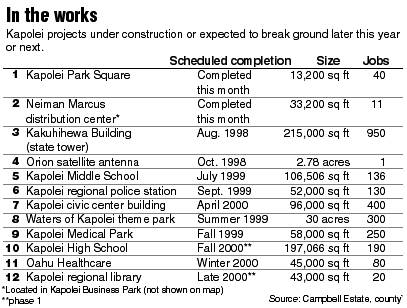
Star-BulletinIn August the state is scheduled to start moving nearly 1,000 workers to a new office tower in Kapolei.
For Oahu's so-called second city, the move is supposed to mark a critical milestone: the first major presence of government.
But the planned move, in the works for several years, isn't going as planned.
It has turned into a political nightmare for the state, creating dissension among many of the workers targeted to relocate.
Many don't want to leave offices in or near downtown for new digs about 20 miles away. While many objections focus on the disruption a longer commute would cause in workers' personal lives, some employees claim the move will make their offices less efficient or less accessible to much of the public.
Rather than relocate, some have quit for private-sector jobs or transferred to other government positions.
And many workers, especially those who frequently must conduct business in town, say the way the state planned the move is puzzling.

"I've never seen anything so poorly executed as this," said Ron Nicholas, a welfare fraud investigator who estimates productivity will drop nearly a third in the investigations office because of back-and-forth driving. "It's absolutely insane."The move, though, isn't a sure thing.
The Hawaii Government Employees Association, the union representing most of the affected workers, is trying to block it.
HGEA has filed a complaint with the Hawaii Labor Relations Board, alleging the state violated the union contract by failing to negotiate the relocation.
The state denies the allegations, saying management has the prerogative to relocate offices, has given affected workers plenty of notice and has sufficiently consulted with the union. It also says the move won't change workers' hours and wages nor will it materially affect working conditions, precluding the need for negotiations.
A ruling is pending.
State officials acknowledge that many workers are unhappy about the planned relocation but maintain that many others are pleased about it, especially those who live in West Oahu.
"It's not universally hated, it's not universally loved," said Kate Stanley, deputy director of the Department of Human Services, which is moving more than 300 workers, including those in the welfare investigations office. "Change is very hard for people."
The welfare investigators, for example, will have to more carefully plan their days to minimize the loss of efficiency, Stanley said. "I know it's going to take some adaptation."
For some workers, such as Ewa Beach resident Adele Tangjian, the move will be welcomed.
Tangjian, a clerk-typist for the Child Support Enforcement Agency, now takes the bus to her Iwilei office, a rush-hour trip that takes up to an hour. Once the agency moves to Kapolei, Tangjian and several of her colleagues plan to ride bicycles to work -- about a five-mile trek -- and shower in locker rooms at the new building.
"We're really looking forward to it," she said. "And working in the countryside will be good for everyone's soul."
The move to Kapolei is part of Gov. Ben Cayetano's efforts to support development of a second urban center on Oahu, one that is supposed to help ease traffic congestion in Honolulu's main job corridor.
The resulting controversy, however, underscores the difficulties any employer would face relocating offices from that corridor to the growing West Oahu community.
How will employees take such a move? Will customers like it? Will it improve or worsen employer efficiencies? And even if there are adverse effects, will other benefits outweigh them?
Those are questions other government agencies and businesses increasingly will have to address as they plan or ponder moves to Kapolei.
Indeed, some businesses say they have successfully dealt with such relocation issues and are now benefiting from their Kapolei operations.
The state's problem, though, is particularly thorny because it must abide by union contracts covering the roughly 950 affected workers.
On that score, HGEA members say the government has failed miserably.
Peter Trask, an attorney representing the union, said in documents filed with the labor board that the state has demonstrated "a dismal record of disorganized, incomplete, misdirected, confused and a misguided array of elementary consultation at best."
Trask said some workers didn't get written notice they would be moving until December, though state officials say workers were told of the move more than a year ago.
Workers also maintain they had no say in what offices would be moved and were kept in the dark as those decisions were made. Many say they still haven't been told why their offices eventually were selected.
"Nobody is telling us what's happening," said Mary Look, who as an affected DHS worker faces a more than 30-minute commute to Kapolei. She now has an eight-minute walk to her town office.
State officials say workers were told as long as two years ago that their offices likely would be moved. Coordinators within the affected agencies were appointed to keep workers informed, and tours of the area were held.
Yet correspondence between state officials suggests that even key state players at times were unaware of important developments.
"In our cursory check with the personnel officers of two affected departments, they indicated that they have received little or no information on the progress of the relocation," James Takushi, the state's human resources director, wrote in March 1997 to then-comptroller Sam Callejo. "In fact, they were not even aware that assignment of agencies for the relocation (had) been finalized."Callejo used to head the Department of Accounting and General Services, which is coordinating the move.
Ivan Nishiki, DAGS leasing program manager, said his agency has provided sufficient information throughout the process to keep employees informed.
On how offices were selected for relocation, Nishiki said those leasing privately owned commercial space were the main candidates. But efficiency factors were considered before final selections were made, Nishiki and other officials said.
Marilyn Kali, a spokeswoman for the Department of Transportation, which is moving about 200 workers, said some decisions were made arbitrarily because the agency had to eliminate its leased space and knew the results wouldn't please everyone.
While most affected offices from the seven departments involved have minimal contact with the public or serve only the Leeward area, some will serve all Oahu, requiring people to go to Kapolei if they need to conduct face-to-face business.
The agency where clerk-typist Tangjian works, for instance, deals with parents of children getting child support.
Many of those parents now go to the Iwilei office to check on the status of checks, meet with social workers or conduct other business.
But to lessen the need for face-to-face contact, the agency is launching an automated system under which much of that business can be conducted over the phone.
"We're trying to do as much as we can to be of service without (parents) actually having to come in," said Michael Meaney, administrator of the agency.
For the state, the move to Kapolei is expected to cost roughly $3.7 million.
The government will lease the office tower from its builder, KCCD LP, which is headed by developer Bert A. Kobayashi, a prominent Cayetano supporter.
The annual lease cost of about $4.3 million for roughly 200,000 square feet of space is about what the state now pays for leased offices occupied by the affected agencies, Nishiki said.
At the end of the lease, the state will own the Kapolei building outright.
If the move isn't blocked or delayed by the labor board, the state expects to have all 950 workers in the new tower by early November.

How other firms have fared
By Rob Perez
Star-BulletinIt can be done.
While the state sorts through problems associated with moving nearly 1,000 workers to Kapolei, other employers already have wrestled with many of the same issues and have opened offices in the West Oahu community.
Some employers have met with success; others haven't fared so well.
Companies that have made the move generally give Kapolei high marks, though some say the distance from downtown -- roughly 20 miles -- is a sore point for some customers and workers who live in town or even farther away.
Lance Wilhelm, Hawaii business manager for the construction firm Kiewit Pacific Co., said the distance means he has to better plan trips into town.
But since Kiewit moved its local headquarters for about 30 workers from near Honolulu Airport to Kapolei in 1994, the staff likes it better, Wilhelm said. The biggest plus: free parking.
Bank of Hawaii, which transferred roughly 650 workers from town to a new Kapolei building three years ago, says the move exceeded the company's expectations.
Productivity has increased, and for most employees the commute takes much less time because they don't drive in heavy town-bound traffic, said Ron Schmid, the bank's executive vice president for Hawaii.
Unlike with the state, however, the vast majority of the bank workers who transferred to Kapolei wanted to make the move. For most of those who didn't want it, the bank was able to find other jobs within the company, Schmid said.
But even workers who had mixed feelings about relocating have since come to enjoy the new building and area, he said. "After they try it, they really like it. We find our employees are very satisfied out there."
Some businesses, however, haven't been as successful.
Kober/Hanssen/Mitchell Architects decided to close its three-person Kapolei office last year because of slowing business. Its headquarters is downtown.
When the company had several major projects under construction in West Oahu, keeping staff in Kapolei made sense and even helped the firm win additional jobs in the area, said President Stanford Lee.
But after business started to slow, the company brought its workers back to town and subleased the Kapolei space, Lee said.
Campbell Estate, master developer for Kapolei, is eager to see the state office tower open because it expects a significant government presence to help draw other employers to the area.
It's so eager to attract government that Campbell gave the state the land for the new building and intends to turn over other free sites for additional state and county offices.
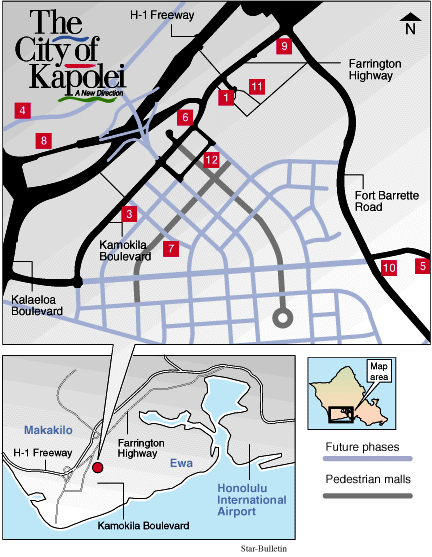
As more government buildings go up -- a police station is in the works and construction on a county civic center is expected to start by September -- real estate brokers expect demand for surrounding office space to increase. They say lawyers and others who do business with government will want to locate nearby.
"I think it will have a very broad effect over the whole area," Dave McCoy, Campbell's chief executive, said of the coming of government to Kapolei.
Employees interviewed in Kapolei say they enjoy working in a place less congested than Honolulu's main job corridor, though some complained of a limited choice of restaurants.
State offices scheduled to move to Kapolei beginning in August: Moving west
Department of the Attorney General
Child support enforcement agency