
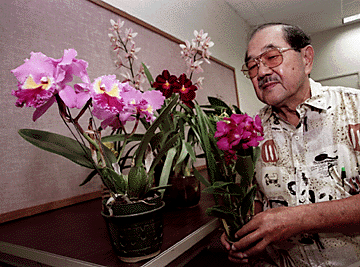
ONE of the things they don't teach in colleges of education is how to get rid of the students when the class is over. Never happens -- they usually have one foot out the door before the teacher has finished the lesson. Hopelessly devoted to Yee
John Yee's students keep
retaking his classBut here we're talking about John K.H. Yee, master instructor of orchid culture and 1998 Teacher of the Year of Farrington Community School for Adults. Not only do his students stay on after their class is over to sit in on the one that follows, they take the same course over and over again because it's never the same.
"John is an inspired teacher," said Libby Viduya, principal of the community school. "He brings life to his subject, and he's able to share so much of his knowledge with the people in his classes." Viduya's enthusiastic support of Yee's classes has encouraged Yee to continue with the class for the past nine years.
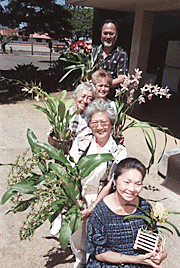
Among the many returning
members of John Yee's orchid
growing class are, from top, Ted
Sakamoto, Dorothy Sakamoto,
Elsie Young, Ruth Chun
and Jane Lee.
By Craig T. Kojima,
Star-Bulletin
If there were a class president, it would probably be Jane Lee, a part time teacher at the school. "I was interested in orchid culture because my father grew orchids as a hobby and I grew up with them," Lee said. "I saw the class in the school catalog a couple of years ago, and signed up for it. When the first class was over, I gathered up my things and started to leave. Then I noticed that I was the only one on the way out. So I stayed on for the second class, too."
Clinics critique efforts
Yee breaks each class into two sessions -- he lectures for the first hour on orchid culture, and runs a clinic for the second hour. People either ask questions about their plants, or actually bring the patients in for a diagnosis. Yee is working with adults, and he doesn't baby them along."I tell the students that whatever they bring in to be critiqued will be improved if they follow the advice. There's no sense in telling them they're doing fine, so their feelings won't be hurt. Often they just have the plant in the wrong place, or they're giving it too much water or it's got a bug we can get rid of. And I tell them that."
Elsie Young of Pearl City had, with very little success, been trying to grow miltonia orchids in her yard. "I struggled," she said, "and they died. Then John said that it's too hot to grow miltonias in Pearl City, that I should go into oncidiums or brassias or dendrobiums that can take the heat. You should see my dendrobiums. I had 35 flowers on one plant last year."
Another student brought in a blooming cattleya with two of its five petals drooping. "Where is it growing?" Yee asked, and was told that the pot was kept in the garage behind the car. "It's the emission from the engine whenever the motor is running," Yee said. "It's the exhaust that's ruining your flowers.
"Petal damage can be due to a number of things. Never grow orchids next to gardenias. Gardenias harbor thrips that will move right over to your orchids. And don't grow them under plumeria trees because the aphids and mealy bugs that live in plumerias will drop down on the orchids."
Too much water kills
Yee also lectures them on watering, which is more likely to be too much than not enough. "In the rain forest, the roots are bound tightly. I've seen orchids growing in Brazil and Guatemala, and in Africa and the Philippines. You want your orchids to be potbound. They get wet from the rain, then they dry out, then the cycle repeats. The plant can't be constantly wet or the roots rot and it dies," he said."On a hot, humid day, you're hot so you water your orchids. But they don't need it. They thrive on the humidity in the air. Water when it's dry. When you do water, make sure you get the underside of the foliage where the stoma are, where the nourishment is stored."
Different areas of the island require different watering patterns. "In Aiea, where it's hot and dry, deep water your orchids twice a week, and spray lightly daily. In Kaneohe, where it's wet, deep watering once a week is enough," he said.
Yee advises against cleaning the leaves of orchids, because you might remove the cutin, the varnish-like material the covers the leaves and helps them to retain moisture. "If you take that off, the plant dries up," he said.
Keep 'em in the pots
It used to be the practice among orchid growers to repot whenever roots began growing through the drain holes, but Yee discourages this. "When you repot, you lose all the existing micro-organisms that the plant needs to break down its nutrients."He prefers clay pots to plastic because the clay pots retain less water.
Many of the class members grow some of their plants in hanging lath baskets, made by a classmate, Ted Sakamoto. "My wife dragged me into this three years ago. Now our whole yard is filled with orchids and I'm a trustee of the Windward Orchid Society," he said. Sakamoto has just enough time to build the flat square baskets by the dozen, and to give them out in class.
Yee said that he has had no formal training in horticulture, and that he has learned through experience and by traveling to orchid centers all over the world. He is retired from the engineering department at Pearl Harbor. "From the day I graduated from high school, there were only two working days when I didn't have a job. I got out of the army on a Wednesday and went to work the next Monday."
A 12-hour video of his lectures and advice has been taped by a media class at Leeward Community College. It needs to be edited, and the intention is to make it available to interested groups. The project is stalled at the moment for lack of funding.
Yee's next session of classes will begin in the fall. Watch in mid-August for newspaper reports of the schedule of adult community classes, given in several high schools around the island, and act quickly. His classes fill up fast, mostly with alumni.
Gardening Calendar in Do It Electric!
Send queries along with name and phone number to:
Evergreen by Lois Taylor, Honolulu Star-Bulletin, P.O. Box 3080, Honolulu 96802.
Or send e-mail to features@starbulletin.com.
Please be sure to include a phone number.
Evergreen by Lois Taylor is a regular Friday feature of the
Honolulu Star-Bulletin. © 1998 All rights reserved.

