

WATCHING Payne Stewart in the U.S. Open, I felt his pain. I also felt Casey Martin's pain as he negotiated the hilly fairways at the Olympic Club in San Francisco. Even he had to walk up to most greens. Waialae could take
some tips from tough
U.S. Open courseCome to think of it, I felt some pain of my own, walking the course. I wanted to hop on Casey's cart.
This year's U.S. Open was again a test of survival. The winner, Lee Janzen, didn't even break par. No wonder Stewart said, "When you come right down to it, it was the Olympic Club that really won."
Having gone to the Masters at Augusta National and now the U.S. Open, I'm halfway through my personal "Grand Slam" of attending golf's four majors. That leaves the PGA Championship and the British Open to go.
The U.S. Open is probably the most fascinating of the majors. It is, after all, the national championship of the United States.
And the event is run by the U.S. Golf Association, which seems to find fiendish delight in reducing the best PGA Tour professionals to guys who can't break par. Just like the rest of us.
The USGA does it by tightening the fairways, growing ankle-deep rough and making the greens so swift and firm that even precise golf shots can roll helter-skelter. And, for kicks, it'll come up with pin placements that border on the ridiculous.
Two-putting proved a real test of skill. Just ask Tom Lehman and Justin Leonard, who both four-putted.
UNDER those conditions, no wonder par was the winning score.
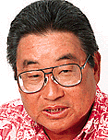
"The fascinating thing about the U.S. Open was that they (the pros) look like us," said Honoluluan Cedric Choi.
Another way the USGA toughens a course is by its practice of converting two par-5 holes into par 4s, making it a par 70. At Olympic they were the fifth and the talked-about 17th.
Choi was particularly interested in Olympic's uphill, 468-yard 17th hole, which, not surprisingly, ranked as the most difficult. It yielded only five birdies on the first day when only a third of the 155-player field got on in regulation.
Needless to say, the pros, not used to having to go up and down from 80 yards out to save par, didn't like it:
"It's a great hole, but obviously not a par 4," said Martin, who played it 4-over during the week.
"It's a par 5 in my book," said Dave Maggert.
"I made par even though it had a square box," kidded Stewart after his second round. (On a scorecard, bogeys are indicated by a square box.)
Choi admits that the pros have a case because the 17th is designed to play as a par 5. The uphill, small and well-bunkered green isn't designed to receive long iron shots.
THE reason for Choi's interest is that he's a golfing member of the Waialae Country Club, which is preparing to convert two par-5 holes (tournament No. 1 and No. 13) into par 4s for next January's inaugural Sony Open in Hawaii.
A new tee at No. 1 will make it a slight dog-leg right, playing anywhere from 470 to no more than 485 yards. No. 13, traditionally the Hawaiian Open's easiest hole, should now be one of the toughest.
"As par 4s, they'll play close to par," Choi said.
Not that even par will win it at Waialae as it did Olympic, but by turning eight easy birdie chances to more difficult pars, the winning scores at a par-70 Waialae won't be as outlandish anymore.
John Huston, the last United Airlines Hawaiian Open champion, can rest assured that no one will come close to the PGA Tour record 28-under-par score he set at Waialae.