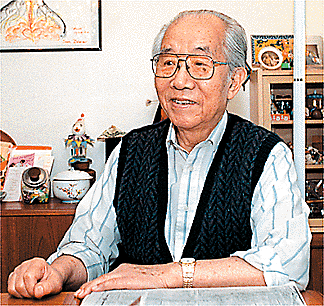
Star-Bulletin file photo
Seiichi Higashide, pictured in his Honolulu apartment in 1994,
spent two decades fighting for reparations for Japanese who
were abducted from their Latin American homes during
World War II and interned in the U.S. He was one of
them, and he died before his battle was won.
Isle woman’s
father led fight
for reparations
The Japanese were taken
By Susan Kreifels
from Latin America and
interned in the U.S.
Star-BulletinSeiichi Higashide spent two decades in Hawaii trying to persuade the U.S. government to apologize for what it admitted last week was a "tragic chapter in the history of our nation."
Higashide died a year before the United States said it would compensate more than 2,200 Japanese Latin Americans who were abducted to the United States during World War II, stamped as illegal aliens, and forced to live in detention camps. They were to be traded for American prisoners in Japan.
But his daughter, Hawaii resident Elsa Kudo, said Higashide would have been sorely disappointed in the country he eventually learned to love even though it caused so much misery for him and his family.
"In a way it's good he died," said Kudo, 61. "He had high hopes. He would have been very disappointed because the compensation is so little and there are no guarantees.
"He grew to love this country. He believed war causes a lot of inequities. But he felt the United States still had the heart to correct its past mistakes."
After being excluded from reparations to Japanese Americans interned during the war, Japanese Latin Americans filed a 1996 class-action lawsuit that was settled last week. The United States will pay each of the Japanese Latin American internees $5,000 each and apologize for its actions. But the money will come only if there's any left from reparations to Japanese Americans, who were granted $20,000 each.
Hideko Elena Nakasone, 63, is disappointed as well. She is one of at least three people in Hawaii who qualify for the reparations announced last week.
Nakasone was 9 years old when the U.S. government forced her father to leave his family and business in Peru. Nakasone, who has lived in Hawaii since 1962, later joined her father in a detention camp.
"It's not fair," said Nakasone. "We suffered more than the United States people. We lost everything. I think we had more heartbreak, too."
Kudo and her husband, Eigo, helped Higashide, author of "Adios to Tears: The Memoirs of a Japanese-Peruvian Internee in U.S. Concentration Camps," lead the battle to be included in reparations paid to Japanese Americans. The Kudos were able to receive the $20,000 reparation due to technicalities in the 1988 law. But last week's settlement for others brought the two little satisfaction, and they believe the Japanese Latin Americans should have received at least equal compensation.
Of the total 2,264 internees, 865 were exchanged for Americans held in Japan during the war. Fewer than 100 -- citizens of Latin American countries or married to citizens -- were allowed by those countries to return home. Nakasone's family was sent to war-devastated Japan, where they had nothing.
Julie Small, co-chairwoman of the Campaign for Justice: Redress Now for Japanese Latin Americans, estimated that 1,200 of the internees are still alive or survived by heirs. Her organization has found 500 of them in Japan, 100 in Latin America, and 50 in the United States.
The 1988 law provided reparation for Japanese Americans but excluded the "illegal aliens." It expires in August, leaving little time for the others to seek redress, and Small said the settlement was the best they believed they could get. Some may sue independently or seek new legislation, Small said.
Many in Washington know that excluding the Japanese Latin Americans was morally wrong, Small said. But she believes a new law addressing them will be difficult because of setting precedents for other groups that may seek reparations.
Small, the internees and historians describe an event fraught with illegality in what Attorney General Janet Reno last week called "a tragic chapter in the history of our nation."
Foreseeing conflict with Japan, the FBI started blacklisting Japanese Latin Americans in the late 1930s. Thirteen countries agreed to allow the United States to take their Japanese residents. Most came from Peru, which received $29 million from the United States, Small said.
Elsa Kudo said her father's name appeared on a list published in a newspaper on Christmas Eve 1941. The Japanese, many of whom ran prosperous businesses, had their phones cut, drivers licenses confiscated, bank accounts frozen, and daily receipts taken except for small food allowances.
In January 1944, the fathers of Elsa and Eigo Kudo were jailed. Then they vanished. Families later found out they were sent to the Panama Canal Zone, where they spent three months in prison on their way to the United States.
Latin American countries were told not to give the Japanese visas. When they entered the United States, their passports and other documents were confiscated, and they were stamped illegal aliens.
The families of the Kudos followed on ships in March and July 1944. They ended up in a camp in Crystal City, Texas, where they stayed for two and one-half years.
"We were prisoners," said Eigo Kudo, 64. "There were guards with machine guns."
After the war, Peru refused to allow them to return. The United States wanted to deport the families to Japan, but about 300 of the internees refused to go to a place where they had little connection and no future, the Kudos said. Eventually the families ended up in a factory in New Jersey that needed workers and agreed to sponsor them.
"Almost all the Peruvians wanted to go back," Elsa Kudo said. "We had an idyllic life."
She said the "illegal alien" stamp has haunted their lives since then. It restricted her parents to low-paying jobs without benefits until they became citizens. Her mother was forced to clean latrines, a job most Japanese would have found shameful.
But her father believed "as long as we do honest work, we need not be ashamed."
Her family moved to Chicago, where Higashide used his architectural education to renovate old buildings and resell them.
Elsa Kudo also grew to love the nation that had caused so much suffering to her family. She still has difficulty believing that such "a great country" would not give the Japanese Latin Americans what she considers just compensation.
"I still hope," Elsa Kudo said, "that the government will come through."