By Joseph Kuhn, Special to the Star-Bulletin
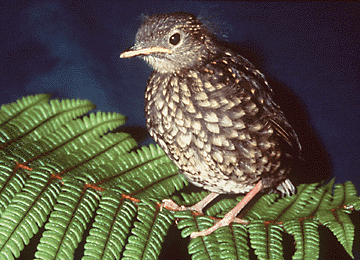
Scientists have had some success breeding the puaiohi,
an endangered bird native to Kauai, at the Keauhou Bird
Conservation Center. At least 10 are scheduled to be
released by the end of the year.
Fund nurtures
birds back from
the brink
Peregrine Fund scientists hatched
By Gary T. Kubota
10 alala last year, but Hawaiian
crows still number fewer than 35
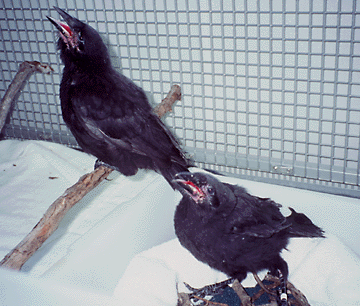
Star-BulletinA researcher uses a crow-shaped puppet to feed a Hawaiian alala chick every hour for 14 hours during its early growth at an endangered bird facility on the Big Island.
The chick, one of fewer than 35 Hawaiian crows in captivity and the wilderness, lives under controlled temperature and humidity.
"It's like having a sick baby. It can be very difficult," said Alan Lieberman, program director of the Peregrine Fund, operators of the facility.
The work can also be productive. Nearly six years after taking over the captive breeding program from the state, scientists at the Peregrine Fund are experiencing more success than ever in hatching endangered bird species in Hawaii.
They are using a technique called "multiple clutching" -- taking the eggs from a nest early enough so the female will lay more. In the case of the alala, which usually lays two to three eggs, the female will typically lay a second set of eggs in a nesting season.
Last year, 10 alala eggs were hatched, the highest number in a year and nearly one-third of the 32 produced at the facility since 1993.
Scientists have also had similar success with the puaiohi, a native forest thrush found only on Kauai.
By Joseph Kuhn, Special to the Star-Bulletin
The Peregrine Fund has hatched 32 alala chicks since
taking over the captive breeding fund from the state in 1993.
At least 10 puaiohi hatched at the facility are scheduled to be released on Kauai by year's end.The Peregrine Fund, which receives most of its money from the federal and state governments, has expanded its program to include five other endangered birds: the nene, the akohekohe, the palila, the Hawaii creeper and the Maui parrotbill.
Robert P. Smith, Pacific island manager for the U.S. Fish & Wildlife Service, is pleased with the results. "We believe we're on the cusp of a really successful effort. We hope it will deliver more results more quickly in the future."
But scientists also acknowledge success has been limited at best, and the attempt to save many of the 31 Hawaii birds on the endangered species list is too little too late.
Nine bird species are considered "possibly extinct," and four are being considered but not on the captive propagation list, said the U.S. Fish and Wildlife Service.
The remaining 10 are considered to have a stable population.
Scientists say more money is needed for research here to determine and develop strategies for encouraging the survival of endangered species.
Many of the recovery plans, assessing the endangered species populations in Hawaii, are outdated, done in the early 1980s.
Although Hawaii is home to more than 26 percent of the endangered and threatened species in the United States, it receives less than 6 percent of federal money allocated to preserve them -- $4.3 million of $77.6 million annually.
"The state of Hawaii does not receive its fair share of federal funds to protect the native species or habitat," said David Frankel, Sierra Club-Hawaii Chapter director.
By C. Kuehler, Special to the Star-Bulletin
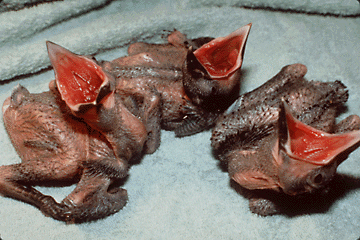
Newly hatched chicks have to be fed hourly
by a puppet-wearing expert.
Lieberman said while federal funding has increased here in recent years, it's still not enough. "The funding should go where the problems are," he said."Unfortunately, it doesn't go where the problems are. It goes where there's political influence."
Lieberman said there needs to be better federal, state and private management of lands for the captive breeding program to secure lasting results.
"If you don't deal with the habitat problems that created the endangered status in the first place, then there's little chance of success."
Lieberman credits Cynnie Salley, general partner of the 15,000-acre McCandless Ranch, as instrumental in preserving the alala.
"Frankly, if it wasn't for her interest in the problem, there probably wouldn't have been any wild species," Lieberman said.
At the 3,000- to 6,000-foot level, the ranch has maintained a native forest that still contains many forest birds.
It is here that the Peregrine Fund has released the alala.
The numbers have remained stable at about 34, with 16 in the wild and 18 in captivity. But the captive flock has not done as well in the wilderness as in the laboratory.
Avian malaria and pox attack birds at this elevation. Several have been eaten by another endangered species, the Hawaiian hawk, or io.
Salley said many landowners don't want the alala released on their land because they don't want the responsibility that comes with it, including potential litigation.
"We need to work together and respect the right to make a living," she said. "If you want success, you've got to take out the threats of lawsuits. Unless they get incentives on the land, it's going to be shoot, shovel and shut up."