
By Pat Bigold
Star-Bulletin
Sporting goods stores sell 40 million of them a year.
But over-the-counter athletic mouthguards are being called "hazardously inferior" by an association of sports dentists.
They are saying store-bought mouthguards, used by well over 90 percent of amateur athletes, oftentimes don't protect users from concussion, jaw fractures, neck injury or damage to tongue and lips.
Many athletes who use these mouthguards complain of difficulty breathing and talking. For that reason, they often cut the back portion of the guards, thus eliminating the buffer that keeps blows to the facial area from transferring to the base of the brain.
Star-Bulletin
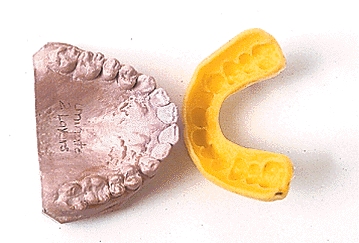
The mouthguard molded by a dentist, shown here,
offers better protection than the boil-and-bite variety
shown at top, dentists contend.
The result can be concussion, the effects of which can sometimes be with a person for life."If you're wearing a mouthguard with the ends cut off, you might as well not be wearing anything," said Dr. Melvin Choy, who heads the Hawaii chapter of the Academy for Sports Dentistry (HASD).
But Choy said he understands why athletes such as high school and college football players alter the mouthguards.
He said he bought one of the best "boil-and-bite" varieties and attempted to fit it to his mouth.
This required boiling the guard until it was soft, placing it into his mouth and using his tongue and fingers to fit it around his teeth.
Choy said that even with his dental degree, he had a hard time fitting it. "I did fit it eventually but it still wasn't comfortable," he said. "If I had to wear this when I was playing, I probably would cut it, too."
The dentists say the least acceptable mouthguard is the stock mouthguard.
They are described as "bulky," and lacking in retention, therefore requiring the athlete to constantly bite down.
Choy said stock mouthguards, and even the more fitted boil-and-bite, are apt to fly out of the mouth on impact because they are not fitted very well.
So what do the dentists recommend?
Vacuum-formed or heat/pressure laminated guards that are prepared in a dentist's office.
Choy prefers the laminated version because it has the best retention, can be made to any thickness and allows the wearer to speak and breathe with comfort.
The problem is the cost. Even though the material for the customized mouthguard might cost only $10, the dental work involved can range from $50 to $250.

Compare that with the cost of the stock and boil-and-bite mouthguards, which range from $1 to $25, and it's easy to see why so many athletes stick with the cheaper protection.Dr. Ray Padilla, a colleague of Choy's who is a faculty member at the UCLA School of Dentistry, takes a swipe at retailers.
"They are providing ill-fitting, bulky and minimally protective stock and boil-and-bite mouthguards," Padilla said.
"These over-the-counter devices cannot deliver adequate protection for athletes with specific needs such as mixed dentition, braces, carious or missing teeth. xxx The reality is that these store-purchased mouthguards are seriously and hazardously inferior to the professionally fabricated custom laminated mouthguards."
Interviews with local prep athletes validate Choy's claims regarding the problems inherent with the stock and boil-and-bite mouthguards.
"Some guys cut them so it would cover only a third of the front teeth because they had a hard time breathing," said St. Louis Schools' all-state defensive lineman Tony Tata. "But I was comfortable with it."
The drawback, Tata said, was that the boil-and-bite guard wore down quickly.
"You kept on biting at it and your teeth went through it," he said.
Tata said he could remember plenty of times when the mouthguard didn't seem to be protecting him adequately. "But I never had a concussion," he said.
Iolani's Joe Igber, who set the Interscholastic League of Honolulu single-season rushing record last year wearing the boil-and-bite mouthguard, said he might try the laminated version in the fall.
He's never had a concussion using the cheaper mouthguards but said he is now leaning toward the custom device. That's because he gave it a try during basketball season and decided it was comfortable enough.
Iolani and McKinley were selected last year as test schools in a pilot program in which almost all sports were designated for mouthguard use.
HASD member dentists donated their time to provide the molds for the student-athletes at those schools.
The only sport required by the National Federation of State High School Associations to use mouthguards is football.
Choy offers statistics to indicate that so-called "non-contact" sports such as basketball have a higher incidence of orofacial injury than football these days because most of the athletes in those activities don't wear a mouthguard.
The goal of the HASD is to get every school in the islands to broaden its requirement for the use of mouthguards in all "at-risk" sports, Choy said.
"We had a very interesting case at McKinley where a softball player avoided serious injury," Choy said.
McKinley athletic director Neal Takamori said a girl was hit in the mouth with a ball but escaped with minor abrasions.
Sports Choy would recommend be converted to the mouthguard movement are basketball, softball, water polo, volleyball, baseball, soccer and judo.
Dr. Mark Mugiishi, the head boys' basketball coach of the state champion Iolani team, said he was willing to encourage his players to wear the specially designed mouthguards. "But I didn't make it mandatory," he said.
Mugiishi said he wants to see more data about the effectiveness of mouthguards in sports such as basketball.
"I really haven't read everything there is to know, so it's hard for me to be sold on this," he said.
Punahou's veteran athletic trainer, Glenn Beachy, is even less convinced.
"I'm leery as to whether or not this is a ploy to get people into the dentist office," Beachy said. "A custom-made mouthguard is always better, but is it worth the expense? The fact is, mouth injuries are not that frequent with us."
Beachy said ankle and knee injuries are more common, and he rarely sees concussions resulting from a blow to the jaw.
"It's usually a very traumatic blow to the head," Beachy said, noting that a mouthguard could not prevent damage in such circumstances.
Beachy said he's been using the boil-and-bites for years and sees no reason to change.
"If you make sure the kids don't trim off too much and fit them in a nice position, they function quite well," Beachy said.
The Hawaii chapter of the Academy for Sports Denistry is sponsoring Project Mouthguard. Taking a bite out of the cost
The dentists will fit athletes with mouthguards at the cost of the materials, which Choy said is about $10-15, or what you would pay for a top-quality, boil-and-bite mouthguard.
For more information about sports dentistry or Project Mouthguard, call the HASD at 524-1081 or visit http://www.sportsdentistry.com.