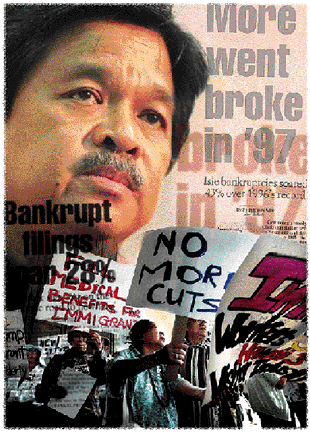
After seven years of economic decline and
with no solution on the horizon, fed-up Hawaii
residents are looking for somebody to blame.
That spells trouble for Gov. Cayetano and
the ruling Democratic PartyBy Richard Borreca
Star-BulletinIf you go by the numbers, Gov. Ben Cayetano looks like a winner in November. With his command of the Democratic Party and his appeal to voters who are most like the state's average residents, he should be able to stand up to the Republican challenges.
No incumbent Democratic governor has ever been defeated in Hawaii. Cayetano himself has never lost an election. And while public opinion polls show Cayetano isn't as popular as his predecessors, his 1994 victory shows he touches the middle class and politically important ethnic groups, including Japanese Americans.
But election consultants now are asking: How close are we to feeling the same way we felt in 1994?
With little to cheer after seven years of economic down-turns, voters are turning ugly and looking for someone to blame, say the consultants. It is a problem that Cayetano's campaign recognizes but hopes will fade.
"I don't know what will happen, but I'm as interested in 1954 as I am in what happened in 1994," says Jim Dannemiller, president of SMS Research and a veteran local pollster.
"This is certainly not like anything we have seen in the past. People are believing that there is something fundamentally wrong."
It was in 1954 that Democrats first won control of a chamber of the territorial Legislature. It was the beginning of the end of Republican control of Hawaii.
Bob Awana, spokesman for Maui Mayor Linda Lingle's gubernatorial campaign, says he thinks Lingle will win districts carried in the 1994 race by Republican Pat Saiki and independent Frank Fasi -- plus make gains in many Cayetano districts.
"Voters are crying out for new leadership," he said.
Democratic State Sen. Mike McCartney, a Cayetano re-election campaign co-chairman, says the voters' mood will change.
"Initially, it is a hurdle to overcome, but I don't see it as a hurdle at the finish line," he said. "It is a perception that needs to be overcome."
Political strategist and consultant David Wilson, a principal in McNeil Wilson Communications, has advised former Congressman Cec Heftel, former Gov. John Waihee and Mayor Jeremy Harris. This year he sees the economy causing political problems.
"You still have a powerful voting block of people who work for the government. The question is whether the rank and file will follow lock-step with the party. It used to be that the feeling was that they had been taken care of," Wilson said.
"Now union members are feeling other things; there is the broad influence of the economy.
"There are kids who have been taken out of private school, trips to Disneyland that have been canceled. At the end of the day, you have this climate of uncertainty.
"Before, you had a climate that you would be taken care of; Democrats can no longer say that," Wilson said.
Both consultants said voters likely would "punish" politicians for the state's economic problems.
Surveys show that Hawaii voters consider it government's responsibility to solve the state's problems, and when that doesn't happen, there could be serious repercussion, Wilson said.
"There is a feeling that someone needs to be punished," he said. "Not since 1954 has there been this need to find someone to blame."
Wilson warned that the anti-incumbent mood that crossed much of the country in 1994 may have reached Hawaii. "I think there is a great possibility that the 'throw the incumbents out' mentality has landed here," he said.
More troublesome is the issue of the state's economy. As Senate President Norman Mizuguchi observed, "A good economy translates into a good public-approval rating."
"They might not be voting for the GOP as much as voting against the Democrats," Wilson said. "They could say they can't blame the Republicans for the economy."
Lingle is starting to get the benefits of Democratic disenchantment. Hoaliku Drake, for instance, a Democrat who served as Waihee's Hawaiian Home Lands director, is on Lingle's honorary campaign committee.
"I am a Democrat, but sometimes you have to step forward when you see someone with strong convictions," she said.
"She (Lingle) has the skills and willingness to bring Hawaii out of this depression. I'm a woman who has been in government long enough to know when the state is in trouble."
That feeling of trouble and depression is what is driving the race for governor today. Dannemiller says when Democrats go to vote, they will be asking themselves: "Can I vote for a Republican haole woman. Can I actually do that?"
If they answer yes, it will be because they answered the other campaign question -- Are you confident government can fix the economy? -- in the negative.
Even McCartney agrees that the state's voters have changed dramatically in four years.
"There's a lot more complexity out there," he said. "There is no Big Five, so there is no big enemy out there."
As the boomer generation ages and younger people move into prime voting age, people like 38-year-old McCartney see changes for this year's gubernatorial race and local politics.
"The traditional Democratic voters worked in plantations, they fought in the war, and they had it hard," he said.
"They are getting older -- some have died already -- and us younger ones never had to go through it."
How Cayetano won
in 1994He captured the 'average' isle voter,
By Richard Borreca
showing how important demographics can be
Star-Bulletin"Who loves you, baby?"
On TV, that's what police sleuth Kojak used to ask. Today on the campaign trail, politicians are asking the same question.
Getting the right answer can be crucial in a close race.
For instance, Ben Cayetano in 1994 won the governor's race with just 36.6 percent of the general election vote.
Former Honolulu Mayor Frank Fasi, running as an independent, had 32 percent of the vote, and former Republican Congresswoman Pat Saiki had 29 percent.
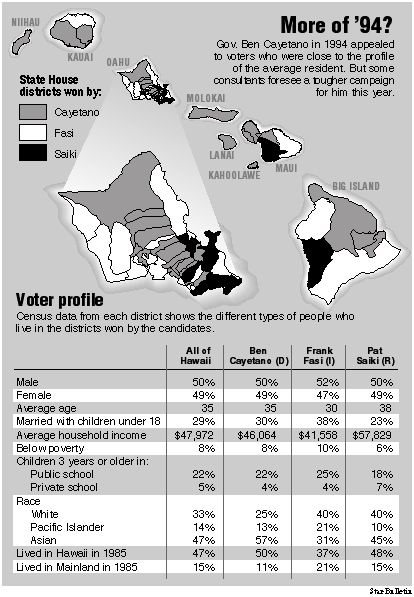
But a Star-Bulletin computer study of the results shows that Cayetano four years ago stood solidly in the middle, winning the support of voters who were most like the average Hawaii resident.
By mapping the state House districts won by Cayetano, Fasi and Saiki four years ago, and studying U.S. Census data for those districts with computer programs, it is possible to see characteristics of the districts won by each candidate:
Cayetano districts were within 4 percent of the statewide average household income, while Fasi's were 15 percent lower, and Saiki's 20 percent higher than the average. Cayetano districts also matched statewide poverty levels.
Important data
Using such demographic data is important both for campaign tacticians and for officeholders.One veteran political strategist, who requested anonymity, explained that knowing the characteristics of your supporters is vital in deciding how to make appointments, pick Cabinet officials and direct your administration.
During the campaign, knowing your supporters means you can target political messages to the interests of certain groups.
For instance, if a candidate is supported by families with school-age children, it would be wise to let those voters know about the candidate's stand on education.
Knowing who likes you means you also know who to register to vote. It means you know who to call to remind to vote on Election Day, and where to hold rallies.
Jim Dannemiller, president of SMS Research, a firm that specializes in surveys, polling and analytical studies, says knowing the data can be vital.
"Number guys are important because they can find the votes a candidate needs in the last few days. If you are in a close race, the guy with the numbers is a lot more valuable," he said.
Political consultants can then make sure the candidate is briefed on the issues that supporters care about, he said.
Gut feel
Getting politicians to understand the differences and to pay attention to the numbers, however, can be frustrating.Don Clegg, who designed polls for both Fasi and Mayor Jeremy Harris, said politicians take in much of their information from the people around them.
So if a politician hears from supporters in the crowd that he or she is doing great, they will believe that no matter what the polls say, Clegg said.
"Candidates tend to go by their gut feelings," he said.
"But the problem is that few people are going to go up to them to tell them they are full of it."
By using computerized maps of the state's 51 House districts and the files for Hawaii from the 1990 census, the Star-Bulletin was able to extract the information about districts won by Ben Cayetano, Frank Fasi and Pat Saiki. About this study
A computer mapping program was used to examine the House districts. A second computer program overlays the census data on the maps. Then the information is pulled out for each House district.
Finally, the information about each district won by the three candidates was added together, and percentages -- comparing the area to the entire state -- were calculated.
Political advisers and candidates frequently use studies such as these, but this is the first time in Hawaii the data has been independently calculated and made public.