
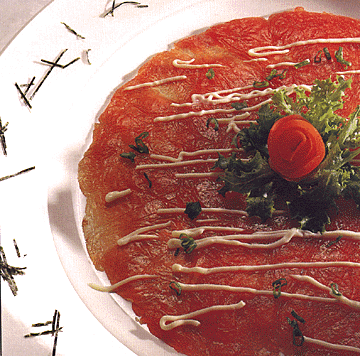
Ahh, ahi!
Yellowfin and
By Mike Dunne
bigeye tuna swim into
the mainstream
Scripps-McClatchyAhi, the longtime staple of the sushi bar, has gone mainstream. Rare is the fashionable restaurant that doesn't feature tuna prominently as either appetizer or entree. And many of the attributes that make ahi attractive to chefs also make it increasingly appealing to home cooks.
At restaurants, it's usually grilled or seared rare, sliced thin to show off its glistening red interior, and spiced with seasonings in prickly contrast to the mild flesh -- a crust of black pepper, a cream sauce laced with wasabi. Presentations range from the simply artistic to the dramatic.
Without exception, ahi is expensive. Top-grade tuna can go for $15 a pound in stores, and you'll pay $15 to $22 for a plate in a restaurant. Nevertheless, it remains popular.
"Even at the high price, we have no problem selling it," says Todd Cole, a butcher at Corti Bros. Market in Sacramento. "Our customers really like it for their grills and for sashimi."
(Guy Tamashiro, vice president of Oahu's Tamashiro Market, said ahi and other fish prices have started a summertime dip. "From last week prices started coming down," he said, "so they're a lot more attractive." Lighter, milder ahi tombo -- preferred for frying, baking and broiling -- costs from $3.98 a pound this week, while ahi -- both bigeye and yellowfin, preferred for raw preparations -- is $4.95 and up, he said.)
Clearly, restaurant patrons have yet to get their fill of ahi. Restaurateurs have good reason to favor it: Sliced thick and cooked quickly, ahi looks like a fine steak -- but an exceptionally tender and light one. Plus, ahi is mild and adapts well to a wide range of seasonings and techniques.
Though prized in sushi bars for its fatty feel, ahi is relatively low in calories, cholesterol and fat; a 3-1/2-ounce portion packs only 145 calories, 60 milligrams of cholesterol and 1 gram of fat. In contrast, a 3-1/2-ounce cut of trimmed porterhouse packs 218 calories, 80 milligrams of cholesterol and 11 grams of fat.
At home, ahi is versatile and adapts well to assorted wines. If it's accompanied by a rich reduction sauce, a pinot noir works. If the seasoning runs more to spicy peppers or fresh herbs, a light sauvignon blanc would be best.
Making the most of your ahi
Look for: Firm texture, a fresh smell, a moist and shiny look, and a bright and even color, "almost like a reddish Jell-O," suggests one chef.
Hawaii fishers long have used "ahi" to refer to both the yellowfin and bigeye species of tuna. The ahi in seafood cases and on restaurant menus on the mainland could be either species, though it most likely is the more abundant yellowfin.
Bigeye almost invariably goes to sushi bars, with yellowfin going to fish markets and restaurants.
Yellowfin is caught year-round and is most abundant off Hawaii between May and September, though the annual catch can fluctuate widely. Most bigeye generally is landed from October through April. Both almost invariably are sold fresh.
"Once on the plate, there's virtually no difference," says Dave Holtz of the National Marine Fisheries Service in San Diego.
In Hawaii, some fish markets will sell as many as seven grades of ahi, ranging in price from $6 to $18 per pound. The fresher, the fatter and the redder the cut, the more prized the ahi and the higher the price, says Howard Deese, marine programs specialist with the state of Hawaii.
Grading of ahi is highly subjective and is worked out by fishers and buyers at seafood auction houses, explains Deese. In short, the worth of ahi depends in large part on how fatty it looks and feels to the seasoned buyer.
On the West Coast, seafood distributors and restaurateurs like to boast that they deal in "No. 1 grade sashimi ahi." But No. 1 grade on the mainland and No. 1 grade in Hawaii likely are two different grades, says Deese. The No. 1 grade sold in California well could be from the Gulf of Mexico and off the west coast of South and Central America, and would be considered No. 2 grade in Hawaii. Virtually all the No. 1 grade ahi caught off Hawaii goes to Japan, where it fetches three times the price it would command on the U.S. market, Deese notes.
"Ahi" translates literally from Hawaiian as "fire," a term possibly inspired by the fish's deep-red flesh. But there's a more colorful story behind the term.
"Fire is probably what the fisherman's hands felt like when a tuna took hold of his line and began to dive," says Deese. "It's a very powerful fish."
Aiden Coburn of Farallon Fisheries, a seafood distributor in South San Francisco, says "ahi" means "sales": "Ahi is a more charismatic name than tuna. It's marketing."

