Spirit of
white buffalo
'Know your culture
By Kekoa Catherine Enomoto
and live it'
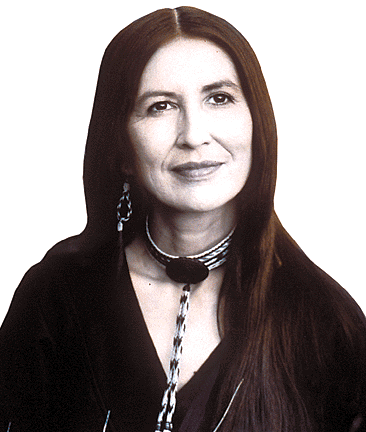
Star-BulletinCHARLOTTE Black Elk speaks in simple, spare, graceful syllables. "Know your culture and live it," she said in a phone interview from South Dakota.
Black Elk is an honored guest at this weekend's fifth annual Warrior Society Powwow. But the 47-year-old member of the Oglala Lakota also speaks with a note of defiance, as if she's seen many skirmishes and survived many battles. And there's a trace of resignation, as if her genetic memory recalls prevailing through countless snow storms and stalking untold buffalo.
Black Elk is perhaps most famous for integrating technology and tradition, science and spirituality. In this manner she conceptualized a Tribal Natural Resource Regulatory Agency for the Pine Ridge Indian Reservation. She also patterned a police department after the traditional warrior society. And, she studied the buffalo dance ceremony to draft the wildlife management program for her 5,000-square-mile Pine Ridge Indian Reservation.
"In performing the buffalo dance, we become the buffalo," she explained. "When we kill and eat the buffalo, it continues to live in us; so we have to ensure that it continues to live.
"Thus, in the wildlife management program," she said, "the areas that we camped in, when we left we planted new trees in them. We took care of the land. It's stewardship of the land that allowed the buffalo to continue to live. It is through the buffalo's life that we also lived." Black Elk speaks Lakota fluently. Her Oglala Lakota name -- Pte Tokahewin Ska -- means White Buffalo Woman of Different Motion. Seamlessly a scientist cum spiritualist, she is the only native American Indian scientist for whom a scientific method -- the Black Elk Rule -- was named. The technique uses scientific technology to verify oral tradition.
"I'm very much into people looking at their culture," she said. "We're not European and so European models are not appropriate for us; they don't take into account people's culture. So I think we're obligated as native people to look at our own teachings, our own ceremonies and our own understandings and bring them into modern society -- because our culture doesn't prohibit technology and it doesn't prohibit modern applications in the world we live in."
Black Elk said that for the Oglala Lakota, stars dictate the ceremonies, laws and life itself. Likewise, for ancient Hawaiians, the moon and tides determined when, where and how they planted, harvested and fished.
"Our laws are only as good as we observe them," Black Elk said. "Our culture exists only as there is perpetuation of everything -- rituals, the community activity that's required, and the keeping of it -- to be who you are.
"Just by laying (yourself) down is not being Hawaiian or Lakota," she said. "You must make a conscious decision that requires action on your part."
The Lakota want to repatriate at least part of the Black Hills, those sacred mounds that rise from the surrounding plains.
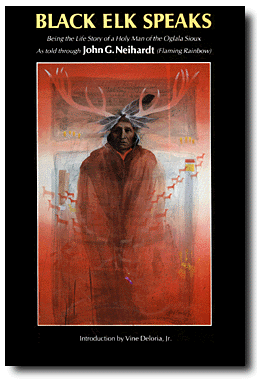
In his later years, her great-grandfather, Nicholas Black Elk, climbed the highest of the Black Hills, the 7,242-foot Harney Peak. There he prayed to his ancestors, as recorded in "Black Elk Speaks," told through John Neihardt in 1932.
"Hear me that they may once more go back into the sacred hoop and find the good red road, the shielding tree!" he prayed. "O make my people live!"
Of repatriation, Charlotte Black Elk predicted, "It will wait for another generation to do that work. Right now Congress is extremely hostile to native people." But in her spare style, she echoed her great-grandfather's hope, "It could be our children or our grandchildren, but we're never going to sell out. I intend for it to be in my lifetime."
5th Annual
Warrior Society PowwowWhen: 10 a.m. to 6 p.m. Saturday and Sunday