By George F. Lee, Star-Bulletin
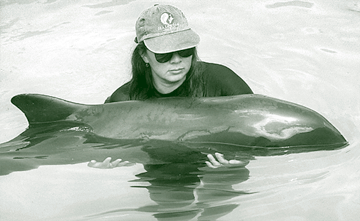
Stephanie Vlachos, supervisor of animal care at Sea Life Park,
swam with the baby melon-headed whale in early April. According
to park veterinarian Robert Braun, the whale is doing well since
being recovered off the Kona Coast about six weeks ago.
Whale calf making
speedy recovery
at Makapuu
Six weeks ago, the rare
By Craig Gima
baby whale was found starving
and dehydrated
Star-BulletinJust a few weeks ago, an abandoned baby melon-headed whale was fighting for its life.
Now it's making a remarkable recovery and playing with new-found human friends at Sea Life Park.
When the animal first arrived about six weeks ago, it was in critical condition -- dehydrated and in danger of starving to death.
It was still nursing and had apparently been orphaned or abandoned. Park veterinarians fed it a high-calorie formula, and the animal has started to gain weight and is eating solid food.
"I think she's out of danger unless something unforeseen comes up," said park veterinarian Robert Braun. "I'm a cautious person; that's my job. But at this point, given her growth rate, her behavior, everything is pointing north and she's looking really pretty good."
The 6-foot-long whale has gained about 40 pounds and is still growing on a diet of about 6-1/2 pounds of fish and squid and two quarts of formula a day.
The next step is to continue to wean the whale off the formula and perhaps introduce a dolphin friend in a couple of weeks.
"We need to look at not only her physiological needs but her social needs and her psychological needs," Braun said. "One of the things we are considering is putting her with another cetacean, another dolphin, and in particular a dolphin that we know in the past has hanai'd or bonded with calves other than her own."
The vet hopes the dolphin will be a companion or perhaps a mother figure to the baby whale.
For now, the whale is enjoying human company.
Before a feeding yesterday, the whale nuzzled and played with a trainer in her pool. It leaped out of the water and dove to the bottom of the tank as the trainer swam.
"We see a lot of comforting where the whale is accustomed to having us there with her as a companion. You see a lot of play activity, which she would normally do with other whales, but of course we're her family now," said George "Paka" Nishimura, Sea Life Park's animal curator.
Nishimura said trainers have individual nicknames for the animal, but it has not been officially named yet. That may change if the whale becomes a long-term resident of the park, which is a possibility, Nishimura said.
There could be problems returning the animal to the wild. Not much is known about melon-headed whales, so it may be difficult to figure out when it may be mature enough to survive on its own and how to reintroduce it to the whale world.
Braun said similar ocean mammals begin to wean away from their mothers at about 2 to 2-1/2 years of age. He estimates the calf is about 5 months old. The whales can grow to up to 9 feet long and weigh 400 to 500 pounds. The baby whale now weighs 140 pounds.
"At what age does a child socialize, that we have a lot of experience in. We don't know this species. It's a very unusual species. To the best of my knowledge, it is the only one in captivity at this point in time, so it's a wait-and-see," he said.
Scientists are learning a lot about the melon-headed whale by observing the calf. They have recorded the whale's sounds for the first time.
The park is also spending "tens of thousands of dollars" on overtime and other costs to care for the whale.
"We're going to pay for this thing," Nishimura said.
"It wasn't an option for us to deny this animal a chance to survive."
Nishimura said if people want to help, they can donate money to the Sea Life Park Marine Research and Education Foundation and specify that the donations are to go toward care of the calf.
The address for the foundation is Sea Life Park Hawaii, 41-202 Kalanianaole Highway, Suite 7, Waimanalo, HI 96795.