Once you learn the rules
By Nadine Kam
of decorating, don't get
hung up on them
Assistant Features Editor
Star-BulletinIT'S not the impossible we fear; it's the possible. The impossible we write off as too difficult. Don't waste your time. Throw your hands in the air and give up. The possible, on the other hand, presents opportunity. Opportunity to succeed, and the flip side, opportunity to mess up big time.
It is with a sense of the possible that we, back as 5 year olds, spontaneously attacked blank pieces of paper with our fingerpaints, ready to smudge, dot and splatter away.
It was only as we got older that fear set in. A blank piece of paper and a crayon was an invitation to failure: The sun can't be blue. These flowers are wrong -- they're taller than the house. What if I put a dot in the wrong place?
Some learn to conquer their fears. Others grow up to face blank walls in their home because they worry about taking the first step toward filling it. This is the reason posters go up haphazardly and noncommittally with tape, or framed photos sit on the floor, propped in low-traffic corner while awaiting a more permanent home.
Well, you can't wait forever to start enjoying your art work.
Jean Wall, ASID, of Inner Spaces, says that she starts the decorating process by taking inventory of items and space available, then figures out what works best where.
The figuring out part is tricky because all design is based on scale and proportion -- a harmonious balance of size, shape, colors and weighting of items -- and determining "harmony" is a subjective thing.
"I can't help you with that," Wall said, "But it helps to start by taking a look at your wall. If you're hanging a picture, hang one that's the same shape as the wall. You don't want to put a horizontal picture in a vertical space, unless you have two or three that can be stacked so the arrangement is vertical. And you don't want to hang a scroll on one large horizontal wall. You want it to go in a long, skinny place."People must work with the spaces they have, but sometimes that narrow space can be created by making room on one side of an entertainment center or other piece of furniture.
To avoid the clash of art work and furniture, Wall suggests placing them close together to establish a spatial relationship.
She said people have a tendency to hang items, such a painting over a sofa, too high.
"The rule is to hang a piece so that its center is at eye level," she said. "There are different heights of people so a tall person is always going to be looking down and a short person is always going to be looking up, but you want to look at it from an average perspective."
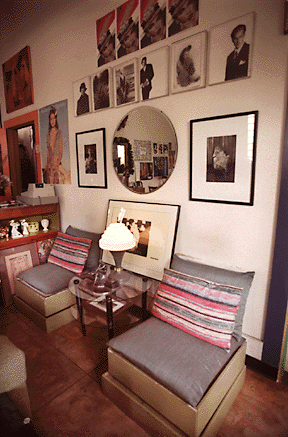
Those with a hodgepodge of items -- masks, paintings, drawings, posters, 3D objects -- can opt for the gallery wall. "Take up the whole wall," Wall said. "But keep everything in close proximity."
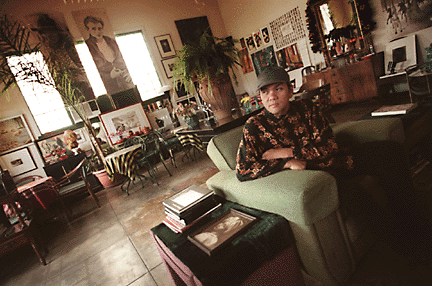
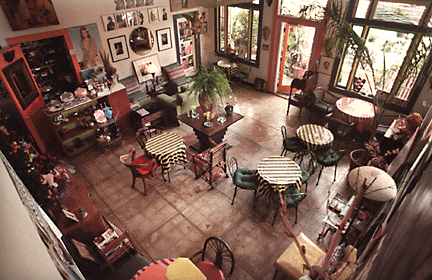
This was photographer Errol Aczon's approach to hanging his collection of ephemera when he opened Caffe Aczione. He closed the cafe recently to allow himself more time to concentrate on his photography, but until the end, cafe patrons could walk into a creative environment filled with art from floor to ceiling.
"I like to start designing from the bottom and work my way up," Aczon said. "Interior designers would come in and comment, 'You seem to break all the rules. Striped table cloths are not supposed to work with Victorian pieces, but somehow it works here.'
"The rules are to keep things clean; don't mix things up. But I collect all different images, from photos to paintings so I'm not afraid to mix it up."
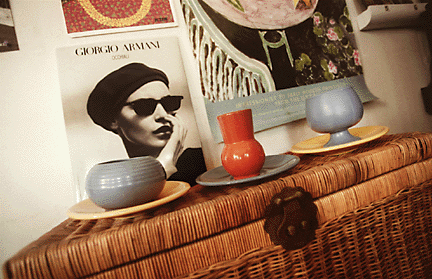
Another approach, he said, is to establish themes, so that all black-and-white photos might go into one room. Drawings of flowers might go into another. He said that working with a series, where each piece is the same size and shape, is relatively easy. Hanging the works is simply a matter of keeping equidistant space between each piece."It's like putting a jigsaw puzzle together. Try one piece and instead of putting a nail in the wall, mark the space and see how the next piece fits," said Aczon.
He said that architectural or interior design magazines are good sources of ideas. "What I'm seeing a lot of now are ledges in homes," he said.
"With a ledge you can lean pieces in a row without hanging so you can put things up and take them down quickly.
If you can't add a ledge to your home, plain shelving might suffice. Or, at City Mill, small glass shelf kits are available in a variety of sizes for grouping small framed photos, art work or knickknacks. The kit costs $12.99 for 6-by-18-inch shelf of clear, tempered glass. It's $19.99 for an 8-by-24-inch shelf. Semi-circle shaped shelves and corner shelves are also available.
And don't think an old chair is useless. Aczon said, "Antique chairs are not meant to be sat on, but a painting can be leaned against it."
Often, framing is the most expensive aspect of hanging art, but Aczon said he finds many frames at garage sales.
As for deciding what frame is appropriate to your piece, he said, "That is an art in itself. Some people collect frames without any art and that's what they display.
"The rules are changing," he said. "The way you arrange your wall is not as important as the idea of putting up stuff you really like and enjoy. That's the bottom line."
Hanging tips
To fill the blank walls in your life, perhaps it's best to think small. The basic design principles that apply to filling a blank sheet of paper also apply to the home.Here are a few tips from Jean Wall, ASID, with Inner Spaces. Keep in mind that once you learn the design rules well, you're welcome to break them:
Make an inventory. You won't know what to put up if you don't know what you have. See if any pattern emerges. Determine which works need framing, what things should stand alone and what should be grouped.