
Found in Space Bishop Museum explores
By Burl Burlingame
our culture and history by looking
at the stars
Star-BulletinYou always hear that space is at a premium in Hawaii, and that might be true if you're storing a couple decades' worth of National Geographics. But look up. It's a great, big boundless universe out there, and the dark blanket of night is reassuringly strewn with glittering stars, beneath which voyagers felt at home as they sailed toward mysterious horizons.
Hawaii's natural and cultural history is one of both voyaging and settlement. The process of exploring, scientific and psychological, is part of the Polynesian and European experience. It's something that's taken for granted, even as we're in danger of losing that edge of curiosity about what's over the horizon.
The Bishop Museum's new show, "Hawai'i in Space," explores the nature of exploring just as much as it connects the rationale of ancient Polynesian voyaging to the deep-ranging excitement of exploring outer space.
The only difference between sailing ships of the past and the starships of the future is a degree of technology, the exhibit makes clear. The intangible desire to explore, and what it means to humans -- that's harder to pin down.
"We had two previous exhibitions about space exploration, but those were about looking backward at what has already been accomplished to date," said Ken Miller, the museum's vice president of public events. "This one looks forward, to where we -- humankind -- are going."
The exhibit includes a walk-in mock-up of the next big thing in the sky, the international space station. The first pieces are supposed to be lofted this fall in a space shuttle.
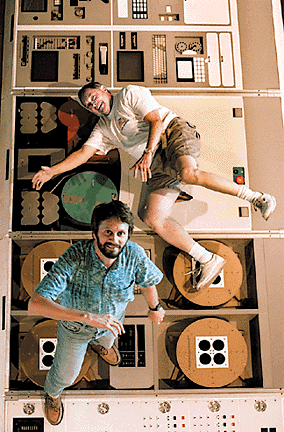
The Habitation Laboratory -- the "hablab" being constructed at Bishop Museum is made of plywood and chipboard, cleverly jiggered together like a puzzle. Al Richmond of Boeing's space-studies program was there to make sure it all went together.
"This module actually combines the functions of two modules on the real station," said Richmond. "Living and Experiments. The exciting stuff. But it's the same size, exactly. Fourteen feet in diameter, 30 feet long, sized to fit inside the space shuttle."

Look down, you're walking on computer keyboards protected by sheets of Plexiglas."There's no 'up' in space," said Richmond. "Every surface is an interchangeable work station."
When completed, the real space station will be about the size of a football field in orbit. You'll be able to see it plainly as it streaks across the sky orbiting the Earth. Something like 16 countries and dozens of aerospace companies are already involved in the project.
When space station astronauts and cosmonauts look down they'll be able to see Hawaii. Part of the exhibition shows spectacular views of the islands from space. "And there are many others on an interactive CD-ROM," said Peter Michaud, the museum's planetarium-ologist.
"The connections between Hawaii and the space program are so plentiful, it was actually harder to decide what to leave out. Hawaii's been integral to space exploration since the early days of Apollo, right to present-day observations made by Keck Observatory on the Big Island."
Another NASA project currently in the works is the Pathfinder low-energy flying wing being tested at Barking Sands. It already has flown successfully at more than 70,000 feet over Hawaii; the goal is to get it up to 100,000 feet, almost 20 miles up, knocking right at the front door of outer space. A quarter-scale radio-controlled model of the Pathfinder is on display.
There's not as much space hardware as you might imagine, although rivet-counters won't be disappointed. In a demonstration gallery in the center of the exhibit, docents will answer questions and perform simple experiments.
And there are allusions and side-trips to other aspects of exploring in Hawaii, from the deep ocean to hidden lava tubes, showing that the processes of all these are interconnected.
Other hands-on activities include remote-driving a rover in a little Martian landscape, with only TV data to guide you. A handy skill to develop.
You could drop the entire Hawaiian Island chain into volcano Olympus Mons on Mars and hear it rattle around. No kidding. Olympus Mons is four times taller than Mauna Kea. Get your Martian driver's learning permit now.
Hawai'i in Space
Dates, times: 9 a.m. to 5 p.m. daily, Saturday to Sept. 7

