Kernels of truth
Makaha learning farm has the
By Susan Kreifels
makings of a sweet harvest
Star-BulletinThe children of Hoa Aina 'O Makaha tread gently upon the land.
The earth, water and living things of this learning farm -- a 5-acre patchwork of color in Makaha Valley -- have become family to the third-graders here to harvest what they have sown. The staple crops are peace, self-sufficiency, love of the land.
"What do we say when we plant the seeds?" asks the soft voice of Gigi Cocquio, his stocky frame and gray-bearded face marking him as a man of the earth.
"Good night, seeds," responds a chorus of 20 voices from Makaha Elementary School.
"How do we walk on the land?" the former priest inquires.
"We walk gently," they answer.
"And what do we say to the land now?" asks Cocquio, his accent still strongly Italian.
"Thank you, land," sing the children, each holding a big bag of the cabbage they planted.
As part of their science program, all 700 Makaha Elementary students come regularly throughout the year to the center, supported by a combination of government funds and private donations.
Every year, another 2,700 students from around the island also reap the bounty of this land. So do countless members of the surrounding community who have learned how to supplement their incomes and sustenance through family gardening, aquaculture and healthy living. The annual open house on May 2 drew 1,300 visitors.
By Kathryn Bender, Star-Bulletin
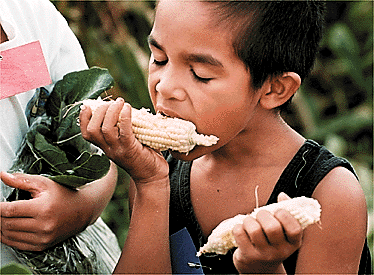
Jonathan Evans devours his corn while another
student clutches Chinese Cabbage
"We try to instill in them an appreciation for the land," said Makaha Elementary science teacher Tami Gandt. "It also builds self-esteem to plant, care for and take things home to the family to eat."
In 1979, Cocquio, then a priest in Waianae, started using the abandoned church land next to the school to work with troubled teen-agers. Eleven years ago the principal of Makaha Elementary asked Cocquio, now the farm manager of the leased land, to develop a school program. In 1992 the U.S. Department of Health and Human Services named it one of the eight best community health-promotion programs in the country.
But Hoa Aina 'O Makaha, which means "friends of the land of Makaha," goes far beyond crops, farm animals and healthy living. The center is bursting with creative ways to master subjects as diverse as foreign languages, merchandising, solar power and the "bee dance."
Beehives are a main attraction for students and visitors, who sit in a cage to watch Roger Furrer, one of five staffers, don protective gear. The honey he collects is sold or made into candy by the students.
The names of states and their main crops identify each garden plot. Streets are labeled in different languages, and staff will start teaching more foreign languages next year. Some grades concentrate on the Hawaiian language, as well as native foods and traditions. A hula group from the center visited Cocquio's home country of Italy last year.
Students also learn how to build businesses. Jonathan Deenik runs the school-to-work program. Sixth-graders over the past years have built a solar house, a carpentry workshop, a hydroponics farm and a store where they sell the products they produce. Herbs are sold to various local restaurants.
To participate in such programs, students fill out applications and take interviews, dressed in their best and speaking correct English. But no one is paid with cash for their work.
"The best pay is to pay us respect and appreciation," said sixth-grade worker TaraMarie Ku'upohaikealohanani Panoke.
By Kathryn Bender, Star-Bulletin
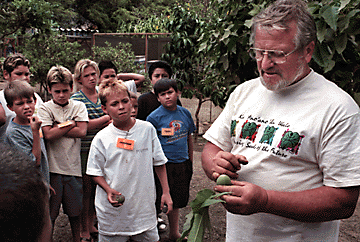
Gigi Cocquio of Hoa Aina 'O Makaha shows Makaha Elementary
fifth-graders at his five-acre learning farm how the outside of a
kukui nut can be used to numb sores in the mouth.
The students are enthusiastic promoters. Third-grader Zoe Wise appoints herself as a guide, showing off the baby goats, the fishponds, the corn crop and the bell that calls students to meals.Cocquio teaches how to cook as well as harvest the crops. The stir-fried cabbage makes those who had turned up their noses at green things now ask for seconds. "That is the beauty of planting our own stuff," Cocquio tells the enthusiastic diners. "Now you know how to cook it."
Makaha Elementary Principal Ed Oshiro says the center has received praise from the community as well as students and teachers. "They think this is something wonderful," Oshiro said.
"The students love it. Gigi has all these ideas. He teaches values and living off the land. If you treat it with respect, the land will produce for you."
Cocquio applies his knowledge of farming to society: Small seeds of learning can reap huge harvests of change. But it takes time. He knows that lesson well.
In the 1970s he served as a priest in the Philippines, organizing the poorest of Manila's slum dwellers. In 1976, threatened by Cocquio's work, then-President Ferdinand Marcos sent soldiers to deport the priest back to Italy.
A decade later, Marcos himself was deposed and forced to leave the Philippines.
Cocquio chose to work in Hawaii partly because of the many Filipinos here. In his 20 years in the Waianae area, he's seen gradual but marked changes.
"Here is where the changes are," Cocquio said, looking at the land and the students. "You plant the seed, but it doesn't grow the following day."