
Saturday, May 9, 1998
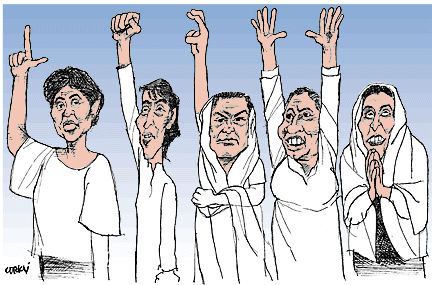
Losing ground
All across Southeast and South Asia, ambitious
Story By Richard Halloran
women leaders were poised to grasp power and
influence in lands where men have always ruled ...
but one by one, they lost their footing on the
rough journey to power in Asian politics
Special to the Star-BulletinIllustration By Corky Trinidad
Star-BulletinAfter beginnings that held great promise, the prominent women who have been political leaders across Southeast and South Asia have been shunted aside or paralyzed over the past year.
From the Philippines to Pakistan, an array of ambitious women had risen to power in lands where politics, the economy and the social order have been the province of men since time began. Despite the Christian, Muslim, Buddhist and Hindu cultures dividing them, these women shared a common political start: They are widows or daughters of powerful men who, with one exception, were deposed by force and were often victims of assassins in the political violence that has marked this region for a half-century.
Thus, these women should not be seen as activists since they did not come up through the ranks but came from prestigious families and have been well-educated, often in the West or in Asian schools influenced by the West. While their prominence helped to open doors for women, the masses of their Asian sisters are only slowly emerging from poverty and have but limited entry into politics.
Neither should these women be seen as surrogates for departed husbands and fathers but rather as partisans willing to engage in the rough-and-tumble of daily politics. Several came to power because no man was their equal when a leader was needed; others allowed themselves to be manipulated into office by men because they had famous names.
Several years ago, the Economist of London asserted that promoting women into high office because of their prominence reflected the ineptitude of the region's political parties, which it called "rotten organizations incapable of producing a real leader." Today, moreover, much of the aura surrounding these women has worn off.
When Filipinos vote on Monday, Congresswoman Imelda Marcos, widow of President Ferdinand Marcos, will have unofficially withdrawn from the race her name had already been printed on the ballots rather than face humiliating defeat. Marcos was a onetime beauty queen who married a political star; as president, he appointed her governor of Manila and a cabinet officer.
President Marcos was ousted in 1986 in a revolt led by Corazon Aquino, widow of a rival, and fled with his wife to Hawaii where he died three years later; Aquino was elected president. Imelda Marcos returned to Manila in 1991 but was sentenced in 1993 to 9 to 12 years in prison for corruption. Out on bail, while appealing her conviction, she hoped to recoup in this election but polls showed she would get only 2 percent of the vote.
In Indonesia, two women have been rallying points for conflicting forces. Siti Hardijanta Rukmana, daughter of President Suharto, has been rumored to be the 76-year-old ruler's choice to succeed him. But she is a symbol of what many Indonesians contend is nepotism and corruption and may become a lightning rod for those who wish to depose Suharto.
On the other side is Megawati Sukarnoputri, the daughter of the late President Sukarno (the suffix "putri" means daughter) who was overthrown by Suharto in 1965 and died in house arrest four years later.
Sukarnoputri emerged from relative obscurity two years ago to criticize Suharto but was soon barred from political activity. She defied the ban recently to blame Suharto for Indonesia's financial crisis but has since remained mostly out of sight.
Things are not looking up for Burma's Nobel Peace Prize winner, Aung San Suu Kyi, now in her ninth year of house arrest ordered by the military junta that prevented her from taking office when her National League for Democracy won the elections of 1990.
Her party has been weakened, many of her followers are in exile, and support from the United States and other nations has faded.
Even so, she told a recent interviewer for the Far Eastern Economic Review: "We will reach our goals. It may take a long time, but we will get there." Suu Kyi is the daughter of Gen. Aung San who was instrumental in winning Burma's independence; he was assassinated six months before independence was declared in 1948.
In Bangladesh, another two women are engaged in a bitter, running battle that appears to have hampered economic progress in that poverty-stricken country. Khaleda Zia, widow of President Ziaur Rahman, was the first woman to become prime minister when she defeated Hasina Wajed in 1991.
Hasina Wajed, daughter of President Mujibur Rahman, turned the tables on Khaleda Zia in the election of 1996. Both Khaleda's husband and Hasina's father were killed by assassins.
India's Sonia Gandhi, Italian-born heir to the Nehru-Gandhi dynasty, met Rajiv Gandhi, son of Prime Minister Indira Gandhi, when they were students at Cambridge in England; they were married in 1968. When Rajiv Gandhi was assassinated by terrorists during a political campaign in 1991, Sonia Gandhi retired from the public eye to raise their two children.
During the ensuing years, however, she was was urged repeatedly to enter politics by members of the Congress Party who sought to use her family name. She finally relented a year ago but was unable to lead the party to a clear-cut victory this winter. In April, however, she became president of the Congress Party.
To the south, Prime Minister Chandrika Kumaratunga of Sri Lanka has been unable to end an ethnic war between the island's Buddhist rulers and Hindu separatists and thus has a precarious hold on power. She is the daughter of Solomon Bandaranaike, who was prime minister when he was assassinated in 1959, and the widow of Vijaya Kumaratunga, an actor and aspiring politician killed in 1988.
In Pakistan, Benazir Bhutto, pushed out of her second term as prime minister in 1996, has been stymied in her striving for a comeback. Her father, Zulfikar Ali Bhutto, was ousted as prime minister in 1977 and later hanged; her husband is in jail for corruption, her brother was murdered several years ago, and she has been estranged from her mother.
The reasons success has escaped these politicians differ country by country but it seems clear that gender had little to do with it. Most have had the same problems as their male compatriots: corruption, an excessive thirst for power, ruthless opponents with guns.
Sonia Gandhi in India may have been the wisest of the lot; until recently, Indian pundits say, she had power because she declined to use it openly. Now that she has entered the visible political arena, she may have stepped on the same slippery slope as her sisters.
Richard Halloran, a former New York Times Asia correspondent,
is a freelance writer based in Hawaii.
