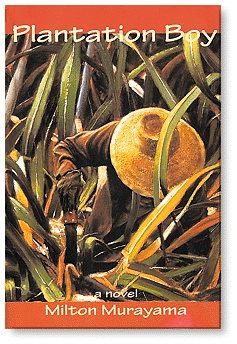
"Plantation Boy" by Milton Murayama,
(University of Hawaii Press)
Milton Murayama reintroduces the Oyama clan in "Plantation Boy," the third novel in a tetralogy. ‘Plantation Boy’
harvest of historyThe first novel, "All I Asking For is My Body," captured the family's early years of life in Hawaii's plantation camps as narrated by third son Kiyoshi. The second, "Five Years on a Rock," was told through the mother Sawa, who reflected on the circumstances that brought her to Hawaii.
This time, oldest brother Toshio whisks us from the early years of World War II through Hawaii's bid for statehood. It's a broad, eventful journey that feels rushed in the telling.
While "All I Asking" painted a vivid portrait of plantation life, pride and prejudice, Toshio's story is dry. Toshio is probably the most abrasive member of the family, given to talking big and lacking in filial piety so important in Asian culture.
When his mother is in need of financial help, he scolds: "Bakatare (stupid)! You and Papa came here as plantation workers and you'll die as plantation workers! You haven't raised yourself one inch! Not once inch! You'll die on the plantation!"
The sameness of Toshio's routines in his single-minded pursuit to become more than a plantation boy gives the novel the feel of a daily log of events that is about as exciting as going to work. Yet this is no doubt the way many of our grandparents lived, sacrificing any sense of fun or individuality for the good of the family.
All the while, so many details of real events are woven into the story that at times it reads like a history book. In the beginning there are tallies of the war dead from Kahana, Maui, where the Oyama clan toils.
Later, Murayama makes note of the Democrat and Republican battle to shape Hawaii's future. Through Toshio, he reports that in 1948, "We're glued to our radio on election night. Kaimuki goes 90 percent Democratic. Democrats win 2/3 or the territorial House and Senate, and nearly half of them are nisei! John Burns loses to Elizabeth Farrington by less than 1,000 votes out of 140,000!"
Whatever Mura-yama's intention, the work rings true to a period in Hawaii's history whose events touch us to this day.
Nadine Kam, Assistant Features Editor.
Send WatDat? questions, stories
or any other story ideas or comments to:
Features, Honolulu Star-Bulletin, P.O. Box 3080,
Honolulu, HI 96802 or send a fax to 523-8509
or E-mail to features@starbulletin.com.
Please include your phone number.