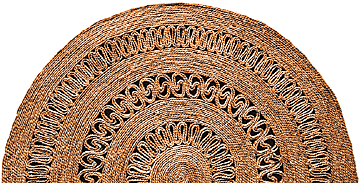
By Dennis Oda, Star-Bulletin A round mat made of maize .
Lauhala mat, above, in different colors and sizes
at the Bamboo Barn in Kakaako.
Mainland designers are
By Burl Burlingame
floored by a look that echoes the
feel of old plantation homes
Star-Bulletin
Photos By Dennis Oda and George F. Lee, Star-Bulletin HAWAII and the mainland have never been quite in sync. Hemlines go up there, fall here; prices go down there, up here. While we're struggling with a recession, it's fat city coast-to-coast. And while Hawaii has used natural-fiber floor coverings for years (to the point where it's kind of dormant at the moment), suddenly mainland designers are discovering the joys of seagrass and sisal."Oh, the catalogs from the mainland all feature area rugs of these materials," said Barbara Coles of Fibre Gallery in Kailua, which supplies such things to professional designers. "Like everything in design, it has bursts of popularity like waves, but natural-fiber coverings are timeless in their appeal."
By Dennis Oda, Star-Bulletin
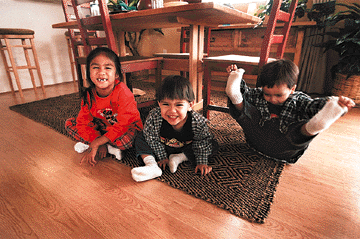
Haeli Barrett, left, Mekenzie Rees and Takota Kaneshiro
pose on the natural fiber mat in a model home their moms
were visiting at the Hoaloha Iki project in Mililani.
What's newly underfoot for mainland designers, as a recent New York Times story rhapsodized, are dense weavings of plant fibers mostly grasses such as seagrass, jute, coir, rush, hemp and sisal. Old hat in Hawaii, particularly for military families who did a tour in the Far East. Such materials still have appeal for those who prefer all-natural decor, or desire a change in floor textures and colors for their area rugs.There is a wide variety in materials. In general, though, these coverings are brownish in color, have a rougher texture than artificial fibers, and are quite porous.
Seagrass is grown in salt-water paddies and is dense and durable, stain-resistant and comfortably smooth underfoot. It's woven, often in Vietnam and the Philippines, into foot-square units which are stitched together by hand.
Sisal (SIGH-sal) is woven from fibers of the aglave sisalana bush, and is also used to make ropes and twines. The fibers can be strong and quite thin and textured, so a kind of prickly rug can be woven from the material. "One thing that's really popular these days are nylon carpets woven and trimmed to resemble sisal coverings," said designer Mary Philpotts of Philpotts & Associates. "That way you get the natural look, but it's more comfortable and flexible."
Jute fiber come from India, and is quite soft when woven, almost like cloth. It doesn't wear well in high-traffic areas. Maize is similar, very light-colored and soft.
Rush fibers are made from reeds, and are similar to jute, except that the pieces are wide. They work better as area mats. It's dark in color.
Coir, made from coconut husks, is the roughest of all so hardy it's generally used as door mats. It's like steel wool. It's not something you want to lie down on, not unless you're a porcupine.
"We represented a lot of it in the 1980s, but it's not so popular today," said Coles, and we're not sure if that means Hawaii is ahead or behind the natural-fiber curve. "What was happening in the '80s was that a lot of architects were using it because it gives a room a kind of warm, oceanic feel."
You can't just get the stuff right off the shelf. As an agricultural product, it can be seasonal. Check with a interior designer with import connections or with a carpeting company to see if it is in stock.
Carpet companies are more likely to carry faux-sisal nylon carpeting that mimics the natural look, but is easier to take care of and fit.
"The look of sisal is very popular right now, but only the look," said Philpotts. "The real thing stains easily, and it's scratchy. There's a whole new generation of solution-dyed nylon carpeting that's trimmed like sisal, that looks neater and is easier to install. And it's stable."
American Carpet One, for example, can get you both real and faux-sisal carpeting in standard carpet-sized sheets 12 feet wide. The real stuff, though, is special-order. Both go for about $2 to $3 a square foot, depending on the level of detail.
"We find that a lot of sisal-style carpeting going to speciality stores and retail spaces that want a particular kind of look," said David Arita, president of American Carpet One. "They're trying to create an atmosphere. But there's very little comfort in real sisal, and it's not easy to take of. You need to Scotch-gard it. There's even a kind of Sisal-Gard available."
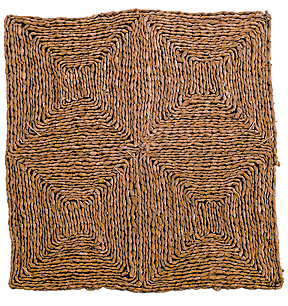
Straw mats like this one are from
seagrass, jute, coir and other fibers.
Floor-covering specialist Siel Matubang of Spectrum Design carries swatch books of natural-fiber matting, and can order the material from industrial sources. "Most of it comes from overseas because of the labor involved. Some actually only make it to order."Despite the greater comfort of nylon, said Matubang, the all-natural construction of seagrass and other mattings have their own appeal.
"It has great resistance to salt air, and will last a good long time if you take care of it," said Matubang. "It's also popular blended with other materials. It's very resistant to insects and bugs. It forms a natural pad under the feet. It's environmentally safe. And if the trend is toward a rustic look, there's nothing like it. You SEE the seams that's part of the charm."
Using area rugs of natural-fiber matting, whether atop wall-to-wall or hardwood floors "creates a nice accent area," said Matubang. "But remember that sisal is very abrasive. Wood needs to be protected from scratching with carpet padding like a light berber-type padding or a rubber-backed scrim. The padding also helps if the matting is atop a bare concrete floor."
Bulk matting is generally available at Bamboo Barn, but they're out right now, said owner Bob Short. "The problem is that the quality of the weaving hasn't been as high as it used to be, and I don't want it in stock unless it's top-notch. And you can't bring it in by the piece. It's so heavy and awkward to move around that you need at least a container-load, and there isn't enough demand right now for that."
Sources include China, Vietnam and Taiwan, and Bamboo Barn's lauhala comes from Western Samoa, Tonga and the Philippines. A "bale" of seagrass matting linked together typically measures 9 by 36 feet, which is folded up like an accordian.
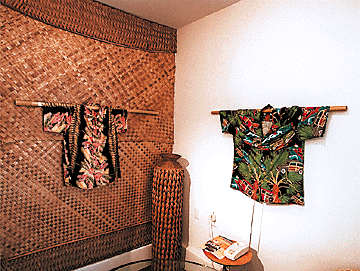
A lauhala mat, inset photo, is used as decorative
wall covering in a Hoaloha Iki model home at Mililani.
"You can tell good-quality matting it's thicker, it's tightly wrapped and braided. Since it's an agricultural product, it's like judging a vegetable or a houseplant. It should be nice and shiny and firm and have good color."One-foot squares of seagrass are $1.50 at Bamboo Barn; one-foot squares of maize or rush are $2.25.
"Sewing it together is an awful lot of work, because the stitching goes through the pieces instead of around them," said Short.
The matting also has to acclimatize to a room, said Coles. "It's best to let it lie there for several weeks before attaching it down, because it'll stretch and shrink from the local humidity before leveling out."
Vacuuming it is about all you can do to take care of it," said Short. "Its not a good idea to get it wet. Even so, a lot of people use it on their lanais. Seagrass will last quite a while, but where it gets wet it'll eventually turn dark and get brittle."
"Coir and sisal simply can't get wet," said Coles.
"It was the sanitation issue that did in a lot of these rugs," said Philpotts. "They're porous, and dirt goes right through. And because it stretches, it will eventually walk up your walls and get irregular. Not to mention flammability issues."
Where Hawaii is definitely ahead of the mainland is in lauhala, the dense matting made from pandanus leaves. "Most of the really fine art pieces of lauhala comes from the Big Island or Maui, but the big mats comes from the Philippines," said Maile Meyer of Native Books and Beautiful Things, which sells "a big, steady pile" of lauhala items.
"I use a beautiful piece in my own living room, right on top of the carpet," said Meyer. "But after three years, it's beginning to unravel around the edges. There's a job waiting to be created for a traveling lauhala repair-person. I guess I'm going to have to learn it myself."