By Kathryn Bender, Star-Bulletin
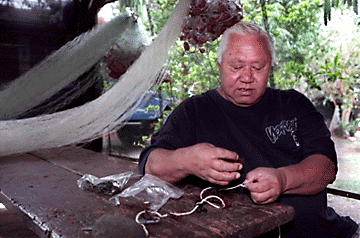
Uncle Walter Kamana, a master ocean gatherer, attaches
limu seed plants to a section of rope to be "planted" in the ocean.
Kamana hopes to bring limu back to waters off Ewa,
where it once thrived.
Ewa Beach celebrates its
By Kekoa Catherine Enomoto
singular relationship with limu
Star-BulletinA 60-year-old po'o lawai'a master ocean gatherer calls Ewa the "mother" of limu manauea. Uncle Walter Kamana of Nanakuli Hawaiian Homestead refers to the coastal area from Barbers Point to Nanakuli as the "father." And, the Maili, Waianae, Makaha and Makua communities are the "daughters and sons."
Kamana is responsible for teaching his two children, three grandchildren, nieces, nephews and neighbors about the ocean just as his grandmother, la'au lapa'au (herb healer) Maude Kau'i Hinawale, and his parents taught him.
"I call Ewa the mother because Ewa was the part of the Hawaiian Islands that grew five different types of limu manauea," said Kamana, who is showcased at this weekend's 'Ewa Beach Limu Festival. "I'm one of the boys who knows, because I had to catch the train past Barbers Point and go up there and pick limu."
Admission is free to the inaugural fest, which features humpback whale activities, a Hawaiian Electric wheel of fortune, state Department of Land & Natural Resources educational activities, ethnic plate lunches and door prizes. University of Hawaii limu maven Isabella Abbott and her graduate students will demonstrate pressed-limu notecards.
Kamana said this month witnesses a wave of limu activity. He and members of his 'ohana for whom limu gathering is a daily ritual have developed a system of replenishing much-needed limu stocks along the Leeward Coast. The month of May is the start of the three-month harvesting season, the middle of the four-month planting period, and the end of the two-month seeding time.
In his shady garage neatly draped with fishing nets, fishing poles and body boards, with roosters crowing in the background Uncle Walter demonstrated the first planting step: He tucked small limu clumps between separated strands of rope. His 'ohana members use rocks to anchor 50- to 100-foot rope lengths interspersed with the limu seedlings along the ocean floor. Or they twist the rope into a circle, like a hair bun; then anchor it with a rock on the ocean bottom, he said.
To seed limu, one finds limu with seeds little reproductive nodes on its surface; tears the limu into pieces; and disperses them in the ocean. To harvest limu, one must gather limu that is neither too young or too old for best flavor, he said.
Kamana a husky, clear-complected, retired fishing boat master born in Nanakuli and raised in Makua said his 'ohana has restocked more than 200 limu types in a basin outside a West Beach reef. He declined to say exactly where, for fear that pickers would over harvest, as has been the story in Ewa.
Kamana envisions teaching to restock, harvest and use limu in the wild as part of the educational curriculum for youngsters who grow up on beaches of the ahupua'a (land divisions) from Ewa to Makua.
But he said two major obstacles militate against the burgeoning of limu as in former times over harvesting, and the pollution from development and harbor dredging.
Although the DLNR enforces a 1 pound per person daily limit on gathering ogo and limu manauea for home consumption, Kamana says some "sneak" and over harvest. He urged wardens to carry weighing scales for better enforcement; however, he says DLNR should issue special permits for increased gathering before occasions such as family luau.
While Ewa is the mother of limu, his own mother, Margaret Kau'i Ching Kamana, who passed away April 24, nurtured his limu knowledge.
"She said, 'Share your ocean mana'o (knowledge) with the people you trust,' " he said. "If you could, better your district or better the Hawaiian people or any nationality of people.
"She had a philosophy," he added. "She said any people that are born in the Hawaiian Islands are Hawaiian. No matter what bad, rough, ugly or discolored she said, 'You help 'em.' So we help one another; I would share my fish, I will share my limu."
'Ewa Beach Limu Festival
Featuring: Food and craft booths, exhibits, entertainment