By George F. Lee, Star-Bulletin
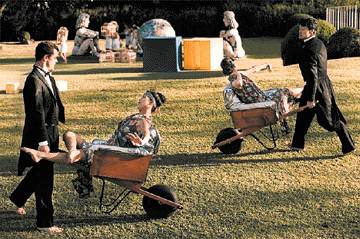
What's going on here? It's obscure, absurd and oh-so
dada -- and part of the newest Dances We Dance show.
Dance group explores the
By Burl Burlingame
absurdist art form
Star-BulletinIf necessity is the mother of invention, then absurdity is the dada of modern art. While the bloody, unceasing horrors of the Western Front created a paradigm shift in 20th-century philosophy, a small art colony in 1916 Zurich protested by creating a new style of art. Called "dada," it lampooned the corporate evils of society while experimenting with new ways of seeing. And you thought the '60s were hip.
Dadaism is the core of "Fish in the Garden," a new Dances We Dance production debuting this weekend. But before we move on to Modern Dance, let's wrap up Modern Art History 101.
"Dada was an attack on the status quo, a lead-in to surrealism and other forms of modern art," explains University of Hawaii art professor Duane Preble. "WWI really triggered it, as it did other
forms such as literature, because the veterans were fed up with what they saw as false values and corruption on all levels of society. They fought back by elevating the absurd, with the transformation of everyday objects."
The dadaists tried to stir up the public with public protests and demonstrations, cabaret sit-ins and poetry readings. Even the word dada was nonsensical, chosen at whim from the dictionary, meaning either (in French) "hobbyhorse," (Slavic) "yes yes" or (African) "tail of a cow."
"Absurd and ambiguous! The essence of dada," said Preble.
Dadaists included Jean Arp, Kurt Schwitters, Marcel Hanco, Max Ernst and -- out there in left field -- Marcel Duchamp.
"While the thunder of guns rolled in the distance, we sang, painted, glued and composed for all our worth," Arp said at the time. "We are creating an art that would heal mankind from the madness of the age."
Dancer Fritz Ludin became fascinated with dada, and the catalytic role it played in modern perception, while touring Europe last year. His Dances We Dance company became the vehicle for integrating dada's nudge-nudge-wink-wink visual iconography in the new "Fish in the Garden."
In collaboration with venues like the garden at the Contemporary Museum (which is actually too contemporary for dada!) and the big lawns at the Academy Art Center at Linekona and Windward Community College, Ludin found a canvas big enough to do the dada.
"We've never been outdoors before -- it's a whole new way of thinking in our staging," said Ludin. "Out among the beautiful trees, and going up and down hills instead of a flat stage -- dada dada dada."
Ludin found five artists to help him integrate dada with -odance: set designer John Koga, costumer Evette Tanouye, and prop designers Ellen Leo, Mari Sakamoto and Suzy Mandel. "They're paying homage to dada, and are inspired by it, not trying to reproduce it," said Ludin. "It's a fun show with social concerns."
Pieces include a dance with life-sized dolls, one with hundreds of pink flamingoes and another where clothes hangars on mobiles are connected to the dancers by elasticized bands.
"I came up with the overall ideas, and then turned it over to the artists for collaboration. I even -- at the last second, I assure you -- cast myself in it."
"I had to go to the library and look up dada," admitted Tanouye. "I was really taken with Ernst and Duchamp. Weird -- anything that kind of makes fun of things. Turns your perceptions inside out."
She sketched her ideas and showed them to Ludin, as did Koga, who's the hammer-and-nail guy for exhibits at the Contemporary Museum. After some intense give-and-take, Ludin basically left them alone with their visions.
"You have to think of the whole setting, using the garden as part of the performance," said Koga. His efforts include a large clock atop a 30-foot pole, fabric-covered boxes that scamper about on their own, a pond floating in the sky with fabric waves inhabited by fish on poles. "You need large-form props when you're working outdoors," said Koga.
Tanouye's costumes include a ballet outfit with a tank top adorned with giant nostrils and lips. "I'm sewing like mad these days," said Tanouye. "Dancers are different than actors. They demand better fit, but the fabric also has to be stretchy so they can move easily."
After this five-performance run, Ludin would love to take "Fish" on the road and perform it like guerrilla theater in "the most unusual places on Earth."
Fish in the Garden
Contemporary Museum garden: 4 p.m. tomorrow and Saturday. Tickets, $12-$15, also good for admission to the museum in May. Call 526-1322.