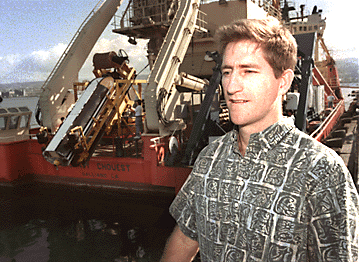
By Ken Ige, Star-Bulletin
Oceanographer Bruce Appelgate heads the UH
team on the hunt for the USS Yorktown
Destination Midway:
UH team leads way
The crew sets out today, seeking
By Gregg K. Kakesako
an aircraft carrier graveyard
Star-BulletinBuoyed by optimism and the prediction of fair seas, a team of University scientists, World War II veterans, Navy salvage operators and an oceanographer-explorer left today in search of a Pacific graveyard containing five aircraft carriers.
After analyzing weather patterns near Midway Atoll, University of Hawaii oceanographer Bruce Appelgate said, "Historically, this is a good time of the year for that part of the world."
"Seas will be from 3 to 6 feet; everything looks good," said Appelgate, director of field operations at UH's Hawaii Mapping Research Group.
The focus of the 1-1/2-month expedition, which will begin tomorrow, is to locate and photograph the five major actors in the most decisive naval Pacific battle of World War II -- the Battle of Midway. It was the last major offensive by the Japanese.
It will be up to Appelgate and his UH crew to survey the ocean floor and chart the exact location of the USS Yorktown and then the four Japanese carriers, located about 150 miles westward.
The Navy then will deploy its remotely operated, tethered, unmanned vehicle with its six-color and black-and-white video cameras to film the exterior of the sunken vessels for the first time in 56 years.
Cmdr. Kurt Sadorf, the Navy officer in charge, said the expedition allows the Navy to test its salvage and recovery technology.
"This will be an opportunity to train at a depth deeper than we normally work at," Sadorf said.
Videotaping and recording the World War II battle site will be Robert Ballard, best known for discovering the Titanic in 1985 in a collaborative effort with the Navy and National Geographic Society.
Fifty-six years ago, on June 4, four Japanese aircraft carriers, then part of the largest task force in the world, launched a strike on Midway, located 1,250 miles west-northwest of Honolulu.
At the same time, three American carriers, located roughly 150 miles to the east, turned their decks into the wind as they prepared to send out their airplanes in search of the Japanese. The Americans had already broken a secret Japanese code and knew the Japanese were planning to strike Midway on June 4, 1942, in hopes of using the atoll as a stepping stone to an invasion of Hawaii.
But warbirds from the Yorktown, Enterprise and Hornet caught Japanese planes on the flight deck of the Akagi, Kaga and Soryu, being rearmed and changing torpedoes for bombs for a second attack on Midway.
Finding no U.S. warships in the area, the Japanese had gambled and lost.
Dive bombers from the Enterprise and the Hornet attacked the Kaga and sank her with four bombs. Yorktown dive bombers went after the Soryu, the flagship of Adm. Isoroku Yamamoto, and sent her to the bottom of the Pacific with three direct hits of 1,000-pound bombs.
Only the Hiryu and the Akagi were left. The Hiryu launched 18 Kate torpedo bombers and 18 Zero fighters against the Yorktown, damaging it with two torpedoes and forcing the American skipper to abandon ship.
The Enterprise and the Hornet retaliated by launching airstrikes against the Hiryu, which they found 150 miles north of the Yorktown. They hit the Hiryu with four bombs, damaging it severely. On June 5, the Akagi was scuttled and the Hiryu was lost.
A salvage operation was started on June 6 to try to keep the Yorktown afloat. Power was supplied by the destroyer USS Hammann, but the Japanese submarine I-168 fired a spread of four torpedoes on the two vessels.
One hit the Hammann, breaking it in two. Two others hit the Yorktown.
Although the Yorktown stayed afloat through the night of June 6, listing badly to port, by 7:01 a.m. the next day the flattop had rolled over and sunk in 3,000 fathoms of water.
Japanese losses in the battle were estimated at 2,500 pilots and sailors, while 307 Americans were killed. Besides the four carriers, the Japanese lost one heavy cruiser and 332 aircraft. America's losses included one carrier, one destroyer and 142 aircraft.
After the University research team retrieves the bullet-shaped MR1 sonar scanner from the Laney Chouest in June, its next mission will be to survey a proposed telecommunications route from Japan to California or one planned for the Bermudas this summer.
It's just part of a routine year for Appelgate, who spends 90 days a year at sea. "Last year, I visited 14 different countries and three different oceans."
For the 18 sailors and 11 civilian crew members of the Navy's deep submergence support vessel Laney Chouest, the next job will be to survey the wrecks of the submarines Scorpion off the Azores and the Thresher, which sank in waters near Connecticut.
And if Ballard is successful, the search for the Yorktown and the four Japanese carriers will become a National Geographic television special next year. Ballard's efforts also will include recollections from Japanese and American survivors of the Midway battle.
The crew
Bruce Appelgate
Age: 35
Todd Erickson
Steven Tottori
Nathan Becker
Karen Sender