

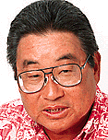
GOLF is about people such as Hope Yee, Jack Omuro and the late Edna Lee Jackola, who were inducted into the Hawaii State Golf Hall of Fame yesterday. Their contributions have made golf the great game that it is. Promoting golf
would mean more greenNow it seems as though local golf needs contributions of a different kind, according to Mark Rolfing, who spoke at the first-ever golf conference sponsored by the Aloha Section PGA prior to the hall of fame luncheon.
Not only a financial contribution in the form of a legislative bill, which asks for $800,000 in state funds to help defray the cost of five nationally televised golf tournaments -- the PGA Grand Slam, the Senior Skins, the Kaanapali Classic and the two new events on the 1999 PGA Tour schedule, the Mercedes Championship and the Sony Open. But also the need for those in the Hawaii golf industry to present a unified front in promoting golf and convincing anyone who will listen -- especially legislators -- that the sport can have a greater economic impact.
"It is something long overdue," Rolfing said.
Part of the problem, Rolfing said, is that most of the golf resorts have been rather proprietary with their data, promoting their own needs rather than looking at the bigger picture. Consequently, it's difficult coming up with quantifiable numbers to make the legislators sit up and take notice.
A Coopers & Lybrand study in 1996 -- in which only 55 percent of the golf courses responded -- showed that golf here generated $327 million. But there was no multiplier factor involved, so the total is pretty much dollar for dollar.
Yet the Department of Business, Economic Development & Tourism estimates that a tourist golfer spends four times more than an average tourist. If an average tourist spends $200 a day, imagine the economic impact if more golfers visited Hawaii, Rolfing said.
"I think it might be a billion dollars, if we can quantify it with some figures," Rolfing said.
He pointed out that South Carolina budgets $1 million a year to golf advertising. And not just Hilton Head Island or Myrtle Beach, two of its more famed destinations. South Carolina even has its own touring pro in Jay Haas.
"For some reason, we don't go out and market golf," Rolfing said. "It's time for us to pool our resources and convince the powers-that-be how big the golf industry is. We're the only major golf destination that doesn't market itself."
Yet without much promotion and fanfare, Hawaii is the No. 1 golf destination in the country, Golf Digest reported in a poll of subscribers.
ROLFING gets revved up when talking about the need for state funding of golf.
"The tournaments we now have are a proven product," he said. "I think it's better to maintain what you already have instead of looking for new events."
Obviously, Rolfing had something to say about the Miss Universe contest, which cost the state $3.3 million to host. He realizes it will have worldwide coverage. But what's the return value in terms of tourism?
"I'm sure the people in Ecuador will be watching and rooting for Miss Ecuador. But I doubt if many from Ecuador will ever visit Hawaii after watching it on television," Rolfing said. "It's not the kind of audience that golf can generate."
Whereas the Miss Universe contest is a one-shot deal, maybe three hours worth on television, the five golf tournaments will get nearly 10 times more exposure, showing Hawaii at its best -- outdoors, not indoors in an arena.
Taking in the economic impact and TV exposure, golf still provides the best buy for the state, according to Rolfing.