Courtesy Red Cross
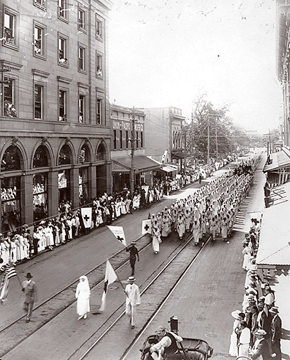
A Red Cross fund-drive parade marches down King Street
on May 6, 1918. The drive raised $677,265 for the war effort.
Red Cross:
‘Always there’
Elizabeth Dole lauds the state
By Lori Tighe
chapter, 'the leader in disaster
service to the Pacific community'
Star-BulletinWhile Princess Kaiulani struggled with America's annexation of Hawaii in 1898, yet another problem landed ashore: the sick and wounded soldiers of the Spanish-American War.
The princess and 300 other women mobilized to feed and care for the shiploads of injured stopping in Honolulu on their way from the Philippines. Taking a cue from Henri Dunant, the Swiss citizen who formed the world's first neutral society called the Red Cross in 1863 to help war victims, the women began the Red Cross Society of Hawaii.
Today with American National Red Cross President Elizabeth Dole in Honolulu, the state chapter commemorates 100 years of Red Cross service. A history that began by caring for soldiers expanded to help victims of tidal waves, volcanic eruptions, hurricanes, floods, fires and major airline disasters. The Hawaii chapter now serves as the lead coordinator for the Pacific islands.
"There are now 3,000 disaster volunteers statewide, 250 trained to respond throughout the Pacific. I applaud the Hawaii state chapter for its excellent preparedness and response to disasters," Dole said. "I know the chapter will continue to be the leader in disaster service to the Pacific community."
Hawaii's geographic isolation has made it more self-reliant than the mainland for disaster recovery, said Russell Fujita, spokesman for the Hawaii state chapter. As a result, Hawaii's Red Cross has evolved over the century to reach a constant state of preparation for the next crisis.
When the Spanish-American War ended, Princess Kaiulani's Red Cross Society dissolved. Then, in 1907 a different disaster struck Hawaii: bubonic plague, cholera and typhoid. To control the fatal diseases, the Hawaiian Red Cross Society came together to help the victims. The society disbanded four years later as danger from the diseases passed.
Once World War I erupted, the Hawaii territory mobilized again to help under the nonpolitical flag of the Red Cross. In 1917 the American Red Cross chapter in Honolulu was born. The Red Cross flag, a gift from Queen Liliuokalani, flew above the capital, Iolani Palace.
"The Red Cross became Hawaii's rallying point for the war relief effort," Fujita said. "They raised money with Red Cross war fund drives. They sewed, knitted and made bandages." The Hawaii chapter also sent its volunteers to help with the world's crises. A group of doctors, nurses and refugee workers went to Siberia in 1919 to set up the first Red Cross Hospital to help thousands of war refugees. Volunteers who went included the editor of the Honolulu Star-Bulletin, Riley Allen. He took 800 refugee children found in the Ural mountains on a three-year journey to reunite them with their parents, according to "Wild Children of the Urals" by Floyd Miller.
Courtesy Red Cross
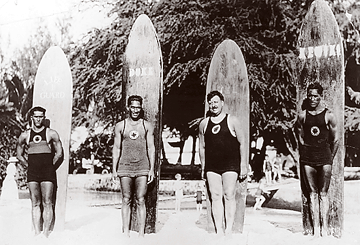
Hawaii's premier waterman and Olympic gold medalist
Duke Kahanamoku, second from left, received lifesaving
training in 1920 from Commodore Wilbert Longfellow,
third from left. Longfellow started the Life Saving Service
of the American Red Cross to prevent the high drowning
death toll from becoming a national tragedy.
One of the state chapter's oldest and most respected volunteers has been Councilman John Henry Felix, who began volunteering in 1938 at age 8."My first introduction was with the Junior Red Cross," Felix said. "The Japanese invaded China, and the Chinese were really hurting for basic needs. We put together ditty bags for the children. It helped to make a difference."
Felix, who has volunteered ever since, became the first American to receive the Red Cross's distinguished medal of honor, the Henri Dunant Medal, from the International Red Cross in 1983. He helped evacuate and care for refugees in Vietnam and China. Felix was recently invited to Cambodia to see if human rights have been restored since the demise of Pol Pot's regime.
"The Red Cross is always there. It's one of the greatest humanitarian organizations ever to be developed in the world," Felix said. "It's been a labor of love. I truly feel privileged to be involved."
The Hawaii chapter became the only American Red Cross chapter in a combat zone when Pearl Harbor was bombed in 1941. Within hours after the attack, the Red Cross evacuated people from the area, transported supplies and helped the wounded. The chapter began feeding people at Iolani Palace. The first day 300 were fed; the next day, 1,000. In 1942, Red Cross volunteers made 2.6 million total dressings, and by the end of 1945, they were producing 1.1 million dressings a month.
After the second World War ended, a devastating 55-foot tsunami crashed into Hilo in 1946. The disaster killed 159 people, injured 163 and left hundreds more homeless from the damage. The Red Cross coordinated relief efforts, including 260 tons of food delivered the next day.
Natural tragedies pockmarking the decades continued to define Red Cross's history in Hawaii, with the slow years filled with first-aid training, safety and emergency preparedness campaigns.
"The main focus today is still caring for wounded, refugees and innocent victims effected by armed conflict," Fujita said. "But our greatest concern is hurricanes, tsunamis and now brush fires because of the drought. In Hilo we opened up shelters four times already this year."
From one disaster to the next, Hawaii's chapter learned how to improve its preparedness, Fujita said.
"The chapter always tried, and tries, to be proactive," he said. "Through the years, we're getting better and better at it."
Heroes, all
Eight local heroes were honored today by American National Red Cross President Elizabeth Dole and the Red Cross Hawaii state chapter.
Care-giver: Caroline Hernandes
"Aunty Carol" opened up her home in May 1997 to a friend diagnosed with pancreatic cancer and his two sons. She provides his meals, does his shopping, makes his doctor's appointments, and does whatever is needed. She cares for two nieces and her brother-in-law. Hernandes also works as manager at Jack in the Box Kapahulu and as a volunteer board member of the Kapahulu Raiders Pop Warner football team.
Good Samaritan: Lydia Hilbert
Lydia Hilbert gives of herself every day, helping friends and volunteering at countless nonprofit organizations. She takes a friend with kidney problems to the doctor, runs his errands, does his shopping, waters his plants and is there for him, just to listen. She has done similar acts for others. When she volunteers she is usually the first to arrive and the last to leave.
Educator: Marcia Miyasato
Marcia Miyasato decided three years ago she wanted to teach her students at Pearl City High School CPR (cardiopulmonary resuscitation). She and a group of teachers took the Red Cross first aid and CPR training. She then helped launch the CPR program in school with the help of the Honolulu Fire Department in February . A third of the school, 725 students, participated. She wants the entire school to be trained by the year 2001.
Peacemaker: Marion Bagley
Marion Bagley left a 37-year marriage filled with physical abuse to begin a new life free of fear. After attending group support meetings, she discovered she connected well with the younger members of the group. She became a volunteer worker at a shelter for abused spouses and their children. She was later hired as a full-time shelter worker.
Lifesaver: Marvin Nuestro
Marvin Nuestro rescued a mother and her two young children March 25, 1997, after they fell from their body boards in the water off Paradise Cove and couldn't swim. When he saw the family in danger, he paddled out on his rescue board to assist. He reached the 8-year-old first, but lost his board in the confusion of rescuing the 10-year-old and her mother. Nuestro wrapped his arms around all three and brought them safely ashore.
Good Samaritan: Darren Sekiguchi
Darren Sekiguchi used his first aid training to rescue an 11-year-old girl hit by a car and thrown 75 feet into a concrete fountain. Sekiguchi moved into action after witnessing the accident Aug. 8, 1997, while on his way to work. He used his shirt to apply direct pressure to the girl's wounds and kept her head above water. He also calmed the girl's father and assisted the paramedics when they arrived.
Public Safety: Bobby Torres
After meeting up with a childhood friend who had become a prisoner, Adult Corrections Officer Sgt. Bobby Torres developed the Student Future Awareness Program. It brings together Hawaii's youth with inmates. The prisoners share their personal experiences and how certain decisions affected their lives. Torres coordinates the program, which took two years to develop.
Animal Rescue: Christin Matsushige
Cat lover Christin Matsushige and a small group of fellow cat lovers opened the Hawaii Cat Foundation two years ago. The foundation aims to be a quality care, volunteer staffed, no-kill shelter for all cats. It advocates a humane approach to reduce and stabilize the cat population in Hawaii. Rescuing cats in distress and danger has become a way of life for Matsushige.
Red Cross in Hawaii
A History of Coordinating Relief -- American Red Cross Hawaii State Chapter:
1898: Hawaii's Red Cross started by 300 women, including Princess Kaiulani, to help Spanish-American War soldiers.