
City asks $8.2 million
to study rail transit
Federal funds will cover
By Gordon Y.K. Pang
$5 million, a city official tells
Council members
Star-BulletinOnce again, the City Council is being asked to fund rail transit.
There will be a lot of public input and a scaled-down proposal which incorporates existing facilities, unlike the 1993 heavy-rail plan that the Council killed.
That's the pitch city Transportation Director Cheryl Soon made to Council members at a Transportation Committee meeting yesterday in urging them to approve $8.2 million for a primary corridor study.
The city has a commitment of $3 million from the federal government for the study, thanks in large part to Sen. Daniel Inouye. An extra $2 million would come from federal sources next year, Soon said, leaving the city's share at $3.2 million.
The study would look at ways to ease traffic on Oahu, but what stands out is the electric trolley system.
Soon said the study would delve into whether there should be a trolley or light transit line running from Pearl City to Moiliili.
City transit officials have identified "a priority corridor where we have built-up ridership" as potential routes.
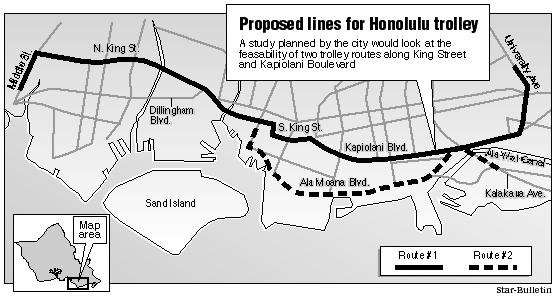
The first route would start at the stadium, connect with King Street in Kalihi, go to Kapiolani Boulevard and head back up University Avenue.The second route would begin downtown and go down Nimitz Highway and Ala Moana and into Waikiki, and turn up Atkinson Drive to wrap around the Hawaii Convention Center.
Soon refused to call the routes the proposals of the administration. "These are potential routes along the identifiable corridor."
Councilman Mufi Hannemann is skeptical. "They've made up their minds, this is the route they're selling to us," Hannemann said. "The administration has to take the posture they're open and flexible, because they know the Council is irritated with them."
Hannemann said he's hoping he is wrong. "The key is how willing they are to let us and the public provide input," he said.
Councilwoman Donna Mercado Kim said Soon painted a contradictory picture.
"It's like they're telling us they're building a big cage for this elephant and then saying we're not sure we want the elephant," she said. " 'We want the people to give us input on what kind of animal to put in it.' "
Kim questioned the need to spend $8.2 million on a study.
Councilman Andy Mirikitani who, like Kim, endorsed the last transit project, said he's pleased to see a plan that involves not only light rail but pushes transit alternatives such as biking and walking.
Councilman Duke Bainum said the plan makes more sense than the heavy-rail project.
"It recognizes the fact that one system won't fix all the problems," he said. "It uses a lot of what we already have. That way we can implement in phases when we have the money to proceed."
Soon said the study would take 10 to 36 months, depending on how much consensus, or disagreement, there is.
The administration, in its construction budget for the year, also wants $3 million for a King Street demonstration project that would have buses simulate a light-rail system to see how effective it might be. About half of that money would come from existing federal funds, Soon said.
Mayor: Japanese teams
By Keith Kosaki
interested in playing here
Star-BulletinMayor Jeremy Harris says his trip to Japan to meet with baseball officials could pay dividends because teams have expressed interest in playing exhibition games here next spring.
However, he declined to identify the teams or say how far along they are with any Hawaii travel plans.
"There's a lot of interest in Hawaii," said Harris, who returned from his seven-day trip earlier this week.
The mayor and city Sports Development Coordinator Sid Fernandez spoke with executives from the Yomiuri Giants, Chunichi Dragons, Nippon Ham Fighters, Fukuoka Daiei Hawks and Yokohama Bay Stars.
They explained to the Japanese teams that the state facility in Kapolei would be available first, and the city's Waiola Sports Complex facility would be built if there's a demand and if a private operator, possibly a ball club or a business enterprise, agrees to run it.
Ground-breaking for the state's Kapolei complex, which will include six baseball diamonds and a 4,000-seat stadium, will be in August. It could be completed by 2000.
The city's project -- which includes four diamonds and a 5,000- to 10,000-seat stadium as part of a proposed 269-acre regional park -- is still in the planning stage and needs City Council approval.
"We need to fill the first facility," Harris said. "The second facility is completely dependent on the first one."
Any exhibition games played next spring would need to be at existing facilities, such as the Aloha or Rainbow stadiums.
Wally Yonamine, the state's special advisor for baseball promotion, was cautious about Harris' optimism.
Yonamine said it will be difficult to have exhibition games here because Japanese managers prefer playing in Japan so players can get acclimated to the cold weather.
But "maybe two, three games might not hurt them that much," said Yonamine, who leaves for Japan today.
Yonamine hopes to meet with all 12 Japanese teams eventually.
He played 11 seasons with the Giants and the Dragons, and spent 38 years as a player and coach in Japanese baseball.
He has scheduled a Sunday meeting with the Giants.
Harris expects to unveil plans for the city baseball complex in June. He also that month will start the search for an organization interested in operating it.
"We're not going to spend the money and hope somebody comes," Harris said.
Harris said he received a lot of input from the teams on building the facility, because the city doesn't "want to put out a proposal they aren't interested in." Harris said. Construction of the city's park could begin as early as July 1999, he added.
As for spring training, Harris said the success of the state's facility will determine if Japanese teams would be willing to spend extended time here.
Yonamine said having spring training in places like Hawaii sometimes serves as a reward for teams with successful seasons.
"If (teams) do win the championship, there's a good chance for them to come over," he said.
