177 people are on the Hawaii
By Helen Altonn
organ-recipient waiting list
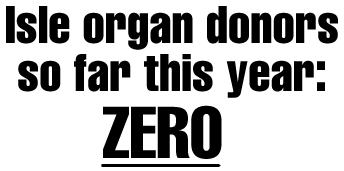
Star-BulletinThe Organ Donor Center of Hawaii so far this year hasn't received a single organ donation -- nothing to help save the lives of Richard Panui, Tony Sagayadoro and about 177 other residents.
"We've had other slow periods before but we're going on the fourth month now," said Judy Swanson, organ procurement transplant coordinator at the Organ Donor Center of Hawaii.
The center has received heart valve, eye and tissue donations, but no organs, said the concerned nurse.
About 165 people are waiting for a kidney and three of them also need pancreas transplants, according to center records. Eleven more are waiting for livers, two for hearts and one for a pancreas.
"As we speak, more could be added," Swanson said.
Panui, a 58-year-old Ewa Beach patient, now is living with an "artificial heart" at St. Francis Medical Center.
He was the first Hawaii resident to receive a "HeartMate" after he was hospitalized Feb. 12 with a severe heart condition.
The father of five remains attached to the blood-pumping device until a heart is donated. Meanwhile, he's started cardiac rehabilitation workouts to prepare for the surgery.
Donor hearts must come from within the state because they must be transplanted within a certain time.
But Hawaii is at the bottom of states in organ donations and 30 percent of all heart transplant candidates die waiting for a donated heart.
Sagayadoro, with the minority Organ Tissue Transplant Education Program, has waited more than two years for a kidney and is trying to encourage minority donations.
His friend, Filipino community leader David Paco, died Jan. 13 after waiting about three years for a kidney.
Bob Yoder's wife, Joan, was lucky. She received the first liver transplant done in Hawaii.
She will celebrate the fifth anniversary of the transplant next month, said Yoder, an officer of the Hawaii chapter of the Transplant Recipients International Organization.
He said a local donor gave the "gift of life" to his wife.
"It's an opportunity to have something good come out of a tragic situation."
The Organ Donor Center last year had a total of 92 donors, including organs, corneas, tissues and heart valves.
There were 18 organ donors -- an increase from the previous year's 13.
Swanson attributes the rise to education and more visibility by center specialists who talk to hospitals, families, schools and others about the program.
The 92 donors contributed 113 corneas and 25 tissues, and the 18 organ donors resulted in 52 transplanted organs, Swanson said.
"There is no way to tell how many people are helped," she said, pointing out that from 40 to 60 people can benefit from one tissue donor and many can receive organs from a single donor.
Of the more than 1,400 hospital referrals to the center last year, only 104 were potential organ donors, those with brain deaths and hearts still beating, Swanson said. Families of 28 refused to donate organs and all but 18 of the others were found medically unsuitable, she said.
The center estimates about eight residents will die annually while waiting for organ donations at the current rate of giving.
"The thing I'm concerned about is people don't think about organ donation until someone suffers a tragedy," said Dr. Livingston Wong, founder and medical director of St. Francis Medical Center's Transplant Institute.
"If a family member dies, they get frustrated or mad when someone then asks them to donate organs," he said. "The wise thing to do is for family members to sit down and talk about organ donations well in advance.
"If they have an understanding that nothing can be done to save their loved one's life and there are out people out there whose lives can be saved, it makes the process much easier."
The center's specialists are trained to talk to grieving families, Swanson said. "It still doesn't make it any easier if the family hasn't talked about it."
Just saying you're an organ donor on your driver's license isn't enough, she emphasized. People must tell family members what they want because the family must make the decision. Most refusals occur because families don't know what their loved ones wanted, she said.
"Until you have accepted your own death, it's difficult to discuss the issue," she added. "It's just not something people want to discuss. . . . I think it will be the youth who change it."
Cultural beliefs also present problems that the center is trying to overcome, Swanson said.
"We want to make sure every family is given the option of donation and no one else makes the decision based on a cultural belief they think may keep these people from wanting to donate.
"People need to see the goodness that comes out of this," she said. "Blind people can get sight and finally see loved ones.
"We get letters from donors saying the only thing that got them through (the loss of a loved one) is knowing the organs helped save someone's life."
To find out more about organ donations, call 599-7630. Neighbor island residents may call 1-800-695-6554.