By Dennis Oda, Star-Bulletin
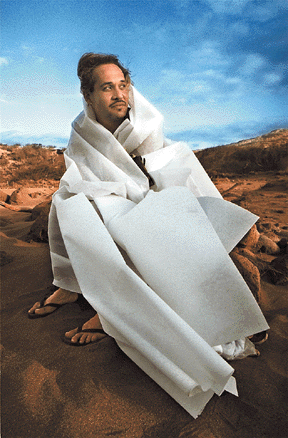
Kumu hula Sonny Ching took his halau to Kahoolawe to
prepare for the Merrie Monarch Festival. Here he has wrapped
himself in white cloth for protection from the wind. The cloth
was later dyed by the red Kahoolawe dirt to be worn
by dancers at the festival.

For the past two weeks, members of a Kalihi halau have been going without alcohol, raw sugar, squid, some kinds of fish -- and sex.
"Those are the kapu that we place ourselves under and this stems from ancient times," says William Kahakuleilehua "Sonny" Ching, kumu hula of the 400-member Halau Na Mamo O Pu'uanahulu. "We believe that in order to accomplish something, you have to sacrifice."
Ching's halau hula is among 21 from across the state and California dancing at this weekend's 35th annual Merrie Monarch Festival -- touted as the Olympics of hula. The three-day event starts tonight with the Miss Aloha Hula solo competition in Hilo's Edith Kanaka'ole Tennis Stadium.
Ching brings 41 dancers to chant and dance in tomorrow's hula kahiko (traditional) group competition; then participate in Saturday's hula 'auana (modern) group finale.
"We always impose a kapu upon ourselves for a few weeks before we go into competition," says Ching, who to ready his dancers for a contest replicates the strict, celibate life of hula trainees in ancient Hawaii. "We abstain from sex, from alcohol, from certain types of foods, like squid. We stop eating sugarcane and lipe'epe'e type seaweeds."
"Basically those things were from tradition," he says as he chain-smokes and chain-sips coffee in the comfortable living-dining room of his Kapahulu home. The room is dominated by a large framed photo of his late grandmother and mentor, kumu hula Lena Pua'ainahau Eleakala Nahulu Guerrero.
"But a lot of it is a play on words -- like he'e means squid, but it also means to slip and slide. So we believe you don't eat that kind of food when you're in training, because then the knowledge you've learned will slip away from you.
"It's not only with hula, it's with anything you do," he says of the symbolic gestures. "You're always sacrificing to achieve something else. It's just one of the sacrifices we make so that we're physically ready, mentally ready and spiritually ready.
"It's the same thing with lipe'epe'e seaweed. Pe'e is to hide and this has the word twice. And so once again, you don't eat that" -- here one can hear his grandmother saying these same words to him as a young dancer -- "because the knowledge that you've learned will be hidden from you."
Ching's competition dancers have gone from weekly practices, to two or three practices per week as the Merrie Monarch neared, to daily practices for the past week and a half.
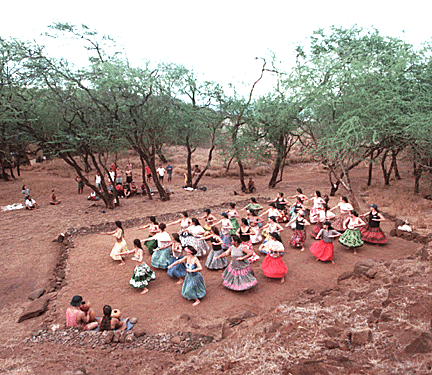
"The way that we run our classes is based on the traditional way that classes are run," he says. "The haumana (students) come, but they don't just get to walk in. They need to mele kahea -- call to seek to come in."Once they enter they are quiet. They put their belongings into shelves and lockers. They line up and start stretching the body to the beat of the ipu (gourd drum).
"We say a prayer, followed by the stretching of arms, a vocal warm-up, then we do the hula creed. Then, they're ready to start class. All that takes them 40 to 45 minutes before we even start dancing."
Journey to Kahoolawe
Although Ching says Merrie Monarch training didn't start until January, he began back in August, when he traveled for the first time to the island of Kahoolawe. There the 36-year-old kumu hula camped, toured and absorbed the island's spirits and muses. The experience inspired him to compose an 'oli (chant), which the women dancers will present during their kahiko performance.The chant flows "like a ka'apuni -- a journey around the island," he says. Verses go back and forth from sea to inland until the chanter completely circles the isle. The eight-verse chant and its strenuous choreography require speed and endurance, so at first the dancers concentrated on fundamentals and conditioning.
"For the entire month of January all they did was basics," Ching says. "They'd come three times a week and do basics for three hours. But actually they needed that, because our kahiko dance is so strong and it's long. They needed that stamina, because they chant and dance at the same time. The chant is so long that by the third verse they were dying. It's much faster, much stronger than usual."
Just as the kumu had to experience Kahoolawe to compose the mele (song), the students needed to make a pilgrimage before they could bring life to the powerful chant and fluid choreography.
"It's been the hardest preparation for us in so many ways, because dance-wise at the beginning they just weren't getting it," Ching notes. But after Kahoolawe, "It was incredible the difference from the Saturday when we left Kahoolawe. The first practice back was on Monday; the moment the girls opened their mouth, all of us kind of looked at each other and it was like wow, and you could just see it in their faces.
"So, even though technically we're still not ready -- we could be cleaner, smoother, more precise -- I always say, 'Make your dance live.' It's senseless to dance motions and feet. You need to gain mastery over the dance, so you are able to bring these things back to life -- which builds your personal mana, which builds the mana of the group.
"That may have been a problem (before) because we were just lacking mana," he says, emphasizing the word lacking. "That's not a problem any longer."
Ching says Kahoolawe gifted the group with stronger bonds and trust.
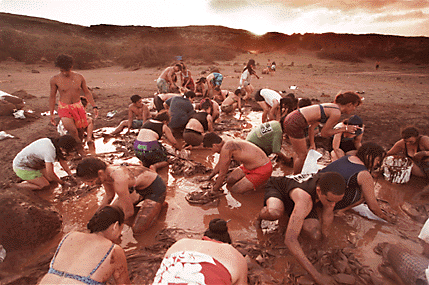
"I was trying to force something to happen, which is totally unnecessary when you go to Kahoolawe," Ching recalls. "So I just stepped back and let it happen for my students, and it was beautiful to see."There's always been a bond between everyone, but I guess the bond was weak and invisible. There you could see it getting stronger and visible, you could see it between each person.
"You cannot go there without trust -- without knowing you can depend on someone to help you, to care for you -- because you cannot survive without each other. It was just incredible to see all of these things manifesting themselves in their actions and activities.
"That was good for me. Then it eased all of this worry and concern. All of these things I wanted to happen on Kahoolawe -- I didn't need to mold or force through or channel."
Lessons learned
At an evening practice at Kaumakapili Church last week, the women lined up on a porch area. The chilly night blew drizzling rain intermittently. The dancers repeated each section over and over -- "1 and 2 and 3 and 4" -- to synchronize the hand placements and movements.Ching emerged from the church hall every 20 minutes to smoke a cigarette and check the women's progress. "Pili, arms like this. Lift your head," he said sternly, then retreated to the hall; inside he put the men through their chants and paces.
Later the kumu choreographed the entrance of the women's 'auana number, on the spot. Many last-minute costume details remained, but the group already had negotiated the most difficult hurdles on Kahoolawe -- of understanding the 'oli, of bonding as dancers, of climbing Pu'u Moa'ulaiki, where they had seen forever.
"There was a navigational school," Ching's golden eyes refocused on the peak.
"The view is incredible. At this point you can see Maui, Molokai, Lanai, the Big Island and the ocean beyond that. Actually you can see seven of the eight seas that surround our islands. While we were there the winds had died down. There was also a lele, or altar, where they made offerings to (the god) Lono at Makahiki (season)."
The moving experience gave Ching and his dancers a clear vision of the real lessons of Merrie Monarch.
"Normally I would feel stressed about this," Ching said, "but I just know everything will be there. We'll have our costumes and everything we need. It'll be OK."
Power of the kapu
For this year, the preparation was about an island and bonding and trust and vision -- just as in Halau Na Mamo O Pu'uanahulu's first year at Merrie Monarch, the lessons had been about the kapu. Ching remembered that in 1994 the men danced perfectly and did not place, while the women did not perform up to par but swept overall honors.After the halau returned to Honolulu, a dancer called Ching to admit that he had broken the kapu on sex.
"We came home and I got a call from one of them, crying on the telephone, and he was telling me what they had done. And I just said, 'OK, now I know,' " he chuckled at the memory.
"He definitely learned a big lesson, because he's been to every Merrie Monarch since then," the kumu said.
"It just shows the power of these things."