By Craig T. Kojima, Star-Bulletin
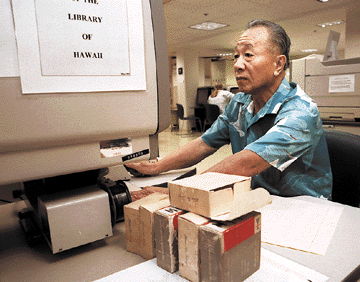
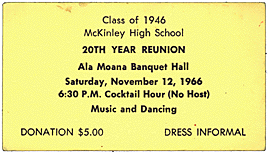
Herbert Murayama, above, tracks high school classmates
at the state library. Below, a memento from McKinley's
Class of '46 20th-year reunion.
Herbert Murayama has been
tracking long-lost high school friends for
renewal of old ties, yet in school he was
the guy least likely to be...
First Class Sleuth (’46)
Stories By Nadine Kam
Assistant Features Editor
Star-BulletinHIGH school graduates learn quickly that their classmates disappear after graduation day. That's why reunions were invented. They offer a chance to come clean with unrequited crushes, renew old friendships, compare life stories, and match expectations with outcomes, all in the guise of a frilly social event -- that is, if you can find everyone.
The Internet has made it somewhat easier to stay in touch, but such technology was unavailable to McKinley High School's Class of '46 when they marched to "Pomp and Circumstance." To this day, they've managed to stay in touch the old-fashion way, through phone calls and letters. But they've also had a secret weapon in Herbert Murayama, a spunky, retired soft-drink salesman with a passion for ballroom dancing, and, as his classmates have discovered, the heart of a detective.
With the tenacity of a Chang Apana or Sherlock Holmes, he tracks the movements of some 660 individuals, out of a graduating class of 840. He uses a combination of newspaper obituaries, city directories and the good old phone book to find, if not the person he's looking for, at least the close relatives who might provide leads to classmates' whereabouts.
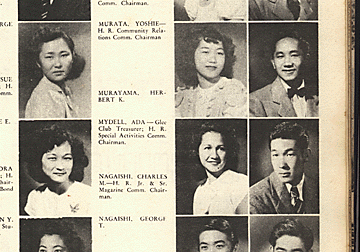
McKinley Class of '46 yearbook
Herbert Murayama is shown at upper right. Jean Muraoka, who
he's still on the lookout for, is pictured in the bottom left corner.
Murayama estimates that he has found about 300 people in 30 years but there are about 82 more on his missing list and he pursues them with more diligence than he ever spent on homework."I felt this was my project," he said, "to find all my classmates."
When Murayama first started working on his master list, he did a lot of phone book searches. He said it was easier in the past because there were fewer names than today. Even so, he said he's saving the Wongs, Lees and Chings for last, finding the legion of these surname sharers intimidating.
At first, Murayama would call prospects, who were often leery of the stranger who said he had been looking for them.
"On the phone, people are hesitant to talk. Now, I go to their house. If I knock at the door, they're still kind of afraid, but I carry a yearbook with me. I show them 'This is me, and this is you, and try to explain what I'm doing."
He spends three to six hours a day, about three or four days a week in the process.
Part of the reason for Murayama's diligent record-keeping is due to an error made early on, when he added one individual to a list of the deceased. The "dead" person later called to say, "I'm still alive!"
"I thought, how embarrassing," Murayama said. "From then on I check each one, I go to the graveyard and check the headstone to make sure the deceased is there."
He's had trouble verifying information when gravestones were marked in Chinese characters only, or in one incident when a classmate was known by an alias that didn't match the real name on his gravestone.
Although most classes have trouble locating women because of name changes made after marrying, Murayama said it was more difficult to locate many of the men in his class.
"A lot died in the Korean War and those who came back went to college on the mainland on the G.I. Bill, and they never came back.
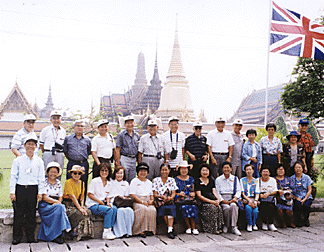
Courtesy Edmund Leong
Some of the Class of '46 reunited in Bangkok in 1996.
Those looking for lost or hidden souls can start their search at the main branch of the Hawaii State Library system for information that is part of the public record. Library a good place
to start your searchHerbert Murayama, who has found about 300 people for his class reunion list, said, "When I started I didn't know where to start. I didn't ask for help. I just browsed."
He can often be found searching the microfiche, along with others who are usually researching their genealogy.
The Internet provides an easy way to search. Look for high school home pages or check out Reunion Hall at http://www.nowandthen.com/reunion/ or Switchboard at http://www3.switchboard.com for a list of public phone numbers in the United States and Canada. You can even use the site to send a card or flowers to the person you found.
The non-wired can start with the low-tech system Murayama has worked out.
1. Start with the phone book. If person you're looking for isn't listed, chances are, in this family-oriented state, you'll find someone who knows the individual or the right family. Call at reasonable hours and speak clearly and calmly to avoid scaring or angering anyone.
2. City directory, available in the Hawaii & Pacific section of the library. Lists phone numbers, addresses, and sometimes, work places of individuals.
3. Newspaper obituaries. These may list the person you're trying to find as a son, daughter or relative of the deceased.
4. An index to the Honolulu Star-Bulletin and Honolulu Advertiser, topic "Death," is available in the Hawaii & Pacific section of the library. You'll have to write down the names of the deceased who share a surname with the person you're trying to find.
When you've completed your list, head to:
5. The microfiche room, basement of the library. You'll have to look up each of the obituaries you made note of above. One might list the person you're trying to find as a son, daughter or relative of the deceased.
6. Armed with the names of possible relatives, go back to step 1 and call those individuals for more leads.
That's why Murayama goes through obituaries, making lists of any possible relatives. Once he's found the right family, he keeps track of members by writing names, addresses and phone numbers on index cards so he always has someone to call when a classmate moves. About a fourth of the individuals he finds are interested in keeping up with the classmates.
Murayama's method has become somewhat legendary among McKinley alumni, and once in a while, another class will ask him for lessons in finding people.
"I tell them you can't do it in six months. It's taken me 30 years," he said. "Anybody can do it. The only thing is you have to know where to look and have a lot of patience.
As for his current quarry, reunion committee member Ernest Uyetake put the sleuth on the trail of Jean Muraoka, originally from Makaweli on Kauai, who up until 10 years ago worked at Straub.
Uyetake said, "We were talking about her and then we realized how popular she was in school. All these guys were chasing her and here I was, on this committee and I was dating her. She was my prom date and I can't find her."
Murayama says he may very well go to Kauai to search for Muraoka. He absorbs all the costs of research -- travel, long-distance phone calls and photo-copying -- for the sake of the class.
If it took this long for Murayama's detective skills to surface, well, that's what time does. "There were more changes than labels that stuck," Uyetake said.
Casanovas became respectable. The intimidating Ume Gang, a name bestowed on an elite clique of girls, became approachable.
"Most of that group became teachers. We were the guys in the back of the room," Uyetake said. "They were the girls too smart to talk to. Now they're quite active in our reunions."
Note to Jean Muraoka: If you read this,
please call the reunion committee.http://starbulletin.com/doit/reunions.html