Associated Press
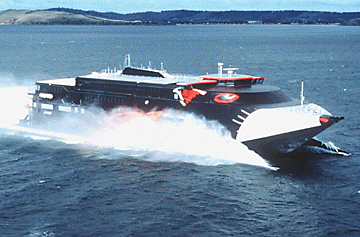
Next month, Incat Australia plans to demonstrate
its wave-piercing catamaran design, like the ferryboat
Devil Cat pictured here, to the Pentagon to show its
usefulness as a high-speed ocean transport.
Cats coming
Australian catamarans dominate the
By Rohan Sullivan
world market for fast, large ferries—
and now they're aiming for U.S. shores
Associated PressHOBART, Australia -- As a small-time ferryboat operator, Bob Clifford got his big break two decades ago when the only bridge over the river dividing his hometown collapsed after being hit by a freight ship, spurring demand for his service.
Now he's talking with high-level U.S. defense officials about how they could use the giant, high-speed mass-transport ferries he helped pioneer to carry soldiers, tanks and helicopter gun ships into the 21st century's military hot spots.
Clifford's International Catamarans Pty. Ltd. is one of three Australian companies leading the world in developing technology that is quietly transforming the way people and cargo are moved on the high seas.
Incat's ferryboats are unmistakable. Unlike conventional mono-hulled boats, they are catamarans, with sharply pointed hulls called "wave-piercing" because they cut through waves, rather than float on them.
Lightweight welded aluminum, the ships can travel at up to 50 knots (58 mph) -- some three times faster than conventional ships -- without the pitch, roll and heave normally associated with sea travel.
With similar designs by Australian competitors Austal Ships Pty. Ltd. and Wavemaster International Pty. Ltd., the ships are revolutionizing the market for ferries designed for short trips with cars and passengers. Incat alone claims 40 percent of the world market in high-speed ferryboats.
Australian ships currently ply waters in northern Europe, the Mediterranean, South America and Asia. The biggest of Incat's current boats can carry 900 people and 240 cars, driven aboard in the same way as into a car parking station.
The ship makers have their eye on other prizes.
Incat vessel was tried here
By Jerry Tune
Star-BulletinHawaii commuters from Leeward Oahu rode on a "wave piercer" catamaran in 1992 when the ferry service from Barbers Point Harbor to Pier 8 at Aloha Tower was operational.
However, for a variety of reasons that ferry service didn't survive. Inadequate transit linkups with Barber's Point Harbor, and the $3 fare each way, were part of the problem.
Hawaii Ocean Transit Systems had a 20-year contract to operate the 121-foot-long "wave piercer" but suspended operations in December 1992.
Executives were hoping that mid-day cruises at $25 to $35 an hour would help offset the lower prices for the ferry service. But they found that residents and tourists were taking "joyrides" using the $3 commuter fare instead of the mid-day cruises.
Nichols Brothers Boatbuilders of Whidbey Island, Wash., built the catamaran used in Hawaii, under a license agreement with International Catamarans Pty. Ltd.
The Hawaii catamaran is the same basic design as the 300-foot-long "Devil Cat" vessel built by International Catamarans in Tasmania, said Brian Nichols, vice president and marketing manager for Nichols Brothers.
He said the difference between the two catamarans is size, a new ride control system and different engine for the Devil Cat.
"The freight market and the military market show a lot of potential," said Clifford, a former fisherman and high-school dropout.
In October 1997, U.S. Transportation Command called the world's leading fast ship manufacturers to Washington for a workshop jointly sponsored by the U.S. Navy and Army.
The defense forces have identified more rapid deployment as one of the challenges for the next century. High speed ferries may be a solution. The Pentagon has allocated $20 million to examine the technology, an Australian delegate to the workshop said.
What the Army would need is a fleet of up to 60 ships that could carry 2,000 to 10,000 metric tons at speeds up to 100 knots for up to 10,000 nautical miles.
"If they ask for it, we could deliver a prototype inside two years," at a cost of about $100 million, Clifford said.
In May, Clifford will demonstrate his $30 million, 300 foot "Devil Cat" to defense officials off the East Coast of the United States as it is delivered to its Canadian buyer.
Austal chairman John Rothwell is "less bullish than Bob," and said the U.S. talks were "first-round stuff." He said the Pentagon is more likely to adopt Australian-developed technology than buy its ships, although there is potential for joint ventures.
Freight is his target, particular in Asia. He said fast ships can compete with air freight on trips of less than 600 nautical miles, delivering perishables and expensive goods at one third the cost.
For the past 20 years Clifford has been refining his catamaran design. In the process tripling his business revenues in the past five years to $77 million.
"I believe these type of ships are the way of the future and the rest of the world is slowly coming to that realization," Clifford said.