Society for Hawaiian Archaeology
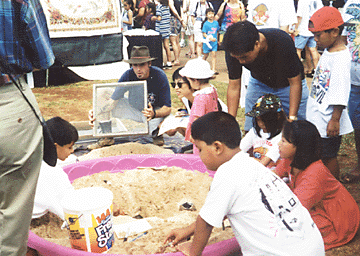
An archaeologist shows kids how to sift for artifacts at a
sandbox "dig" during a Bishop Museum Family Sunday
exhibit for Archaeology Week.
Archaeologists do more than
Dig for history
By Burl Burlingame
Star-BulletinWHAT gets bigger the more you take away from it? Archaeologists know it's a hole in the ground. But archaeologists do more to learn about the past than digging. They also scour archives and sort through oral traditions to get a sense of past life. While the careers of high-born chiefs are remembered, the daily details of the average Hawaiian's life in pre-contact days are known only through the work of archaeologists.
You can learn more about archaeology in Hawaii through Saturday during this year's Archaeology Week. According to information from the Department of Land and Natural Resources, the science of studying the past has become important to modern Hawaii. More than 6,000 reports have been written about archaeological research in the islands, and more than 95 percent of these have been composed in the last couple of decades, largely in response to federal and state historic preservation regulations.
Ironically, the state is currently preparing to lay off most of the archaeologists in the Historic Preservation Division.
"One of the reasons that Archaeology Week was created was because of criticisms from the Hawaiian community," said DLNR State Parks public-interpretation specialist Martha Yent, who has chaired the event for several years. "We were hearing that 'You guys do all this digging but we never hear about what you find or why you do it.' So Archaeology Week was created as a kind of outreach program, so people could find out what archaeology is, how it's done, and why we're required to do it."
This year the Department of Education has gotten involved, developing curricula to use with the events, such as a student "dig" on Kauai, a kind demonstration excavation. There's also a public-archaeological dig going on in Kahana Valley State Park.
"A lot of what's important about archaeology is simple resources-management," said Yent. "You need to know everything possible about an area, and that includes its past history. In parks we like to know everything that's under the ground as well as what's on top of it, because we have to explain to citizens what's important and special about that site.
"What if it's discovered there's an irreplaceable historical site there during the initial archaeological survey? That's why a lot of federal and state preservation regulations demand archaeological surveys, and that's why so many precious sites have been discovered and preserved over the last few decades."
In the past 15 years or so, lava flows in Puna destroyed more than 15,000 archaeological sites, according to DLNR statistics.
Yent doesn't know exactly what will happen when the government archaeologists are let go, but imagines there might be "a slowing down of the process."
Why does archaeology matter? "We're preserving the past for the future -- it sound like a cliche, but it's true," said Yent. "If you understand the past, it's easier to plan for the future, to not make the same mistakes."
As a Society for Hawaiian Archaeology flyer puts it, "No single site can tell more than a sliver of Hawai'i's history, yet each has a story to tell. In recent decades much archaeological research in Hawai'i has focused on sites threatened by economic development. A few sites have been saved intact and other have yielded information before being bulldozed. Many, however, have made way for buildings, fairways and pavement, leaving little or no record of having existed. Each site is unique, and when it is destroyed, its story is gone forever."
Oahu Archaeology Week events include lectures and field trips, many through the cooperation of parks, museums, historical societies and universities. Field trips may be limited to 15 to 20 people, so make reservations at 587-0014, and wear appropriate clothing, shoes, sunscreen and mosquito repellent. Observance opens
doors on the pastEvents include:
"Applying New Technologies to Understanding the Archaeology of Settlement and Agriculture in the Kohala District of Hawai'i," a lecture by Michael Graves, and "Adze-Makers and Birdhunters: Archaeology on the Big Island Saddle," a lecture by James Bayman, 7 p.m. tomorrow at Atherton Halau, Bishop Museum.