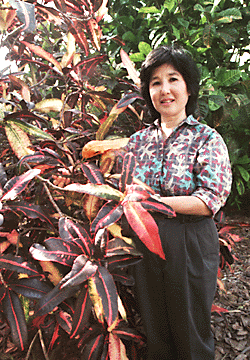

By Dennis Oda, Star-Bulletin
Botanist Winnie Singeo maintains that croton, which for some
reason has gone out of style, is good home-garden material.
THERE'S something very reassuring about Wahiawa. It doesn't change. You can drive down California Avenue, and it looks pretty much the same as it did 20 years ago. That's why tomorrow's Old Fashioned Plant Sale and Country Fair belongs in Wahiawa. It will be held at the Wahiawa Botanical Garden 9 a.m. until 2 p.m., and will feature the sale of heritage plants, those old favorites we remember from gardens of the past. Match foliage to your space
Plants must be chosen to fit your garden
and your gardening styleNot only will you be able to shop for plants -- and there will also be a selection of newer introductions -- but you can pick up dinner at the same time. There will be farm fresh vegetables and fruit from Helemano Plantation, barbecued chickens, shave ice and baked goods for sale.
Three 30-minute classes will be offered on the theme of "Get It Right the First Time," encouraging gardeners to choose the right plant materials for their gardens, and to plant them in the proper place. At 9 a.m. Winnie Singeo will discuss proper plant selection for the home garden, at 10 a.m. Frank Sekiya will help you choose the right fruit tree for your area, and at 12:30 p.m. Alvin Tsuruda will talk about anthuriums.
Wahiawa Botanical Garden's Old Fashioned Plant Sale and Country Fair: 9 a.m. to 2 p.m. tomorrow, 1396 California Ave., Wahiawa. Call 621-7321Singeo, a botanist on the staff of the Honolulu Botanical Gardens, actually promises to discourage people from buying some of the plants in the sale. It's a matter of size, she says.
"My next door neighbor bought a tiny banyan plant at a sale and planted outside her bedroom. It got bigger and bigger and bigger. She tried to keep it pruned back, but banyans are very aggressive. She finally had to have it taken out."
Unless you are familiar with them, it is difficult to judge the growth potential of plants sold in gallon cans at sales. They aren't like puppies with big feet that indicate a lot of dog later on. A nice little 10-inch banyan tree is capable of uprooting your lanai, given enough time.
"Be careful of the word 'dwarf' when it refers to plants," Singeo warned. "It's all relative. If you are talking about an 80-foot tree, a 40-foot variety could be called dwarf. I had a dwarf crape myrtle that I pulled out after I learned that a crape myrtle can grow to 50 feet, and my yard is 5,000 square feet. You have to think about these things before you plant."
The first thing to consider when choosing plant material, she said, is what you want it for. If you want to screen your yard from the neighbors or if you want to block out an uninspiring view, you don't need heavy plant material in a solid mass. You just need something to partly mask what you want to hide. If, however, you want to block out the sound of heavy traffic or other persistent noises, you will need a thick hedge.
Are you looking for an accent plant as a focus in your garden or a ground cover or something to grow indoors? Ask the vendors. They are experts in what they grow, and they want the plant they sell you to thrive. Then you'll tell a friend, and you'll go back and buy more.
"They are particularly helpful in knowing where their plants will grow," Singeo said. "There are plants that belong at sea level and others that belong in the wet valleys, there are some that will grow in sand and others that will grow in clay soils. You don't want the wrong plant in the wrong place."
You should also find out if the plant you have chosen will stay put and not stray. Certain bamboo, ginger and heliconia varieties have a serious wanderlust. Their root system is likely to sprout new plants in places where you don't want them, and pulling them out is tough work.
"Consider maintenance," Singeo said. "Do you like to spend weekends working in your garden, or would you rather be doing something else? If so, look for plants that don't require a lot of pruning and weeding and watering.
"If you have children or pets, safety is a concern. Stay away from the cycads with their sharp pointed leaves and their poisonous seeds. This morning, one of our propagators was cleaning a cycad and got poked in the eye by a leaf. The doctor said he didn't damage his eye, but he might have, and it was very painful."
She also advised against plants with thorns in gardens where young children play, and plants with poisonous sap.
What's good to add to your garden?
A lot of things that the fickle finger of fashion has lately overlooked. "Croton," Singeo said. "It is easy to propagate, easy to grow, is colorful and has several different leaf forms. It is easy to keep pruned either as a hedge or a specimen plant, but for some reason croton went out of style and people quit planting it. It is good garden material."
Spider lilies are also the pedal pushers of contemporary gardens. But in the right place -- they take a fair amount of space -- they are attractive and low maintenance.
"For small urban lots, the best advice is to find plants that are slow-growing," Singeo concluded. "That way, you can keep up with them. If they begin to get too big, they can be cut back. The exception, though, is a ground cover. You want that to go as fast as it can because you want it to cover and to hold the soil. I like akia for sunny areas, and chlorophytum (bracket plant) with striped yellow and white bands on the leaves."
Wahiawa Botanical Garden is one of the city's five botanical gardens, managed by the Department of Parks and Recreation. The garden is open 9 a.m. to 4 p.m. daily, and admission is free. It is particularly known for its tree ferns, native Hawaiian flora and its spectacular Mindinao gum tree with its smooth bark striped in red, orange, brown and purple. Don't miss it.
Gardening Calendar in Do It Electric!
Send queries along with name and phone number to:
Evergreen by Lois Taylor, Honolulu Star-Bulletin, P.O. Box 3080, Honolulu 96802.
Or send e-mail to features@starbulletin.com.
Please be sure to include a phone number.
Evergreen by Lois Taylor is a regular Friday feature of the
Honolulu Star-Bulletin. © 1996 All rights reserved.