Keep service, but
dump ‘junk,’
—residents
A poll finds a majority
By Pat Omandam
disapprove of funds for the
Miss Universe pageant
Star-BulletinDespite a stagnant economy, Rosie Rees of Kailua-Kona believes basic public services such as state libraries should be open seven days a week so more people can use them. To her, that means cutting nonessentials like the $3.3 million for Hawaii to host the 1998 Miss Universe Pageant.
"They spend money on all this other crap, and where they really need it is in the education area, the library system, these kinds of things," said Rees, 60, a homemaker and coffee farmer who responded to a recent Honolulu Star-Bulletin/NBC Hawaii News 8 Poll.
"All this other junk is superficial, as far as I'm concerned," she said.
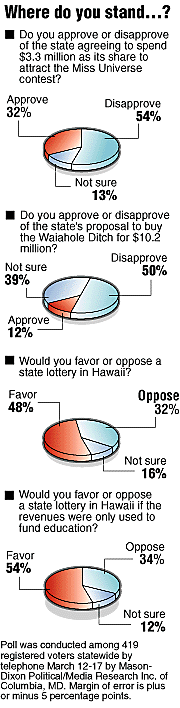
The poll shows 54 percent disapproved with state plans to spend $3.3 million to host the May pageant, while 32 percent favored the idea. The rest were not sure about the idea.
Mason-Dixon Political/Media Research Inc. of Columbia, Md., interviewed 419 registered Hawaii voters in a telephone poll conducted March 12-17. The margin for error is plus or minus 5 percentage points.
Half of those polled also rejected the state's plan to spend $10.2 million to buy the controversial Waiahole Ditch system, while only 12 percent approved of it. A substantial 39 percent were uncertain about the water issue. Waiahole Ditch
Although the ditch purchase would be made with special revenue bonds paid off through water fees, opposition flowed highest among Hawaiians, followed by those of Japanese ancestry.
The state Legislature is considering bills for emergency funding of the pageant and of the ditch.
Poll respondent George Kaeliwai, 70, a retired federal worker who lives in Kalihi Valley, said one way the state could afford the ditch and Miss Universe is through a state lottery. A state lottery
Kaeliwai was among the 48 percent of respondents who favored a state lottery, with that figure jumping to 54 percent if the lottery earmarked money specifically for education.
On the other end, 36 percent opposed a state lottery, while 16 percent were unsure.
Kaeliwai believes a lottery can subsidize public education, medical care for the elderly and other programs now under the state budget knife. And he balks at the argument that people will go bankrupt buying lottery tickets.
"All we're doing is going from paycheck to paycheck," he said. "So if you have a chance of trying to get a little more income, the people aren't that stupid that they're going to spend all of their money on gambling."
Kaeliwai added: "If they're lucky, who knows? And that's the way the people are."
But other poll respondents disagree. Steven Philips, 43, co-owner of Tropical Colors, a mail-order flower shop in Hilo, fear politicians will use lottery funds to their advantage, even if they're earmarked for education.
"I think more corruption would follow with gambling," Philips said.
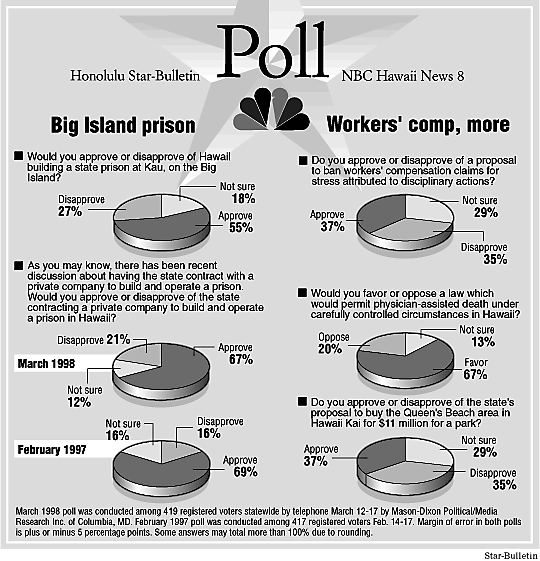
Respondents also had solid convictions about a state prison in Kau on the Big Island, with 55 percent favoring the plan but 27 percent opposing it. Kau prison
Also, 59 percent of Oahu respondents favored a new prison, compared to 47 percent for neighbor islanders. Poll demographics show 301 of the 419 respondents live on Oahu.
In a companion question, 67 percent supported a privately built and operated prison in Hawaii, while 21 percent opposed it.
Rees, the Big Island resident, favors a Kau prison because it would create jobs for displaced sugar workers.
"What better place to put it? There's nothing down there," she said.
In another matter facing lawmakers, 67 percent of respondents favored a law allowing physician-assisted death, while only 20 percent opposed the idea. The rest were uncertain whether a doctor should directly administer a lethal agent to a patient who makes such a request. Assisted suicide
The poll shows 72 percent of male and 63 percent of female respondents favored the idea, with Caucasians showing the strongest support.
A state blue-ribbon panel on living and dying is considering two approaches to some form of doctor-assisted-death law for Hawaii: physician-assisted death and physician-assisted suicide.
The latter involves a doctor who prescribes a potion to cause death but leaves it up to the patient to take it.
Other poll results show 37 percent approved of, while 35 percent disapproved of, the state's proposal to buy the Queen's Beach area in Hawaii Kai for $11 million. Other issues
And 51 percent of respondents disapproved a legislative plan to ban workers' compensation claims for stress attributed to disciplinary actions, with 30 percent favoring a ban.
1998 Con Con is favored
By Pat Omandam
by 47% of respondents
Star-BulletinAlmost half of 419 people surveyed in a new poll favor a state constitutional convention this year. That bothers Steven Philips of the Big Island's Pahoa district.
The 43-year-old small-business owner, who operates Tropical Colors in Hilo, said reopening the state Constitution to changes would only make things worse. He fears politics and self-interest would reign at a convention.
"I think corruption in the state is probably the biggest single problem, and I think the politicians are the most corrupt," Philips said.
"I'd leave it the way it is than to give them a chance to tinker with it and make it worse," he said.
A Honolulu Star-Bulletin/NBC Hawaii News 8 Poll of 419 registered Hawaii voters shows 48 percent, or 199 respondents, favor a constitutional convention in 1998, while 32 percent, or 135, oppose the plan. The rest remain undecided.
The poll was conducted March 12-17 by Mason-Dixon Political/Media Research Inc. of Columbia, Md. It has a margin for error of plus or minus 5 percentage points.
Results by gender show 55 percent of males and 41 percent of females favored a convention, with about half of those of Hawaiian ancestry showing support for it. Some Hawaiian leaders had voiced grave concerns about a constitutional convention, fearing delegates, given the state's economical and political climate, might eliminate the Office of Hawaiian Affairs from the state Constitution to save money and avoid ceded-land issues.
OHA was created as a result of the 1978 Constitutional Convention, when Hawaiian issues rose to the forefront of island politics.
Of the poll's respondents of full- or part-Hawaiian ancestry, George Kaeliwai, 70, favors a convention. The retired federal worker said he's willing to put the "cards on the table" and see if things can be improved, not only for Hawaiians but for everyone.
"I think we should have the convention to iron out things," he said. "The way they are now, they're not exactly up and up."
Poll results show 53 percent of Oahu respondents favored a convention this year, compared with 35 percent from the neighbor islands.
In 1996 a ballot question about a constitutional convention led to a Hawaii Supreme Court ruling that blank votes on the ballot counted as "no" votes. But the ruling was contested, with a new election ordered by federal Judge David Ezra. The state appealed Ezra's ruling, and the order is pending before the 9th U.S. Circuit Court of Appeals.