By Kathryn Bender, Star-Bulletin
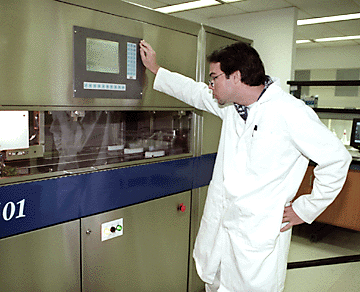
Lab technician Kevin Olival monitors the "Vitron 501"
robot at the Hawaii Agricultural Research Center in Aiea
yesterday. The robot, operated by Ausralia-based ForBio
Tropical Plants, is used to mass produce high-quality
plants for commercial crops
A few million trees
grow in Aiea
An Australia-based firm
By Peter Wagner
hopes to turn Hawaii into an
agricultural powerhouse
Star-BulletinTHE sleek 2,400-pound robot studies the little plant through a cold electronic eye. Lights blink, a motor whirs. Out reaches a metal arm and snips the shoot neatly above a leaf.
"Vitron 501" has just made two plants from one.
But this is more than precision pruning, and these are no ordinary plants. The $500,000 Vitron, recently installed at the Hawaii Agricultural Research Center in Aiea by ForBio Tropical Plants, is here to mass produce high-quality plants for commercial crops.
Working with "elite" stock cloned in a laboratory for quality and rapid growth, the sterile robot can quickly double or triple a trayful of seedlings, multiplying them by quantum leaps to more than three million plants a year.
It's a good way to start commercial forestry or tropical fruit plantations, industries ForBio hopes to foster on vacant sugar lands.
"ForBio plans to make Hawaii a world center for tropical agriculture and forestry," said Laith Reynolds, president of the company.
Reynolds envisions forests of koa, eucalyptus, rubber and teak, cloned for commercial harvest in less than 15 years. He sees disease-resistant fruits, caffeine-free coffee and cocoa and other cloned or genetically engineered crops springing from fallow fields.
By Kathryn Bender, Star-Bulletin
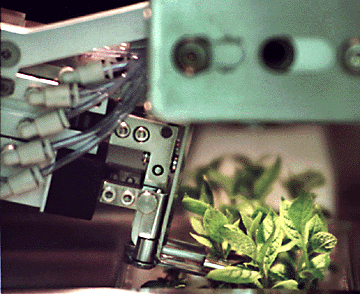
Here, the robot precisely cuts a eucalyptus plant.
The robot, a high-tech box in a sterile laboratory, is hooked to a computer and tended by a lab technician in a white smock. Trays of seedlings are fed into the machine, a button is pushed and, zip -- the trays are grabbed by bionic hands. Sharp scissors guided by computer find the perfect spot just above a leaf node. A shiny arm delicately plants the cutting in another tray.On and on the tireless robot bends over its work.
ForBio Tropical Plants is a holding of Australia-based ForBio Group., a leading biotechnology firm with integrated companies around the world focusing on commercial forestry, horticulture and agriculture.
ForBio Group, in the process of reincorporating in the United States, operates about 20 Vitron robots worldwide. One was recently installed in Watsonville, Calif., near San Francisco, to mass produce seed potatoes.
ForBio hopes its robot will generate interest, and investments. Meanwhile, the company is planning to build a $15 million production plant in Waimanalo or Mililani and plans to hire 8 to 10 laboratory technicians in the next several weeks.
Reynolds said the company is negotiating with major landowners for large tracts of land.
At the Aiea research center, cloned plants include rubber, koa, eucalyptus, teak, mahog-any, pineapple, papaya and bananas.
Also awaiting full-scale production are genetically altered coffee and cocoa plants, a recent breakthrough at the University of Hawaii that could bring naturally caffeine-free products.
During a demonstration yesterday, Vitron trimmed a tray of 28 eucalyptus seedlings bred to reach maturity in 15 years -- half the average time.
"The average clonal tree produces lumber in 10 years," said Reynolds. "Hawaii could be exporting lumber and wood fiber products in under 15 years."
One product that holds promise, he said, is wood-fiber products like laminated beams or plywood for home construction.