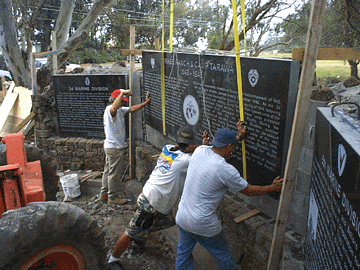
By Rod Thompson, Star-Bulletin
A black granite monument describing the World War II
base at Waimea where Marines prepared for Iwo Jima,
will be dedicated Saturday. Putting it in place are, left to
right, Luke Aitkens, Dayson Kauhi and Kalani Torres.
Waimea’s role in
Iwo Jima remembered
Ceremony Saturday to tell of
By Rod Thompson
Camp Tarawa, rest after one victory
and base for another
Star-BulletinWAIMEA, Hawaii -- With thousands of Marines buying hamburgers from her little stand in the Parker Ranch town of Waimea during World War II, the late Tsugi "Sue" Kaiama once asked one with a dark complexion about his ancestry.
"I am an American Indian," answered the soft-spoken Ira Hayes, who il,6p9,6p9 went on to fame as one of six men who raised the American flag on Mount Suribachi during the 36-day battle of Iwo Jima.
Joseph Rosenthal's photo of the flag-raising entered history books. Kaiama died three weeks ago, one sign of the rapidly evaporating memory of the Big Island Marine camp that made the victory possible.
On Saturday, 53 years and two days after the end of the battle for Iwo Jima, the Camp Tarawa Historical Foundation, Marines and Navy personnel, and about 100 veterans of the battles of Tarawa and Iwo Jima will dedicate a 20-foot-long black granite monument telling the story of Camp Tarawa.
The new monument forms a backdrop to a large rock with a plaque placed by the Waimea Exchange Club in 1984. "Now the rock has a story behind it," said foundation Chairwoman Alice Clark.
Yoshio Kimura was a Parker Ranch utility man in his 20s when Japanese forces bombed Pearl Harbor. Like many, he feared a Japanese invasion.
"It was a scary time," said Kimura, who joined a "home guard" unit, although none in the group had ever fired a gun.
The people of Waimea were relieved when Army units set up camps near town, although in some of the area's rainiest, muddiest sites, he said.
The following year, Stanley Murakami, a mechanic, was among those hired to build facilities for the expected arrival of Marines. They built an electrical plant, cold storage, an ice plant, and reservoirs.
But the camp of tents and quonset huts was still unfinished when the bloodied victors of the Nov. 20-23, 1943, battle of Tarawa arrived and named the camp for their recent battle.
Bob Purinton, now a Florida ranch owner, was one of them.
"We'd come out of hell," he said. "The people here were so friendly. They opened their arms to us."
He wasn't impressed by the cold, dusty side of Waimea. "We slept in grit. We ate in grit," he said.
Retired Hilo bandmaster George Durham wasn't any more impressed upon his arrival seven months later. "When we arrived, we were astounded at how cold it was," he said.
"The food was abysmal. We had pineapple, so much so that I hated it. Spam and pineapple."
They got some relief when Parker Ranch began slaughtering a steer every week and serving it to one battalion after another in barbecues at Spencer Beach Park.
A Marine Corps band member, Durham gave musical advice to a tentmate who composed a march that was to become famous, "The Men of Iwo Jima." The march will be played Saturday.
As a band member, Durham was supposed to be a stretcher bearer in combat.
With other band members being wiped out in battle, someone convinced Durham's commander to give his band the safer duty of carrying water to the front so there would be musicians available for victory ceremonies.
Durham received a minor wound anyway, but went on to play with the Marine Corps band at the White House, drinking beer and martinis after performances in the basement for President Harry S. Truman.
Camp Tarawa was dismantled by 1947. "It was such a quiet town after the war," Murakami said.
But the foundation's Clark wasn't willing to let the stories be forgotten. When ceremonies marked the 50th anniversary of Iwo Jima three years ago, she began taking oral histories from Kaiama, Kimura, Murakami, and others. Then she crisscrossed the country getting more stories and raising $22,000 for the monument.
Purinton hopes people will learn a lesson from it.
"We hope some day maybe we'll get smart enough to get along without killing each other," he said.
Where warriors trained
The Camp Tarawa monument will be dedicated in ceremonies this Saturday.
Dedication: 1 p.m. at site on Highway 190, at the entrance to the Parker Ranch house.