By Dennis Oda, Star-Bulletin
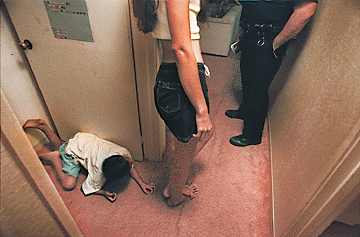
Neglect is abuse, too. Here a 7-year-old boy crawls to his
mother, trying to get her attention as she talks with a police
officer. The boy had arrived home from school in Waianae
with his brothers, 6 and 8, to find his mother gone. Police
received a call, and while they were there trying to assess the
situation, the mother and her boyfriend arrived, about 7 p.m.
Though this youngster eventually squeezed between his
mother's legs, she ignored him, instead giving her attention
to the officer and trying to find out who turned her in.
Police said the case would be turned over to
Child Protective Services.
Counselors don't just sit and wait for
By Richard Borreca
trouble to come to them. In Waianae, one counselor
is riding with the cops, offering legal advice, hope
and a shoulder to women who have
already felt the hand
Star-BulletinFirst off, you have to know this job isn't about saving souls, it is about keeping people alive.
Karen Tan figures her first week on the job as program supervisor for Pu'uhonua, a crisis intervention center, she saved a woman's life. Just by handing her a free cellular phone programmed to call 911.
"It was the very first phone I gave out, and it saved a woman's life. Her husband was beating on the door; finally he broke down the door and was coming at her. She didn't have a telephone because he had already ripped it out off the wall, but she was able to use the cell phone, and the police responded," she said.
Out in Waianae, Jackie Ries, a counselor with Pu'uhonua, isn't waiting for battered victims to come to her: She's riding with the police, ready to respond when someone has been hit or battered.
"Jackie is an amazing example," Tan said. "She has a real gift for the outreach part."
Ries, a Campbell High School and Leeward Community College graduate, worked for a bank until the abuse in her own marriage prompted her to seek help.
"When I got hit by my husband, I thought I was getting punched for opening my mouth."
"Abused women sometimes think they deserve the punishment," she said.
After watching a videotape of a Massachusetts domestic-violence program with a police ride-along program, Ries was hooked. "I saw that and said: 'I can do that. Everybody is in crisis, and they come in and calm things down.'"
The stories are often horrifying. Ries goes through case after case in a litany of brutality.
By Dennis Oda, Star-Bulletin
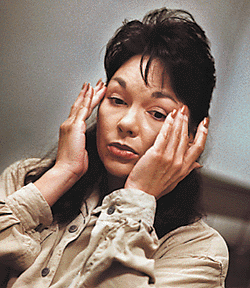
Jackie Ries, domestic-abuse counselor, just got off
the phone with an abused woman who was
wondering what she should do.
A woman covers her young daughter to protect her from a husband who was pulling the little girl's arms so hard they were about to pop out of their sockets.
"She was covering her, so her back was exposed, and he kept hitting her with a wooden 2-by-4. Her entire back was bruised," Ries recalled.
Sometimes the bruises tell the entire story. Ries remembered victims with the handprints of their attackers outlined on their faces in deep-purple bruises. Other victims, picked up by the neck, escaped with bruises in the shape of clenched fingers around their neck.
While beatings eventually stop and bruises heal, Ries said, many women are emotionally tortured.
"They call her names, say how fat they are, how ugly they are, what a lousy mother they are, what lousy cooks they are. They say that nobody will go near them," she said.
"They hear it over and over. Victims tell me even when the physical abuse goes away, you hear it over and over in your head."
Police recognized they needed help. With an average of 2,375 domestic-abuse arrests a year, police on Oahu were handling six arrests a night.
That's what makes the Pu'uhonua program so important, according to Tan.
"The police have things to do already," Ries said. "It's hard for them to stay and sit with the victim for a long time and calm them down and listen to them.
"Also, there is the thing with being interviewed by a male. They may not want to talk to a male after getting beaten up by a man."
Get help to get out
When crisis counselors talk to a battered victim, the first thing they do is work to prevent the attack from happening again."She knows him better than anyone else, so she has to learn to do safety planning," says domestic-abuse worker Jackie Ries.
That means preparing a safety bag packed with two days and nights' worth of clothes for her and her children, and important documents like marriage licenses, birth certificates and bankbooks.
Victims also are taught how to get a temporary restraining order and how to stay calm. "At least then a victim will be able to prepare for the next incident and they won't wait so long before calling 911," Ries says.
SHELTERS / IMMEDIATE SUPPORT
Pu'uhonua, Domestic Violence Drop-in counseling, 200 N. Vineyard Blvd., Suite 100: 522-5535
COUNSELING
LEGAL ASSISTANCE
POLICE
HOT LINE
By Dennis Oda, Star-Bulletin
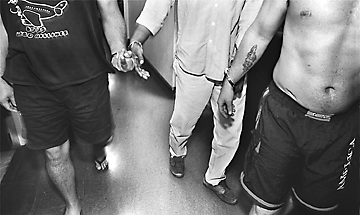
Three suspects wanted for domestic abuse were picked up
and held at the Waianae police station and were being taken
in handcuffs to the main downtown cellblock.
Friday nights can spell trouble
Abuse can happen any time, but
By Richard Borreca
after-work parties and drinking at
week's end keep cops alert
Star-BulletinShortly before 6 p.m. on a Friday, police Officer Howard LeStronge, 45, who grew up in Waianae, and Jackie Ries, 31, Pu'uhonua domestic-abuse counselor, buckle into the front seat of an HPD blue-and-white cruiser.
They are marking the end of the first week of a groundbreaking program. Plagued by high rates of domestic abuse in the Waianae area, the police asked the domestic-abuse crisis shelter Pu'uhonua for help.
Ries volunteered to ride along with a patrol officer, at the ready to counsel Waianae residents.
Debbie Garcia, Pu'uhonua's lead counselor, says evening calls have tripled since the arrangement began. "Jackie says she has been able to reach many more victims because she is stationed at the Waianae police station."
In the last two weeks of February alone, Ries handled 43 cases.
Counselors can't predict what nights are heaviest in domestic-abuse calls, but police say after-work parties and heavy drinking on Friday nights make that a natural time for abuse cases.
6:45 p.m.
Police dispatch reports two or three males arguing with a female.The blue-and-white surges down a back road, LeStronge driving quickly, Ries looking for the address she's jotted down.
The house is one that LeStronge has already visited several times during the month. As he pulls the car to the front yard, another cruiser also arrives.
LeStronge, a large, quiet fellow who is also a martial arts instructor, is out of the car and between the combatants in an instant.
"I try not to approach in an authoritative manner," he says later. "I don't go in there and holler, 'You break it up!'"
By Dennis Oda, Star-Bulletin
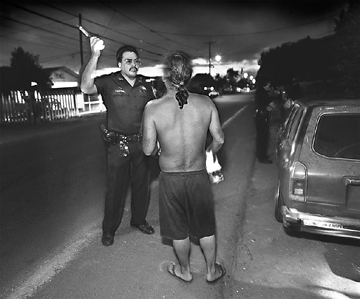
After separating an arguing couple, Officer Howard LeStronge
takes a good look at the man. With a calm approach, he convinces
the man to leave. Meanwhile, counselor Jackie Ries
talks with the woman.
Instead, LeStronge asks what's happening, getting the people to talk, not fight."It is so frustrating, because the parties wait so long, sometimes the people turn their frustration on us," he says. "Suddenly it's, 'Let's not fight each other; let's fight the police.'"
Everyone is drunk; friends and relatives come out of the house. Another police officer tells one occupant to turn off the booming rap music.
While LeStronge talks to the man, Ries has the 47-year-old wife off to the side.
She finds out that the woman has been depressed. Ries gives her handouts about Pu'uhonua and tells her about suicide prevention.
Back in the police cruiser, LeStronge says, "It's a real Budweiser family."
This has been going on for some time, he explains. The husband moved out because he didn't want to get into a fight. But he moved in with his girlfriend, which is upsetting the wife.
"She was pushing him, but he's been arrested for abuse already and he knows what the law is, so he didn't hit back," LeStronge says.
Ries hopes the woman will find the pamphlets when she wakes in the morning. Police also hand out cards with domestic-violence hot-line numbers.
Ries has already visited a housing project earlier in the day, dropping off brochures and telling the manager she is available now every evening in Waianae to help domestic-violence victims. In the first week, she's already talked to 11 potential clients.
9:07 p.m.
Dispatch reports a 911 "dropped call."LeStronge explains that when someone dials 911, the address is automatically recorded. Even if no one completes the call, police respond anyway.
Ries says it's common for a woman to be attacked by a husband or boyfriend, then use the threat of calling the police to get him to stop.
The house is on a crowded street of upper-middle-class homes. Television sets glow in front windows, but otherwise it's dark and quiet on the street.
LeStronge and Ries walk up to the front door past a dog on a chain that looks up but doesn't bark.
Standing in the shadows of the front door, a young woman, maybe a teen-ager, says somebody was at her father's house, so she called 911. She says she went to check the house: a 10- to 15-minute trip up Waianae Valley Road, ostensibly taken in the five minutes between the reported call and the police's arrival on scene.
The girl says she was home alone and there was no trouble. LeStronge and another officer confer and leave.
Ries talks briefly with the girl.
By Dennis Oda, Star-Bulletin
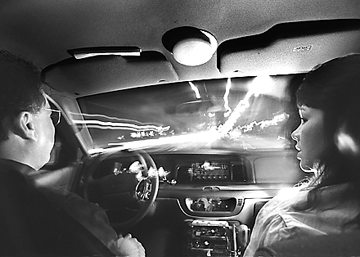
Officer Howard LeStronge, left, and domestic-abuse counselor
Jackie Ries cruise the Waianae night, waiting for a call.
Ries once was a victim of domestic abuse.
"I asked her about the bruise on her face," Ries says later. "She was hiding it. She said she hit something."I bet it was abuse," she says. "It looked like a handprint."
LeStronge adds: "We can't go in; we can't search the house because of privacy laws. We don't even get the name of the person on dropped calls, just an address."
9:16 p.m.
Dispatch reports a fight between a grandson and his grandfather. Domestic abuse isn't always between a man and wife or girlfriend, Ries points out. There are cases of women beating up men and of sons attacking their mothers or fathers.This case, however, is more about simple family tension.
"The kid is getting out of control. He say the F-word to me. I told him I don't want to hear that," the grandfather says.
"He said he would run away. He says detention home would be better than this. We bought him a car when he was 15 and new one, too.
"All of his friends are bad. He's a good kid, has a 3.8 average, but now he's out of hand."
LeStronge talks to the grandfather. Another officer talks to the teen, who is red-faced and has been crying. The other officer reports back to the grandfather: "He doesn't have any problems with you. He says he loves you."
Back in the car, LeStronge explains that the father has a girlfriend and the boy resents that.
"You can get kids everything, but it doesn't make up for lost love," he says.
Yesterday's Part I