DOMESTIC ABUSE IN HAWAII
By Dennis Oda, Star-Bulletin
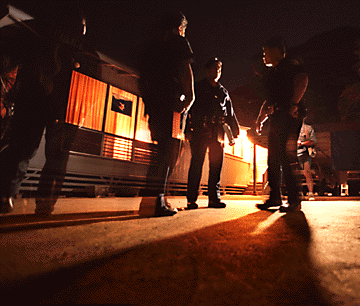
Police responding to a domestic dispute in Waianae
discuss their options outside the home. They decided to
get the man to leave the house for a 24-hour
cooling-off period.
Hurt in the home,
hurt in the heart
Not much has changed. Women still
By Richard Borreca
are beaten by their husbands or
boyfriends. Even when the system
works, justice rarely is served.
Star-BulletinTwenty-five years ago, the state Legislature acknowledged the problem: "It is apparent today that there is little, if any, protection for a spouse beaten by another spouse."
The same could be said today.
When Pu'uhonua, a drop-in crisis center for abused family members opened in October 1996, the staff expected to handle perhaps 200 victims the first year.
"From that October to October 1997, the center handled 3,000 cases," said Karen Tan, program supervisor.
Nanci Kreidman, director of the Domestic Violence Clearinghouse, is even more pessimistic.
"It (domestic abuse) is an ancient practice. It is a constant, and it only appears to be going up because more people are reporting it," she said.
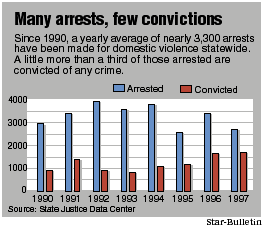
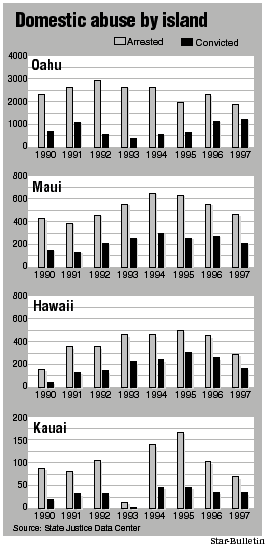
A new Star-Bulletin computer-assisted survey shows that since 1990, a yearly average of nearly 3,300 arrests were made for domestic violence in Hawaii -- but just over one-third of arrestees were convicted of any crime.
Domestic-violence laws were tightened in 1990 to expand police powers to allow removal of a violent family or household member."Ultimately we hope to get a conviction for all our arrests," said Lt. Maria McCauly, in charge of the Honolulu Police Department's family-violence detail.
"Our goal is to get the guy convicted. But we are not going to not arrest because we don't have a strong case."
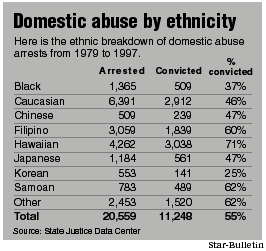
Statistics starting from 1979, when domestic cases were first recorded, through 1997 show that almost half of those arrested and convicted of domestic abuse are either Hawaiian or Caucasian.
Further, a review of police calls from June 1997 through January 1998 shows that Waianae, Kalihi and Pearl City were the most prevalent areas for domestic-abuse complaints.
Domestic-abuse experts say the violence happens all the time, to all people in all areas -- but statistics gathered from the state's Criminal Justice Data Center show specific trends.
Since the domestic-abuse laws went into effect, 20,559 people have been arrested. Hawaiians and part-Hawaiians and Caucasians have had the largest percentages of convictions.
McCauly said the statistics don't show that these groups are more prone to violence, but that they are more willing to take action.
"With more education in the problem, more and more groups are going to report," she said.Police and prosecutors have a frustrating problem with domestic-abuse cases: More than half the time after an arrest, the victim, nearly always a woman, refuses to testify against the man and sometimes even becomes a witness for the defense.
"The problems for the jury include the feeling that it is a thing between boyfriend and girlfriend, or husband and wife," said Lynne Jenkins McGivern, deputy Honolulu prosecutor, in charge of the special domestic-abuse task force within the prosecutor's office.
The jury feels that if the woman recants "we are standing in the way of a reconciliation," she said.
By George F. Lee, Star-Bulletin
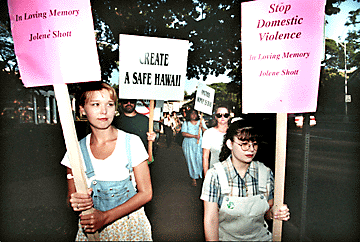
Beverly Clowers, left, and Kim Wheeler, acquaintances
and co-workers of the late Jolene Shott, march along King
Street protesting domestic violence yesterday. They were
among about 75 people taking part in the march. Shott, 35,
was strangled in her Waikiki apartment on Feb. 23. Her
estranged boyfriend has been charged with murder.
Women change their stories of abuse out of fear, according to several experts in the field of domestic violence.McGivern said victims may feel economically tied to the abuser -- if they send him to jail, they will be forced onto welfare.
Women also think that a father figure is important for their children.
"They may think there still is love, the victim wants a family, the children need a dad, especially if they never had a dad," said Jackie Ries, one of five counselors with Pu'uhonua.
McGivern agreed, adding that abused women often feel "any father is better than no father to the kids."
For the women, however, the abuse runs deeper than beatings.
"The question is just not simple; there are also issues of power and control," McGivern said.
In a 1996 survey of domestic-abuse cases, the League of Women Voters of Hawaii observed that convicted batterers generally served little jail time, regardless of the seriousness of their acts.
"There appear to be few serious consequences for batterers who fail to comply with the terms of probation or with their sentences," the report stated.
Enforcing temporary restraining orders -- court directives requested by spouses or girlfriends telling their abusers to leave them alone -- is one of the most difficult areas.
"When we enforce a TRO violation, someone is going to get arrested," Waianae police officer Howard LeStronge, said. But many times it is difficult, if not impossible, to find the violator, he added."Sometimes the victim waits too long to complain, then you don't know where the abuser went, the victim doesn't have an address -- they say something like 'He's living in Maili now.'
"It is very frustrating."
Ries advises her clients to cooperate completely with the prosecutor and to let the prosecutor know they are interested in seeing a conviction.
"Lots of clients don't know what to do, and anyway the victims are in so much turmoil," she said.
Even when the system works, even when the person who injures his spouse is arrested, convicted and sentenced, justice is rarely served.
"If they are convicted, which is apparently very few, they serve only two days in jail and one year probation," Kreidman said.
"Many don't comply with conditions of probation."
Even prosecutor McGivern pauses to consider.
"I know that victims may think that one year (probation) is not enough," she said.
By Craig T. Kojima, Star-Bulletin
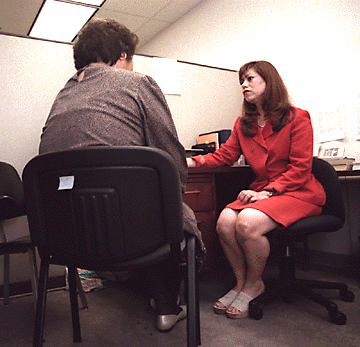
Pu'uhonua counselor Debbie Garcia, right, talks with
Marsha Aetonu about a recent case.
Cash woes may shut
By Richard Borreca
center for womenStar-Bulletin
The police are asking for help. Women, bruised and frightened, need rational advice. Children, the wide-eyed witnesses to domestic abuse, need counseling. But one of the most effective domestic-abuse agencies in town is about out of money.
Pu'uhonua, a drop-in crisis center for domestic-abuse victims, started in 1996 with a $200,000 federal grant. The city also contributed.
Since then, the service has grown to include five counselors, two attorneys, two paralegals, a secretary and a director at Parents and Children Together, a family service agency.
The service averages 300 cases a month, providing crisis counseling, child care and legal counseling to abuse victims.
The program picked up where the old police DART (Domestic Abuse Response Team) left off -- and is drawing praise from police.
"The HPD has told us we are the best," Pu'uhonua Director Karen Tan said.
Lt. Marie McCauly, in charge of HPD's family-violence detail, said: "Pu'uhonua is the only thing we have."
Indeed, police requested that a counselor help with patrol officers in the Waianae area because of its high rate of domestic abuse. A counselor was assigned, and Waianae officers were relieved to get the extra help.
"The money saved and the value received is just incredible," Tan said.
But Pu'uhonua runs out of money in June, the end of the fiscal year.
Last year the budget was increased to $418,000, Tan said, $318,000 from the state and $100,000 from the city. But this year, Tan worries that budget cutbacks will force the Legislature and the city to cancel the project.
"Everyone is trying, but this year money is so tight," she said.