By Kathryn Bender, Star-Bulletin
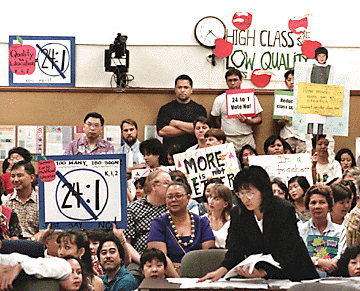
Hundreds of teachers, parents and students attended the
Board of Education meeting last night to protest a
proposal to increase class size.
Teachers protest plan
to boost class size
Faced with heavy opposition,
By Debra Barayuga
the Board of Education votes
to re-examine the proposal
Star-BulletinThe message Hawaii's public school teachers gave was loud and clear: Don't increase class sizes to balance the schools' budget. More than 250 teachers and parents from Kealakehe to Kapalama showed up at the Board of Education meeting last night to protest a proposal to raise classroom ratios from the current 21:1 to 24:1.
Hawaii State Teachers Association president June Motokawa told board members the union could have brought 2,000 teachers to the meeting.
Faced with overwhelming opposition, the Board of Education voted to take another look at the proposal.
Saying the board wasn't making any promises, board chairwoman Karen Knudsen said members will revisit other areas that won't directly affect classrooms.
"We'll try," said Knudsen, noting it will not be easy. "We don't want to hurt the little kids."
Among the areas teachers asked the board to look at instead were staff development, adult education and extra-curricular activities.
Josiah Taimatuia, 5, a kindergartener at Linapuni School led the charge.
"Please don't make my classroom too crowded," he pleaded. "No classroom should look like the H-1 freeway."
The student-to-teacher ratio increase was among several items proposed by superintendent Herman Aizawa last month to find $25 million in current services to balance the department's budget.
Aizawa had also proposed raising A+ after school fees by $15, increasing school lunches to $1 and bus fare to 50 cents one way.
Class sizes should have been the last place the department and board looked at in making reductions, said Joyce Crisafi, teacher at Kealakehe High.
Studies have shown that smaller classes are conducive to student learning, allowing teachers to give their students more individual attention and identify learning problems early on, said Motokawa.The same reports show students in smaller classes achieve better test scores and participate more in school.
"It defies logic and common sense that this board would choose to increase class size as its first option in balancing the budget," Motokawa said.
Even with the 21:1 ratio, it's common to find class sizes of 26 to 28 in the lower grades simply because there aren't enough students to justify opening another class, teachers said.
Kindergarten and first grade classes may start off with 20 or 21 students at the beginning of the year, but by spring, they have reached 25 or more in each class, said Michael Flanigan, special education teacher at Kauluwela Elementary.
Raising the class size to 24 would only make it worse. "It's not going to stop at 24," said Monica Wrenn, a fourth-grade teacher at Kaewai Elementary.
Teachers will be so engrossed in "crowd control" that children won't be getting the attention they need at that young age, she said. "Whoever came up with 24:1 has no understanding of how children learn."
Robyn Hashizaki has her two-year teaching job at Kalihi Waena Elementary and her first-grade daughter to worry about if the student-teacher ratio is raised.
She's already been notified that she may be among the first to go -- one of about 272 teachers the Department of Education says could lose their jobs or be displaced by the class ratio change.