
Photos By Ken Ige, Star-Bulletin
African violets can be propagated from a sturdy leaf,
like the one below, with about an inch of stem
cut on a diagonal,
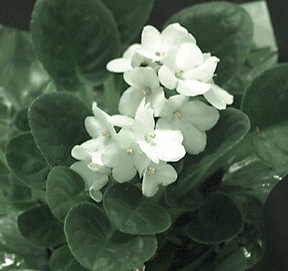
THEY'RE the Oreos of indoor gardening -- the African violet is easy to come by, small, not at all unusual and surprisingly satisfying. The most popular house plant in the United States, it blooms almost all the time and with its fuzzy leaves that surround the flowers, it looks like a tiny bouquet. Satisfying treat in a pot
African violets are the most popular
house plant, with good causeThe original African violet has pale lavender flowers, but hybridizers have produced thousands of varieties and dozens of shades from blue through magenta, pink, coral and white. The flowers are about an inch wide, and some are more than one color, but they all have bright yellow stamens in their centers.
The standard African violet grows to about 12 inches, which isn't very big, but there are also semi-miniatures and true miniatures. Most of these are available at garden shops, and once you have a mature plant, you can make little ones from big ones. African violets are one of the few plants that can be propagated from leaf cuttings. Kalanchoes and begonias are two others, and this same method will work with leaves from those plants.
You'll need a 4- to 6-inch plastic pot, African violet potting medium, a single-edged razor blade, a rooting hormone, a couple of plastic soda straws and a plastic bag. To prevent a diseased plant, disinfect the pot and the razor blade with a 10 percent bleach solution, -- 1 part Clorox or other bleach to 10 parts water.
Then, from a mature African violet plant, choose a firm sturdy leaf from the center. You don't want the biggest leaf or the oldest one from around the rim of the pot because these are likely to rot and are slow to root. But don't settle for a young leaf either. The growth will be fast but weak.
With your fingers, snap off a leaf, leaving about two inches of leaf stalk. Then with your clean razor blade, trim the stalk to about an inch with a clean diagonal cut. Fill the clean pot with African violet potting mix, available at garden shops, or make your own of half perlite and half vermiculite. Press the mixture down gently with your fingers, and moisten but don't drown it.
Use a rooting hormone such at Rootone which contains a fungicide to prevent root rot. Pour a little of it into the lid of an old jar and dip the end of the cutting into the powder. Knock off the excess powder because too much may actually halt root growth.
Take a pencil and make several planting holes. Being careful not to rub off the rooting hormone, plant the leaf by placing about two-thirds of the leaf stalk in each hole. Firm the planting mixture around the stalk so there are no air pockets, and water the planting medium well.
To keep the humidity up, place two or three plastic straws in the medium and then put a plastic bag over the whole works, closing it with a twist tie. Place the bagged pot in a warm place out of direct sunlight. Watch the leaves, and if they show any signs of rot, open the bag for a few hours to let in fresh air. Pull off and discard any rotted leaves.
In six weeks, more or less, tiny plantlets should show up at the base of each stem.
When they are about 2 inches tall, they are ready for independent living. Remove the plastic bag, and let them become acclimated to drier air. Remove the leaf and its keiki from the pot, and with the razor blade, cut the plantlets off. Then plant them tenderly in small shallow pots and water them with lukewarm water, like bathing a baby. Don't overpot these plants, they like to be somewhat rootbound for the greatest number of flowers.
African violets need to be fertilized monthly with "African violet food" or standard house plant fertilizer. Make sure it is low in nitrogen, the first of the three numbers in the fertilizer's formulation, or you will have an abundance of heart-shaped leaves and a dearth of flowers. Over-fertilization will cause the leaves to turn gray and the stems to rot, so generally use less that what the manufacturer recommends. His interest is in selling fertilizer.
If the most light comes from a single direction turn the pot occasionally so that the flowers are evenly distributed and not all growing toward the light.
When watering African violets, avoid getting the crown or the leaves wet. Pour the water in from the side of the pot to dampen the soil. Use water at room temperature or even slightly warmer, and don't allow water to stand in the saucer under the pot.
Like that package of Oreos, African violets don't last forever. Once the plant becomes woody, it goes into a quick decline. So that's when you start to root another set of leaves.
Gardening hints from
The Garden Club of America:When potting a plant, there is a tendency for the potting medium to leak out of the hole at the bottom of the container. Put a paper coffee filter in the bottom of the pot, and you have corrected the problem. The filter is somewhat waterproof, so the soil will remain in the pot, but the paper will decay in a few days and allow water to run through.
Gardening Calendar in Do It Electric!
Send queries along with name and phone number to:
Evergreen by Lois Taylor, Honolulu Star-Bulletin, P.O. Box 3080, Honolulu 96802.
Or send e-mail to features@starbulletin.com.
Please be sure to include a phone number.
Evergreen by Lois Taylor is a regular Friday feature of the
Honolulu Star-Bulletin. © 1996 All rights reserved.