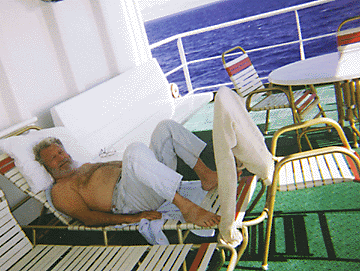
Cione family photo
Cargo ships are short on luxury, long on relaxation.
Jack Cione of Honolulu relaxes during a cruise
to South America.
It’s called a
‘working ship’ but . . .
For a special breed of traveler,
By Peter Wagner
a vacation cruise aboard a cargo vessel
is just the ticket
Star-BulletinIt's no luxury cruise. Not without the floor shows and buffet lines. But those with a yen for the open ocean say there's nothing like a good cargo ship to sort your thoughts and clear your sinuses. Every year, several thousand Americans board freighters on voyages of 50 to 100 days all over the world. That's a relative handful compared with the millions of passengers who annually crowd luxury liners for resorts around the world. But this is a special breed of traveler.
They pay about $100 a day to tag along among the containers, peering over at strange ports as longshoremen bustle on the docks below.
Rarely are there more than 12 of them on board, left to entertain themselves as captain and crew go about their business.
They watch dolphins at play. They lie on deck at night among the stars. They stand on the bridge with the captain as a 30,000-ton container ship maneuvers into the next commercial port.
"If you want to get away from the Las Vegas scene, a freighter is for you," said Jack Cione, noted Honolulu showman who, with his wife, Maydelle, has been hopping freighters for the past 30 years. "I write, I read. My wife does needlepoint. We keep busy."
The Ciones recently returned from a 50-day voyage to South America on the Ivaran Line San Antonio -- their 24th freighter cruise. The 547-foot ship went from New Orleans to Buenos Aires and back, with numerous stops at unusual ports like Puerto Cabello, Venezuela and Santos, Brazil.
It wasn't cheap. Passage, air fare, hotel, taxis, tips and modest shopping added up to about $17,000.
Fares on the San Antonio -- $6,500 a person -- came to $13,000. That's $260 a day for two adjoining staterooms, which the Ciones turned into a suite with separate bathrooms. Air fare to New Orleans added $1,500. Six nights in a New Orleans hotel -- three before the trip and three after -- was another $1,500. Tips, $2 a day for stewards and waiters, totaled $300.
But a freighter cruise can be had for under $2,000. Those looking for a shorter run can pick up a 10- or 15-day segment of a voyage for about $100 a day. Some book air-sea packages to sail one way and fly the other.
The German-owned Columbus Line, for example, is offering an off-season rate (March through September) of $1,615 for a 17-day trip from Auckland, New Zealand, to Los Angeles. The trip is on the return leg of twice-monthly voyage from Los Angeles to Australia and back via the South Pacific and Honolulu.
Egon Oldendorff, another German line, has an off-season rate (April through August) of about $2,200 for a 28-day voyage starting in New Orleans to Mexico and South America. The ship goes through the Caribbean, stops at Cartegena, Colombia, and goes through the Panama Canal to Guayaquil, Ecuador, and back.
Freighter cruising is currently a foreign affair, as American shipping lines concentrate strictly on the business of moving cargo. U.S. companies cite concerns over liability and say they don't have space for passengers.
"Our focus is on moving containerized cargo and not passengers," said Jeff Hull, spokesman for Matson Navigation Co. "It's a more efficient operation and more cost-effective that way."
Sea-Land Services, Hawaii's other major cargo line, is likewise all business at sea.
Some agents confide that ships' captains see passengers as an unwelcome added responsibility. Given smaller crews -- cut in half in recent decades by automation -- there are few hands on deck to look after paying passengers.
The vessels, usually large container ships, are outfitted with six to eight cabins -- an outgrowth of the traditional owner's cabin and guest quarters. Passengers join the captain and ship's officers for gourmet-quality dining.
One exception is the luxurious Ivaran liner Americana, a hybrid fitted for 88 passengers. The German ship, which carries produce, dry goods and other cargo between the United States and South America, borders on a luxury liner with plush 500-square-foot staterooms, polished brass, sun deck and pool, sauna, wood-paneled library, cocktail lounge and other amenities for its well-heeled passengers.
But by and large, passage on a freighter is an intimate affair that won't appeal to all.
"People write novels out there," said Capt. Mike Clarity, of Inchcape Shipping Services-Lavion Shipping Agency. "But if you're an active person on the go all the time, you might have a problem."
Inchcape represents the German-owned Columbus Line, one of two shipping companies that bring passengers through Honolulu on a return leg to the West Coast. The other, the British-owned Blue Star Line, takes a similar route between Australia, the South Pacific and Los Angeles.
Neither of the two shipping lines can accept passengers in Honolulu, however, because of a federal regulation protecting U.S. shipping interests. Under the Jones Act, foreign vessels may not carry cargo -- including human cargo -- between American ports.
That means Hawaii travelers must fly to the mainland to pick up a ship, a costly hassle.
"That's the only problem -- getting to the ship and getting home," said Maydelle Cione. "I hate to fly."
Accommodations on most freighters are top notch. Rooms are big and all have a front-row seat on the ocean with big windows. Many ships have small pools, elevators, air-conditioned rooms, exercise equipment, cocktail lounges, television and VCR and other comforts.
And passengers, as welcome on the bridge as in the engine room, often have full run of the ship.
"I managed to explore the whole ship from forecastle to stern," said Rob Black, a businessman from Adelaide, Australia, who recently made a 10-day crossing from Auckland to Honolulu on the Columbus Canterbury.
Black and his wife, Robyn, won the trip and were initially apprehensive about lonely days at sea. They put the trip off for a year before venturing on board.
"It wasn't something I would have done for a holiday, but with the benefit of hindsight, if I really wanted a holiday with relaxation, I'd do it again," Black said.
A highlight of the trip was arriving at Honolulu Harbor at night.
"It was fantastic to see the city lights from the bridge," he said.
Booking a trip takes some footwork, and a little help from your friends.
Travel agents, more in tune with conventional luxury cruises, can rarely help in this rarefied market. Most will point travelers to one of several mainland agencies that specialize in freighter cruising.
The largest such agency, Freighter World Cruises of Pasadena, Calif., books about 1,200 passengers a year. The company, which represents 15 foreign shipping lines with accommodations on 60 ships around the world, keeps its clients posted on upcoming voyages with a twice-monthly newsletter.
TravLtips, a New York agency, communicates with its 30,000-member Cruise and Travel Freighter Association by newsletter.
The Ciones usually stay in a hotel several days before a ship's scheduled departure because voyages sometimes leave early or make abrupt changes. Port calls can be a moving target because of changing cargo, weather, congestion and other factors. It's an aspect of freighter travel that calls for flexibility.
"When you go on a freighter cruise, you have to flow with the tide," said Jack Cione.
But even the salty Ciones were tried when a trip booked from San Francisco to Africa ended up on the other side of the world. The first change came when they were told the ship was bound instead for South America. Several days before departure, they learned they were headed for India. The ever-adventurous couple was anxiously anticipating their first call on India when the captain informed them the ship was bound for Pakistan.
That's where they got off.
"They smuggled us across the border into India and we had a wonderful two weeks in Bombay," Cione said.
Looking for a ship
Voyages can be long and they aren't cheap. But travelers who have the time and a hankering for the sea might give a cruise aboard a cargo container a try:
Cost: $75 to $130 a day. (Look for off-season rates)
Who to call: