

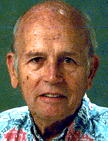
IN the late 1970s, when he still was governor, George Ariyoshi invited me to walk with him out to the fifth-floor lanai of the State Capitol to look at all the high rises downtown. Easing the pain for
Hawaii’s unemployedThey all were new since statehood in 1959, he said, and most of them were filled with jobs that didn't exist when statehood came.
Further, he added, many of the white-collar workers there -- including lawyers and accountants --were descendants of early imported laborers. Some of their grandparents and even parents sweated out long, hot hours in the sugar and pineapple fields.
His point was that our economy is dynamic. It changes. It grows. Despite setbacks, its overall movement is forward. It gives us more material things than ever before. It is up to us to protect the spiritual things, the quality of aloha, our environment, our neighborhoods and more.
We have done so well materially that there now is talk of affluenza as a disease. Its symptoms are compulsive acquisition of showy things. In the process family life has suffered and crime has escalated. But recent numbers say we may at last be doing better. Crime is easing. Abortion is down. Home ownership is up. It's not all bad.
It's not all good, either. Recently announced have been job layoffs by two major private employers, Bank of Hawaii's parent, Pacific Century Financial, and Liberty House plus the city-county, and the closing of three Foodland stores.
Because Asia's economic troubles are just beginning to impact us, worse lies ahead. Tourists from there will thin out and spend less. January hotel occupancy in Waikiki was the worst in 15 years.
We are seeing a down side of capitalism, which thrives on keen competition and forces businesses to be lean and savvy to stay afloat.
The U.S. mainland experienced this down side earlier with hundreds of thousands of layoffs. California was particularly wounded by defense cutbacks. But now the mainland and California have made a comeback, with unemployment the lowest in 20 years or so.
The laid-off mainland workers, at least most of them, have returned to the work force, often doing jobs that never existed before. This is the same kind of thing Ariyoshi pointed out to me from the Capitol lanai.
The mainland experience now is helping us directly by bringing more tourists here from California to offset a portion of the hit we are getting from Asia. In time, Hawaii also will recover.
But we will have more layoffs and must cooperate to create new jobs to take their place. That's what Governor Cayetano's Economic Revitalization Task Force is all about -- creating a better climate for new job creation.
Right now, however, we as a society have an obligation to ease the transition of those laid off. It can be painful. It has been known to lead to suicides.
Employers have a first obligation. They pay severance benefits. They sometimes help with job searches. Government provides unemployment compensation and job retraining. Also welfare. We shouldn't forget the constructive role of churches, communities and volunteer social agencies. Public temporary work programs could become a need.
WE must avoid trying to go back to the past because it's not possible. If we work at it, the future can and will be brighter.
Imagine a village with just 10 workers. One of them is assigned to go out to the well to pump water for the community every day. Then the community gets an automatic pump and he is jobless. For the moment he is at a loss, but in the end he may be put to work performing a new service the community never could afford before.
That's what I think Governor Ariyoshi was talking about the day we walked out on the State Capitol lanai and looked at all those new offices for people doing jobs that hadn't existed even 10 or 20 years previously.