By Kathryn Bender, Star-Bulletin
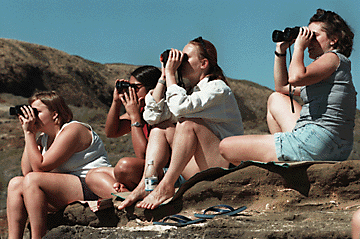
Nearly 300 volunteers at 25 sites around Oahu counted
whales during a three-hour period yesterday, data that will be
used to make a whale-watching guidebook. Graduate students
Amy Lesher, Wendy Delos Reyes, Alison Achor and Julie
Manyak staff their post at Lanai lookout near Hanauma Bay.
Hundreds watch,
help humpbacks
Volunteers aid the National
By Lori Tighe
Marine Sanctuaries document the
endangered whales' activities
Star-BulletinVolunteers gasped as they peered through binoculars and pointed out humpback whale fins, tails and blowholes yesterday.
"I just saw six blows. They were going fast," said Cynthia Ho, 46, of Kaimuki, seated on cliffs at Lanai lookout, near Hanauma Bay.
"I've never seen a real whale," said the locally born and raised woman. "It's something I've dreamed of. It's amazing. Seeing God's creatures in action makes you want to protect them."
At Ho's feet played her 7-year-old daughter, Nicole Sato, who piped up, "Whales are endangered species."
Mother and daughter counted the whale sightings yesterday along with nearly 300 other volunteers at 25 shore sites around Oahu for the National Marine Sanctuaries, said Oahu liaison Naomi Mcintosh of Kailua. The National Marine Sanctuaries will use the data to make an Oahu whale-watching guidebook.
"We had about 120 more volunteers this year than last year," Mcintosh said. "People really enjoy learning about the whales and sharing the experience. The kids have been great. They've been seeing tons of whales, probably more than are out there," she said.
Most of the volunteers seemed unaware of the controversial Navy experiments to test low-frequency sounds on the male singing humpbacks 10 miles off the Big Island, which began Thursday.
The Navy is performing the sonar tests for 30 days to learn how the sound affects the whales who come to Hawaii to mate.
The sonar may be used to detect the new generation of silent submarines.
"Oh, I had no idea," said Alison Achor, 33, who came to count the whales with her friend, Wendy Delos Reyes, 25, both students at the University of Hawaii. "Do they know if it's going to hurt them?"
The Navy said it will stop the tests if they determine any whale is harmed.
About two seconds after 9 a.m. yesterday, when the UH students arrived at Lanai lookout, Achor and Delos Reyes witnessed a humpback slap the water with its tail.
"I just thought, 'Wow, this was worth it,' " Delos Reyes said.
The volunteers, from first-graders to senior citizens, reported what time they saw a whale, what direction the whale headed and what kind of activity.
Rather than an exact whale count, the National Marine Sanctuaries want to know about the whale activity, when and where the humpbacks thrash, play and breathe at the surface.
"We're really lucky. We were told we'd get a lot of sightings at this lookout, and we've had a lot," said Kim Winn, mother of a Waialae Elementary first-grader. "We've seen several breaches."
"We brought classical music. I was listening to Mozart, and I saw two tails come out of the ocean. It was jamming."
About 10 families with first-graders at Waialae Elementary counted whales at the Lanai lookout as a lesson in reality to coincide with what they're learning about marine species protection in the classroom.
"I saw lots of spouts," said Winn's son, Ace, 6.
"We're watching to find out how many whales are still living. They're getting killed. They want to make it a safer place because they're building families out there."