The 'pocket rot' causes losses
By Trish Moore
of up to 50 percent
of crop yields
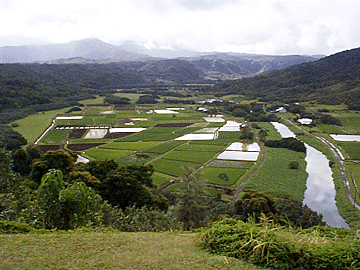
Star-BulletinHANALEI, Kauai -- A mysterious new disease is circulating in taro patches around the state, causing losses of up to 50 percent in crop yields. Commonly known as "pocket rot," the problem is hitting especially hard in Hanalei, where 60 percent to 70 percent of the state's poi-producing taro is grown. Scientists don't know the cause of the disease, much less the solution.
University of Hawaii plant pathologist Janice Uchida has been trying to isolate the disease for the past year.
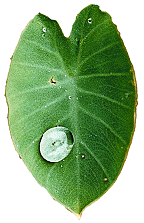
She believes a microorganism is feeding on the corm, or root, of the taro. It creates little pockets of diseased tissue that eventually decompose, leaving an empty cavity.
Until recently, the plants had been resisting the disease and creating a scab-like tissue to "wall off" the diseased area. But that resistance may be weakening and more of the corm is rotting, Uchida said.
By Trish Moore, Star-Bulletin
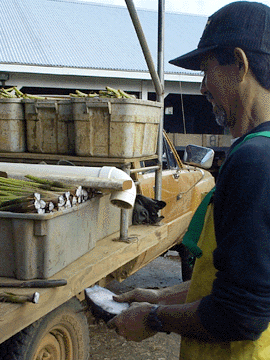
Rodney Haraguchi's 50-acre taro farm in Hanalei is
the state's largest. His crop yield is down 30-50 percent
the past few years largely due to a disease commonly
known as "pocket rot." Scientists don't know exactly
what the disease is or where it came from.
Phytophthora leaf blight, a fungus responsible for wiping out Samoa's taro industry several years ago, may make pocket rot worse because it affects the plant's ability to photosynthesize and create defensive tissue, Uchida said.Rodney Haraguchi, a fourth-generation taro farmer in Hanalei, first noticed the infestation on his 50-acre farm about four years ago. He said his yields are down nearly 50 percent from normal.
At first, he thought the problem might have been caused by residue from Hurricane Iniki in 1992.
But as he and other farmers shared stories at fairs and conventions, they began to realize that the problem was statewide.
And recently, it's gotten much worse.
"It hit really hard six months ago, and I think in future fields in the next two to three months we're going to take a beating again," said Clyde Fujikawa.
By Trish Moore, Star-Bulletin
Rodney Haraguchi inspects taro for "pocket rot."
Farmer Clyde Fujikawa said, "It hit really hard six
months ago, and I think in future fields in the next two
to three months we're going to take a beating again."
Known as a "10-bag farmer," Fujikawa said he has to pull at least 13 bags worth of taro a week to make his 10-bag commitment to the Honolulu Poi Factory."It's an old industry with a lot of old values, and we're hard-put to say we're not going to give you what we said," Fujikawa said.
John A'ana co-owns the Makaweli Poi Mill on Kauai's west side. Having to remove the rotted pockets from the boiled taro increases the labor and time it takes to make poi, he said.
"The apple snail is nothing compared to this," said state Rep. Hermina Morita, who represents the north shore district on Kauai and the taro-growing Keanae district on Maui. Apple snails have caused problems for taro farmers in recent years, multiplying quickly and eating plants.
Morita introduced a bill in the Legislature for $190,970 to fund additional research on the disease. The bill passed the House Agriculture Committee last week.
Other researchers at the UH College of Tropical Agriculture are investigating nutritional elements to the problem as well as trying to find taro strains that can resist the disease.
Morita worries the crop's troubles will increase the price of poi, making it out of reach for many people. "It's culturally significant and so important health-wise. If it becomes unaffordable, we won't be cultivating the next generation to consume poi. That's the spooky part."