By Kathryn Bender, Star-Bulletin
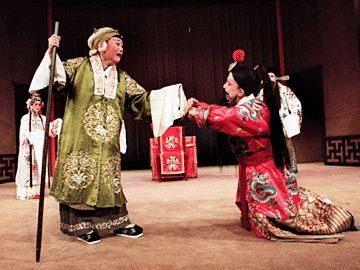
Nicole Tessier plays
a sister of Fourth Son.
Singing through
the pain
Dressing up for Beijing opera
By Burl Burlingame
can be hard on the head
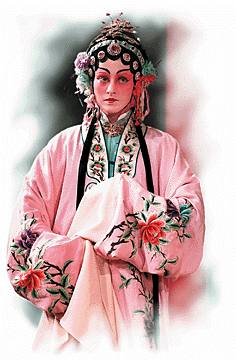
Star-BulletinThe impossibly elaborate outfits worn in Beijing opera aren't really a problem: all the work is already sewn in place. A jacket is a jacket, after all, and it goes on one sleeve at a time like any other jacket, even if it does have embroidery slagged on like an everything-goes pizza. The heads are the real problem. The actors in the University of Hawaii's latest Beijing opera production all take analgesics before putting on their caps. The headwear not only causes headaches, it causes the thin flesh of the scalp to swell alarmingly.
"The aspirin and such are mainly for the swelling," said director Elizabeth Wichmann-Walczak. "The actors need the anti-inflammatories. People often faint or throw up when they get the full head pieces in place. It's quite a production to build a head, and it's painful."
She's not kidding. The male actors have it slightly easier, because their black caps are simpler, but all actors have chunks of hair tied and glued onto their scalp piecemeal, in the old Chinese style. This can run to dozens of pieces. Wigs are for wimps. The effect is like have your whole head trussed up like a Thanksgiving turkey.
The sideburns and such pieces are glued on with elm-bark glue imported from China. "We call it 'goop,'" said costumier Sandy Finney. "Very sticky and hard to get off, but authentic Chinese, nonetheless."
By Kathryn Bender, Star-Bulletin
Brandi McDonald, is the Empress who gives
her daughter in marriage to Fourth Son (Julie Iezzi).
And since the work "Silang Tan Mu -- Love and Loyalty" concerns a cultural clash between the Mongol, Manchu and Han periods in Chinese history, there are also those wild Manchu headdresses, with additional feathers and flowers to tack on. Pass the Bufferin.
A Top 10 opera
"Silang Tan Mu" is a classic work in Beijing opera, "almost like like doing Shakespeare and finally working up to Romeo and Juliet," said Wichmann-Walczak. "It's one of the Top 10 Beijing operas of all time, and it's about the only one that steps out of the purely Chinese world and brings in foreign elements."OK, so the "foreign" elements are Mongol and Manchu, but that means that "Silang Tan Mu" uses costumes that are different than any other Beijing opera. Wichmann-Walczak and Finney traveled to China a couple of times last spring to research the opera, and to order costumes.
"There are different details between Han and Manchu costumes, like in the collars, which are really unusual on the Manchu costumes. But everything has lots of silk and cotton embroidered decoration, incredibly expensive to do ourselves. And it's better to get the real thing."
In China, the seamstresses came to the house where Wichmann-Walczak and Finney were staying, took measurements and showed photographs. The costumes were ready a couple of months later, and packed surprisingly flat. "We got them all into a couple of large suitcases," said Finney.
Choreography training takes about 20 hours a week, and includes stylized movement and voice classes. Raiding the Jiangsu Province Beijing Opera Company, the university has brought in Principal Actress Madame Shen Xiaomei to coach the female actresses, Principal Musician and Composer Shen Fuqing to lead the musicians and Leading Actor Lu Genzhang to work with the male actors.
By Kathryn Bender, Star-Bulletin
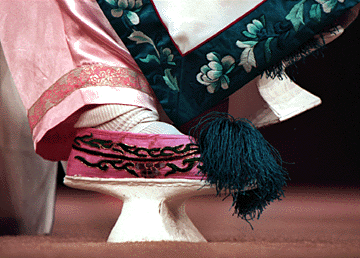
The Manchu characters wear shoes
balanced on tiny platforms.
The Manchus have precariously high shoes with tiny platforms. "It's like learning to walk with your heel in the middle of your foot instead of the end," said Finney.Women's hair is bound back, and men have to shave their necks high and get rid of their sideburns. "Beijing opera calls for a very clean neckline," said Finney.
An extravaganza
Because of the costumes, "Silang Tan Mu" is "quite a visual extravaganza," said Wichmann-Walczak. "It's always been done, except during the 10 years of the Cultural Revolution, and that wasn't long enough to create an interruption in the creative flow. The costumes have essentially been the same since the Ming Dynasty."Although there aren't any hard and fast rules to "hue" to, Finney said that -- in general -- young people dress in pink or pale blues, the Imperial Family is in yellow, abandoned wives wear black and older characters tend to wear darker colors. "The bottom line is, are they pretty?" said Finney. "That's what I hear. 'Make them look pretty!' "
Retired costumes will be placed in a cold-storage container at the university "to keep the bugs out, which can really do a number on costumes," said Finney
About the only costumes made at the university are some "underwear," said Finney. And these aren't Fruit-of-the-Looms: we're talking about long silk trousers often seen peeking out among the folds of the outer costumes.
Keeping it clean
The "underwear" is washed after every performance. There isn't a lot you can do with the outer costumes."We tried dry-cleaning once, and it was a disaster," said Finney. "There's actually no way to clean them. The 'water sleeves' that hang from the costumes are totally theatrical, and hard to keep clean. You can't iron or wash the costumes, because the silk doesn't shrink, but the embroidery does. "But in reality, the costumes, since they're three layers out from the actor, stay pretty clean. But if a sleeve flaps against a sweating actor's face, well, let's just hope the make-up blends well with the embroidery.
"So, the costumes stay in good shape. It's the shoes that take all the abuse and wear-and-tear. The shoes ... and the actors' heads!"
Silang Tan Mu:
Love and LoyaltyShowtimes: 8 p.m. Feb. 6-7, 2-14, 18-21; and 2 p.m. Feb. 8 and 22