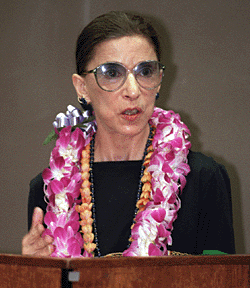
By Kathryn Bender, Star-Bulletin
U.S. Supreme Court Justice Ruth Bader Ginsburg,
left wearing a hat, met with University of Hawaii students
yesterday before addressing a constitutional-law class.
Judicial maverick
inspires, advises
UH law students
The Supreme Court judge is ‘a pioneer
By Linda Hosek
in breaking down sex barriers’
Star-BulletinUniversity of Hawaii law students swarmed around the 60-something woman in the broad-brimmed hat, navy tunic top and tinted glasses. Role model. Pioneer in gender equality. Hero.
The labels flooded the law school's courtyard yesterday as conversation and cameras focused on U.S. Supreme Court Associate Justice Ruth Bader Ginsburg.
"This is the law school's version of the Pro Bowl," Jill Nunokawa, UH civil rights counsel, said, referring to the jurists-in-residence program that brought Ginsburg and Senior Judge Myron H. Bright, 8th U.S. Circuit Court of Appeals.
Known for stressing the individual over stereotypes when she argued civil rights cases, Ginsburg projected her own individuality as she discussed how the court works and communicates.
She amused about 100 constitutional law students when she said justices don't appear on talk shows or hold news conferences to discuss the opinions they write.
She said justices offer "bench statements" or oral summaries to the press.
By Kathryn Bender, Star-BulletinJustice Ruth Bader Ginsburg
"I'm the only one who gives out (written) bench statements," she said, adding that some have questioned her practice because all justices haven't approved her summary.Ginsburg said no one can observe or interrupt justices when they deliberate, not even messengers. "There's no place for the Sunshine Law with court deliberations," she added.
She said justices select 80 to 100 cases to review and hold oral argument on all. She said the press does "pretty well" at explaining the opinions but occasionally misses some major opinions and gets others "wildly wrong."
Throughout her comments, Ginsburg stressed the ability to write clearly, saying sometimes stories can be murky because opinions also are murky.
She said most cases the court takes don't involve "grand constitutional questions" but interpretation of statutes. And justices don't hold back when it comes to reviewing a colleague's conclusions.
"No opinion I have ever written for the court has survived totally untouched by other minds," she said.
She also said it was important for the court to speak as one voice and said the current court has been unanimous in about 40 percent of its cases.
A law professor at Columbia and Rutgers universities for 17 years, Ginsburg gave students advice on how to argue cases before high courts.
"Roll with the waves," she said. "Don't regard questions as intrusions."
She said attorneys sometimes can't get out more than the opening sentence before the first question comes, adding, "We have a hot bench."
Ginsburg emphasized the importance of honesty in legal briefs and of playing to the justices: "All of us are known quantities. We have a track record."
Prompted by students, Ginsburg reflected on changes in the legal profession for women.
"When I graduated from law school, no woman sat on any appellate bench," she said. "Law was not a place where women were wanted."
And as a 1959 Columbia University graduate, Ginsburg couldn't get hired by any New York law firms, a fact she attributed to being a woman, being Jewish and having a young child.
Ginsburg was appointed to the U.S. Court of Appeals for the District of Columbia by President Carter in 1980 and to the U.S. Supreme Court by President Clinton in 1993.
"She is a pioneer in breaking down sex barriers," said Jon Van Dyke, UH law professor.
She wrote one of her most acclaimed discrimination opinions in 1996, finding that Virginia Military Institute couldn't exclude women from its all-male program by creating a separate but similar one for them.
Dan Foley, attorney for the three same-sex couples who sued the state for the right to marry, said he used Ginsberg's VMI opinion in his appeal.
He cited two passages, one about "the evolving social order" to include women and bar sex discrimination.
The other passage referred to risks of distributing benefits on the basis of gender, saying such a practice could reinforce stereotypes about the "proper place" of women.
Sandra Wilhide, a third-year law student, called Ginsburg an inspiration for her ability to raise a child, juggle a family and "achieve so much."