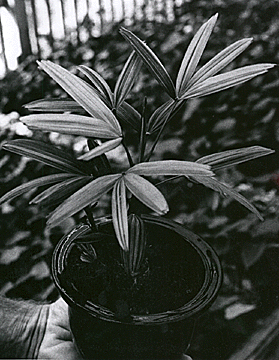

Star-Bulletin file photo
The rhapis palm is a good choice for an indoor plant
because it's a slow grower and can handle being in a low-
light area. However, like any other potted plant, it can't
be expected to live as long indoors as it would
outside in your garden.
SAY "potted palm," and what comes to mind is "old-fashioned." Potted palms graced the lobbies of old hotels like the original Moana and Halekulani, that now sport huge, elaborate arrangements of tropical flowers. Big old houses in Nuuanu and Manoa had potted palms in sitting rooms and on the lanai. Palmy picks for indoors
But the Rolling Stones of the plant world never went out of style, and many current home magazines urge their readers to decorate with potted palms. Part of this is because it's not that easy to keep a palm in artificially heated houses, and the challenge makes the plant interesting. Also, the container in which the pot is placed becomes an item of interior design.
Here, however, potted palms are easy and relatively inexpensive to use as indoor accents. Some, like the rhapis palm, can cost $40 or $50, but when you realize that it will live indoors for five years or longer with not much attention, it becomes a good investment.
Palms make good indoor plants because they suffer in silence. They tolerate the dry air of air-conditioned rooms, the low light of the corner of a room or the draught of a hallway. But what they prefer is an imitation of the environment from which they came. The filtered light, warmth and high humidity of the rain forest create ideal conditions. In drier air, the palm will live, but be more susceptible to spider mites.
When choosing a palm at the garden shop, look for a compact plant with good color. Turn the pot upside down. If roots are coming out the drainage holes, the palm may be weakened by being in the same pot too long.
To repot, use a rich potting medium that provides good drainage, a commercial mix that contains some loam. Use a pot only slightly larger than the one containing the plant. Pots that are too small constrict root growth. Pots that are too big with too much soil hold a surplus of water around the roots, and can cause them to rot. As a general rule, palms need repotting every three years.
The growth rate of palms varies, but keeping one in a pot slows it down. Palms are heavy feeders and need to be fertilized monthly with a water-soluble balanced fertilizer (a higher central number and matching outer numbers, such as 15-30-15), or the same fertilizer at half strength twice a month.
Keep the palm where it gets good ventilation and keep the soil constantly moist but not muddy. The fronds should be washed frequently to increase humidity and clean the foliage. Washing also flushes off the insects which are protected indoors from natural enemies so increase at a speedy rate.
Botanically, the palm family has about 2,700 species from the tropics and subtropics. The trunks rarely branch and the leaves are commonly large and clustered at the top of the trunk. Palms have two kinds of leaves, or fronds: on feather palms, the leaflets are arranged in ranks on opposite sides of the central stalk and on fan palms, the leaflets are arranged at the end of the stalk like the ribs on a fan.
There are also palms with undivided leaves like the fishtail palm. All feather palms and most fan palms look better when old leaves are removed as they turn brown. Make neat cuts close to the trunk, but leave the leaf base. Some palms will shed their old leaves on their own.
The following palms are good choices for indoors. But remember that realistically speaking, there is no such thing as an indoor plant. They developed out of doors and that's where they are truly meant to live. So whatever you choose, it can't be expected to live as long indoors as it would in your garden.
Rhapis excelsa or lady palm is one of the best palms for low light. A slow grower, it will take years before it hits its full height of about 12 feet. It has dark green, fan-shaped fronds growing on hairy, bamboo-like canes. There is also a variegated form with yellow stripes.
Palms, even big ones, transplant easily, since new roots grow from the base of the trunk and the root ball does not need to be large. When transplanting a large palm, tie the leaves together over the center bud or heart where the new growth comes from, for protection.
Gardening Calendar in Do It Electric!
Send queries along with name and phone number to:
Evergreen by Lois Taylor, Honolulu Star-Bulletin, P.O. Box 3080, Honolulu 96802.
Or send e-mail to features@starbulletin.com.
Please be sure to include a phone number.
Evergreen by Lois Taylor is a regular Friday feature of the
Honolulu Star-Bulletin. © 1996 All rights reserved.